
Teaching English to Differently-Abled Learners: Inclusive Methods and Practices
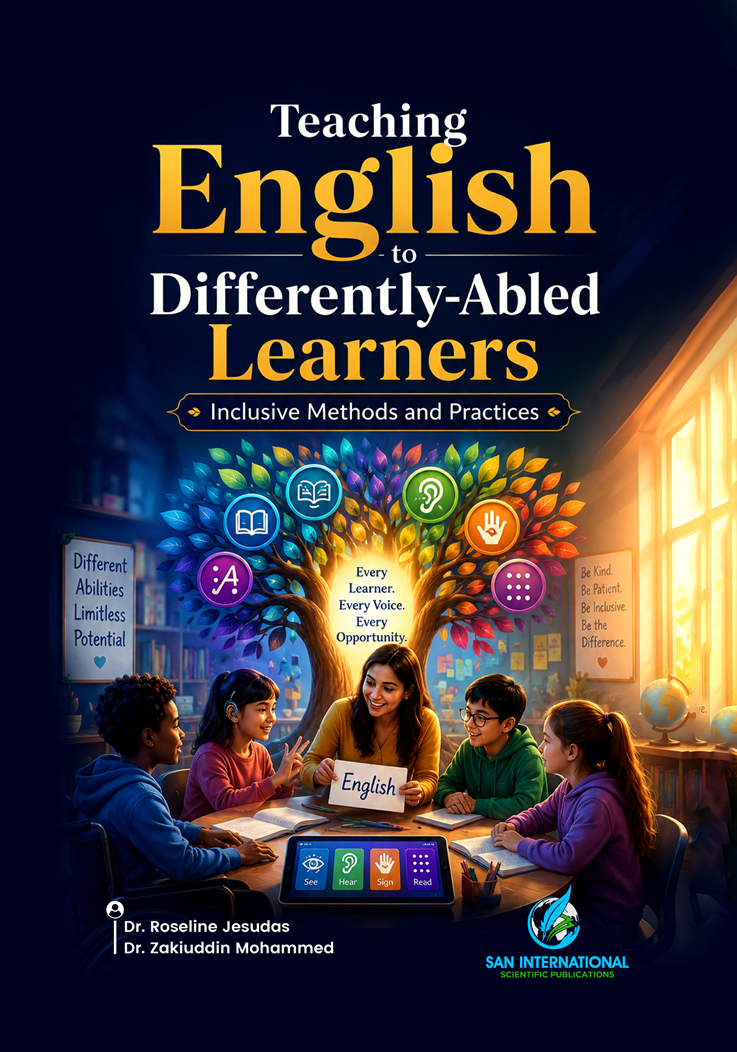
Teaching English to Differently-Abled Learners: Inclusive Methods and Practices
Authors: Dr. Roseline Jesudas, & Dr. Zakiuddin Mohammed
ISBN: 978-81-69297-85-1
DOI: https://doi.org/10.59646/744
Date of Publication: June 30, 2026
Cite this book: Roseline J, and Zakiuddin M, (2026), Teaching English to Differently-Abled Learners: Inclusive Methods and Practices, San International Scientific Publications, ISBN: 978-81-69297-85-1, DOI: https://doi.org/10.59646/744
Preface
Teaching English to Differently-Abled Learners is no longer viewed as a specialized educational responsibility but as an essential component of equitable and quality education. In an increasingly diverse and inclusive world, every learner deserves meaningful opportunities to acquire language skills regardless of physical, sensory, cognitive, intellectual, emotional, or developmental differences. English, as a global language of communication, higher education, research, and professional advancement, opens countless doors for learners. However, conventional teaching methods often fail to address the unique learning requirements of differently-abled students. This book, Teaching English to Differently-Abled Learners: Inclusive Methods and Practices, has been carefully designed to bridge this gap by presenting evidence-based pedagogical strategies, inclusive teaching methodologies, assistive technologies, and learner-centered practices that empower educators to create equitable English language learning environments.
The philosophy of inclusive education emphasizes that diversity should be recognized as a strength rather than a limitation. Effective English language instruction requires teachers to understand that learners differ in their abilities, learning styles, language development patterns, cognitive processes, cultural backgrounds, motivation, and communication needs. Rather than adapting learners to rigid instructional systems, modern educational practices encourage adapting teaching methods to meet individual learner requirements. This shift from a deficit-oriented model to a strengths-based approach enables educators to identify learner potential, promote confidence, and foster meaningful participation in classroom activities. Inclusive English teaching is therefore not merely about modifying content but about transforming teaching practices to ensure accessibility, engagement, participation, and achievement for every learner.
This book begins by introducing the concept of learner diversity and examines the psychological, cognitive, linguistic, and socio-cultural factors influencing English language acquisition among differently-abled learners. It explores individual differences, learning preferences, multiple intelligences, language development, and methods for identifying diverse learning needs. Building upon this foundation, the text presents contemporary principles of inclusive English Language Teaching (ELT), including differentiated instruction, communicative language teaching, task-based language teaching, scaffolding strategies, multisensory instructional methods, Universal Design for Learning (UDL), flexible curriculum planning, and inclusive classroom interactions. These pedagogical frameworks enable teachers to design learning experiences that accommodate varying learner profiles while maintaining high academic expectations.
Recognizing that language proficiency develops through integrated skills, the book provides comprehensive guidance for teaching listening, speaking, reading, and writing to differently-abled learners. Practical classroom strategies are presented for improving listening comprehension through assistive listening technologies, visual supports, tactile materials, and interactive learning experiences. Speaking instruction focuses on communication development, peer interaction, oral confidence, and alternative communication systems where necessary.
One of the defining strengths of this book is its extensive focus on assistive technologies that have transformed inclusive English language education. Advances in educational technology have created unprecedented opportunities for learners who previously encountered significant barriers in language acquisition. Screen readers, speech-to-text systems, text-to-speech applications, Augmentative and Alternative Communication (AAC) devices, educational software, mobile accessibility applications, artificial intelligence-based learning platforms, and adaptive digital tools have significantly expanded access to English language learning. The book explains not only the functioning of these technologies but also practical approaches for integrating them into lesson planning, classroom instruction, learner assessment, and individualized educational support while addressing implementation challenges and ethical considerations.
Beyond instructional methods, successful inclusion depends upon positive classroom environments that promote collaboration, empathy, respect, and active participation. Accordingly, this volume emphasizes inclusive classroom management, peer-assisted learning, collaborative teaching, family involvement, continuous learner monitoring, and inclusive assessment practices that recognize diverse ways of demonstrating learning. Teachers are encouraged to become facilitators who nurture learner confidence, independence, and communication skills rather than simply delivering content. By adopting flexible instructional approaches and continuous formative assessment, educators can support both academic achievement and holistic learner development.
The concluding chapters explore the future of inclusive English language education by examining emerging technologies, artificial intelligence, adaptive learning systems, digital accessibility, global best practices, evolving research in special education, and lifelong learning opportunities. As educational systems increasingly embrace personalized learning and intelligent educational technologies, English language instruction is expected to become more responsive, adaptive, data-informed, and accessible than ever before. The integration of innovative digital tools with compassionate pedagogy offers tremendous potential for creating classrooms where every learner can thrive irrespective of disability or learning differences.
This book is intended to serve as a comprehensive resource for teacher educators, pre-service and in-service English teachers, special educators, curriculum developers, educational administrators, researchers, policymakers, postgraduate students, and all professionals committed to inclusive education. By combining educational theory with practical classroom applications, it provides readers with the knowledge, strategies, and confidence required to design effective English language instruction for diverse learners. It is hoped that this volume will contribute meaningfully to the advancement of inclusive educational practices, inspire reflective teaching, and reinforce the belief that every learner possesses the capacity to communicate, learn, and succeed when provided with equitable opportunities, appropriate support, and an inclusive learning environment. Ultimately, inclusive English language teaching is not simply an educational responsibility—it is a commitment to educational justice, human dignity, and the creation of classrooms where diversity is celebrated as the foundation of meaningful learning.