
Synthesis, Characterization, and Functional Properties of BaTiO₃–PVDF and BaTiO₃–ZnO Composites: Fabrication, Device Development, and Emerging Technologies
Synthesis, Characterization, and Functional Properties of BaTiO₃–PVDF and BaTiO₃–ZnO Composites: Fabrication, Device Development, and Emerging Technologies
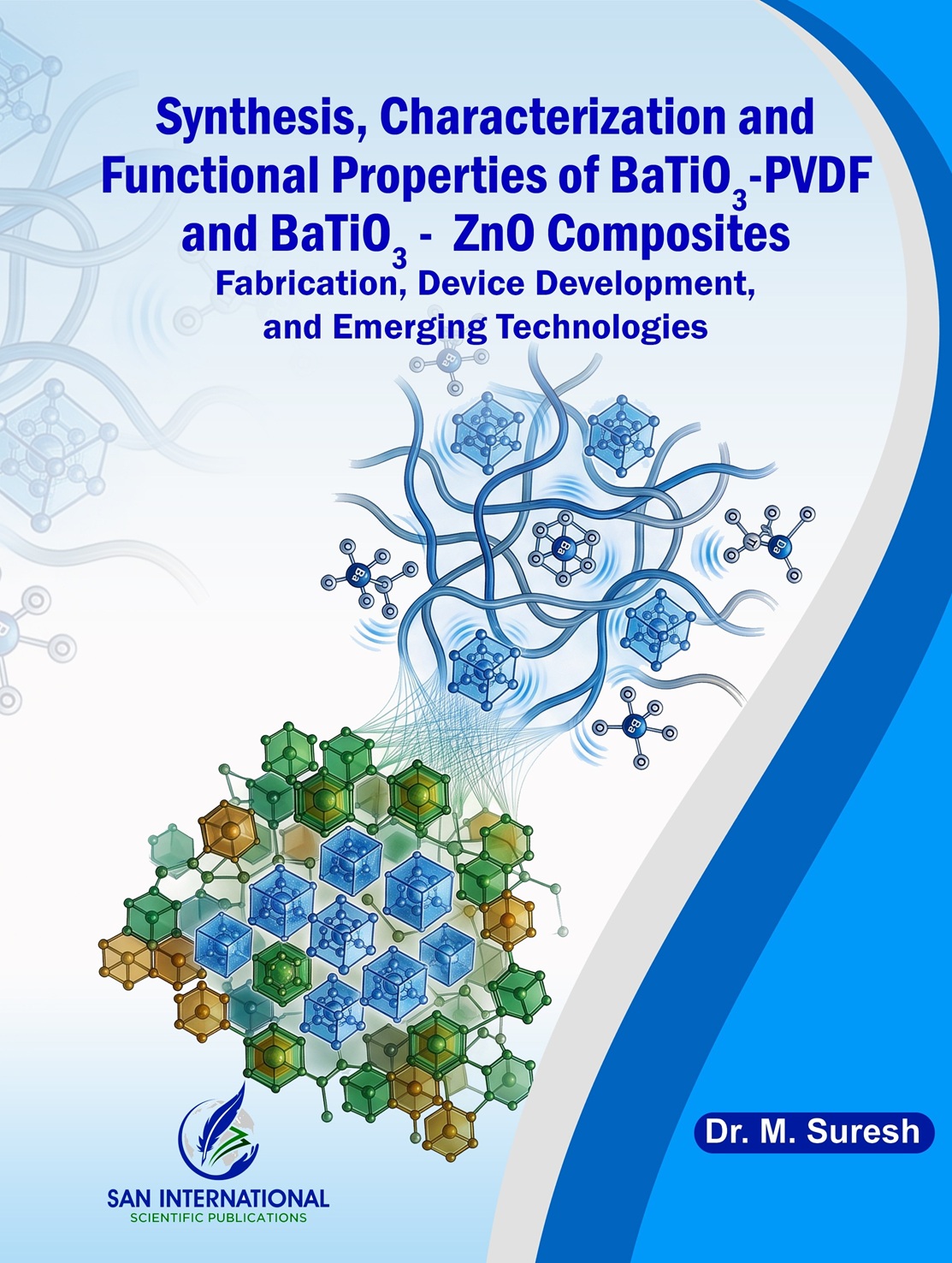
Author: Dr. M. Suresh
ISBN: 978-81-17787-46-5
DOI: https://doi.org/10.59646/898
Date of Publication: November 20, 2026
Preface
Rapid advancements in flexible electronics, autonomous sensors, and sustainable energy systems demand multifunctional materials capable of bridging mechanical, electrical, and optical domains. Barium titanate ( ), a lead-free perovskite renowned for its high dielectric permittivity, spontaneous polarization, and electromechanical coupling, serves as an indispensable building block in modern materials engineering. However, overcoming the inherent brittleness and limited optical functionality of pure ceramics requires strategic hybridization. Combining with polyvinylidene fluoride (PVDF) unlocks flexible, mechanically resilient polymer nanocomposites driven by electroactive -phase crystallization, while coupling it with zinc oxide (ZnO) yields semiconducting heterostructures with enhanced interfacial charge transfer, carrier separation, and photoactive capabilities.
Synthesis, Characterization, and Functional Properties of –PVDF and –ZnO Composites: Fabrication, Device Development, and Emerging Technologies provides a systematic, end-to-end guide to these versatile hybrid systems. Organized into five cohesive units, the text progresses from fundamental crystallography, polymorphism, and Maxwell–Wagner interfacial physics to practical synthesis and processing routes—spanning solid-state reactions, hydrothermal methods, solution casting, hot pressing, and electrospinning. Subsequent units detail essential structural, spectroscopic, microscopic, and thermal characterization protocols alongside comprehensive evaluations of dielectric, ferroelectric, piezoelectric, and energy-storage performance. Finally, the book translates material-level insights into real-world engineering, exploring flexible nanogenerators, high-energy-density capacitors, tactile sensors, UV photodetectors, photocatalysts, hybrid triboelectric systems, and computational or machine learning-assisted optimization.
Designed for graduate students, academic researchers, and materials engineers, this volume bridges fundamental solid-state physics with applied device fabrication, serving as both an authoritative reference and a practical roadmap for advancing next-generation multifunctional technologies.