Sustainable Solid Waste Management and Environmental Protection
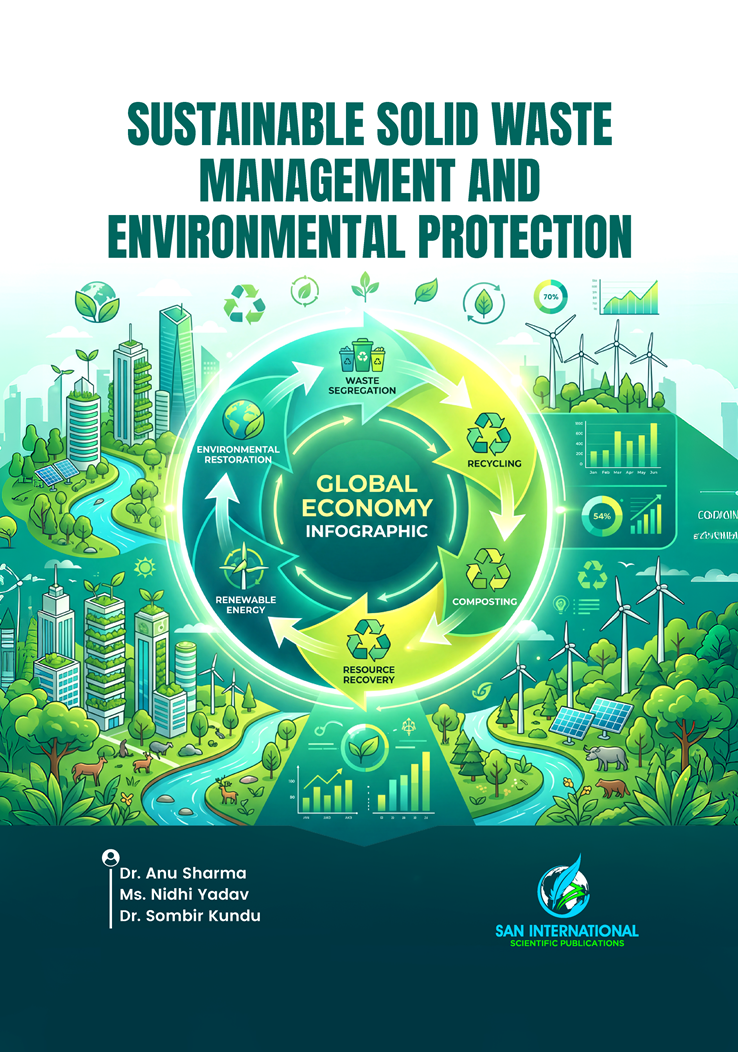
Sustainable Solid Waste Management and Environmental Protection
Authors: Dr. Anu Sharma, Ms. Nidhi Yadav, and Dr. Sombir Kundu
ISBN: 978-81-69297-75-2
DOI: https://doi.org/10.59646/729
Date of Publication: June 12, 2026
Cite this book: Anu S, Nidhi Y, and Sombir K, (2026), Sustainable Solid Waste Management and Environmental Protection, San International Scientific Publications, ISBN: 978-81-687619-0-2, DOI: https://doi.org/10.59646/729
Preface
The rapid growth of population, urbanization, industrialization, and changing consumption patterns has resulted in an unprecedented increase in solid waste generation across the globe. Managing this growing volume of waste in an environmentally sound and economically sustainable manner has become one of the most pressing challenges of the twenty-first century. Inefficient waste handling practices contribute significantly to environmental degradation, resource depletion, greenhouse gas emissions, public health risks, and climate change. Consequently, sustainable solid waste management has emerged as a critical component of environmental protection, resource conservation, and sustainable development. The need for scientifically designed waste management systems that integrate engineering principles, environmental science, resource recovery technologies, and modern digital innovations has never been greater.
This book, “Sustainable Solid Waste Management and Environmental Protection,” has been carefully designed to provide a comprehensive understanding of the principles, technologies, engineering practices, and emerging innovations associated with modern waste management systems. The content presents a balanced integration of theoretical foundations, engineering design concepts, environmental considerations, and practical applications necessary for students, researchers, environmental professionals, policymakers, and practitioners working in the field of waste management and environmental sustainability.
The book begins with the fundamental concepts of solid waste characterization and quantification, emphasizing waste generation patterns, physical, chemical, and biological properties of waste, sampling methodologies, forecasting models, material flow analysis, GIS-based waste mapping, and waste auditing techniques. Understanding the nature and quantity of waste is essential for designing effective management systems and developing sustainable waste policies.
Subsequent chapters focus on collection systems, transportation engineering, and logistics, which form the backbone of municipal and industrial waste management operations. Topics such as collection infrastructure design, smart collection technologies, transfer station engineering, route optimization, fleet management, and IoT-based monitoring systems are discussed in detail to enhance operational efficiency and reduce environmental impacts.
Recognizing waste as a valuable resource rather than a disposal problem, the book explores material recovery, recycling technologies, and circular resource engineering. Detailed discussions on material recovery facilities, separation technologies, plastic recycling, metal and paper recovery, construction and demolition waste recycling, circular economy principles, and life cycle assessment provide readers with a modern perspective on resource conservation and sustainable production systems. The text further examines biological and thermal treatment technologies, including composting, vermicomposting, anaerobic digestion, biomethanation, incineration, pyrolysis, gasification, and refuse-derived fuel production. These technologies demonstrate how waste can be transformed into valuable products such as compost, biogas, energy, and secondary raw materials, thereby supporting renewable energy generation and resource recovery initiatives.
Landfill engineering, leachate management, and emission control systems are addressed with a strong emphasis on environmental protection and risk mitigation. Topics such as sanitary landfill design, liner systems, leachate treatment, landfill gas recovery, methane utilization, groundwater monitoring, remediation strategies, and post-closure management highlight the importance of minimizing environmental contamination and ensuring long-term sustainability.
The final section of the book introduces advanced waste management technologies and emerging innovations that are transforming the sector. Artificial intelligence, machine learning, robotics, Internet of Things (IoT), environmental impact assessment, carbon footprint analysis, waste-to-hydrogen technologies, and integrated waste management frameworks are presented as powerful tools for achieving smarter, more efficient, and environmentally responsible waste management systems. These advancements align with global sustainability goals and support the transition toward a circular economy and low-carbon future.
Overall, this book aims to serve as a valuable academic and professional resource that promotes a holistic understanding of sustainable waste management practices. By combining engineering excellence, environmental stewardship, technological innovation, and sustainability principles, it seeks to inspire future generations to develop solutions that protect the environment while maximizing resource efficiency. It is our sincere hope that this book will contribute meaningfully to education, research, policy development, and practical implementation in the field of sustainable solid waste management and environmental protection.