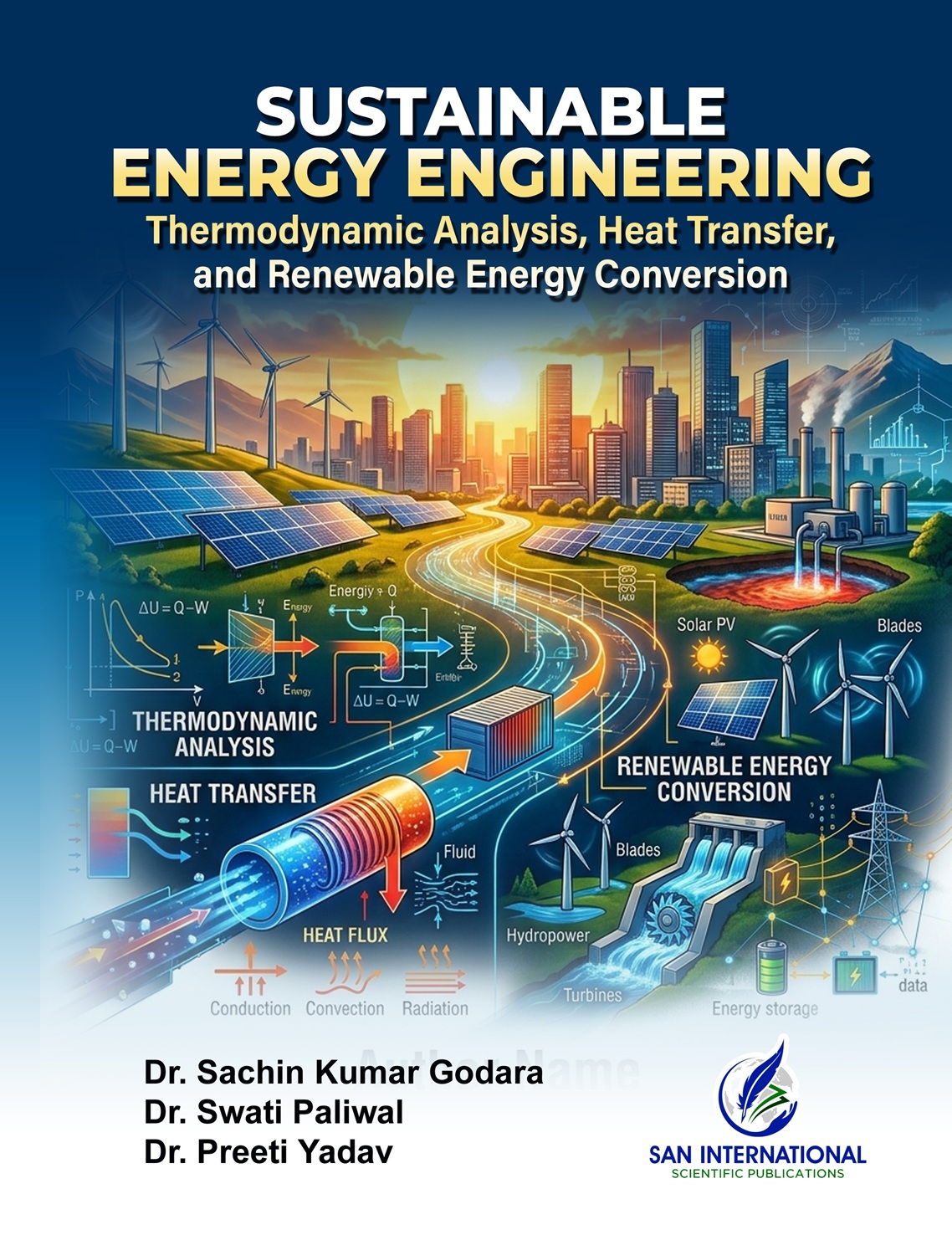
Sustainable Energy Engineering: Thermodynamic Analysis, Heat Transfer, and Renewable Energy Conversion
Sustainable Energy Engineering: Thermodynamic Analysis, Heat Transfer, and Renewable Energy Conversion
Authors: Dr. Sachin Kumar Godara, Dr. Swati Paliwal, and Dr. Preeti Yadav
ISBN: 978-81-17787-31-1
DOI: https://doi.org/10.59646/884
Date of Publication: November 13, 2026
Preface
Sustainable Energy Engineering: Thermodynamic Analysis, Heat Transfer, and Renewable Energy Conversion presents a comprehensive study of the scientific principles, engineering methodologies, and technological developments involved in sustainable energy generation, conversion, storage, and thermal management. The book integrates advanced thermodynamics, heat transfer, solar energy technologies, wind energy systems, and thermal energy storage to provide a systematic understanding of modern energy engineering. It emphasizes the importance of thermodynamic efficiency, effective heat utilization, renewable energy integration, and sustainable power generation in addressing increasing global energy demands and environmental challenges. The contents are organized into five units, covering both fundamental concepts and advanced engineering applications. Unit I explores advanced thermodynamics and energy conversion analysis, including the first and second laws, entropy generation, exergy destruction, thermodynamic cycles, and the optimization of integrated energy systems. Unit II focuses on advanced heat transfer and thermal engineering, discussing conduction, convection, radiation, conjugate heat transfer, two-phase heat transfer, compact heat exchangers, heat pipes, and thermal insulation. Unit III examines solar energy conversion and advanced photovoltaic technologies, covering solar radiation modelling, semiconductor physics, crystalline silicon and emerging solar cells, maximum power point tracking, concentrated solar power, and photovoltaic–thermal systems. Unit IV addresses wind energy conversion and sustainable power generation, emphasizing wind resource assessment, aerodynamic principles, turbine design, generator technologies, computational fluid dynamics, structural dynamics, and offshore wind energy systems. Unit V explores thermal energy storage and advanced thermal management, including sensible, latent, and thermochemical storage, phase change materials, molten-salt systems, heat pipes, waste heat recovery, industrial heat integration, and thermal storage optimization.
The book is designed to support undergraduate and postgraduate students, research scholars, faculty members, and practising engineers working in mechanical engineering, energy engineering, thermal sciences, and renewable energy technologies. Particular attention is given to the relationship between theoretical principles, mathematical modelling, engineering analysis, and practical applications. The topics provide a foundation for understanding the performance evaluation and optimization of energy conversion systems while introducing emerging materials, advanced technologies, and integrated approaches for improving energy efficiency. By connecting thermodynamic analysis and heat transfer principles with solar and wind energy conversion and advanced thermal storage technologies, this book aims to strengthen the technical knowledge required to develop efficient, reliable, and sustainable energy solutions. It is expected to serve as a valuable academic and technical reference for learners and researchers contributing to the advancement of sustainable energy engineering and the transition towards cleaner and more efficient energy systems.