Studies in English Literature and Cultural Expression
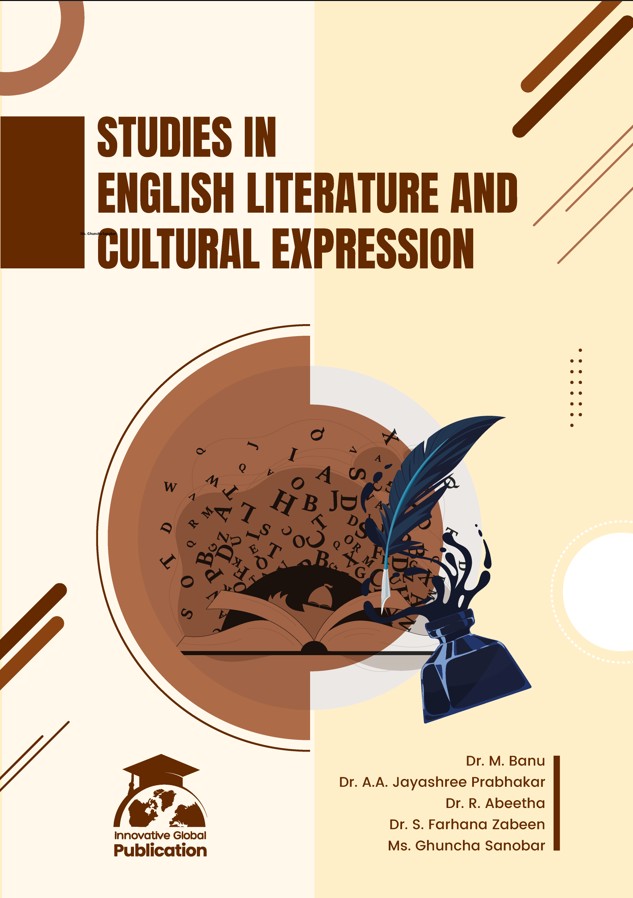
Studies in English Literature and Cultural Expression
Authors: Dr. M. Banu, Dr. A.A. Jayashree Prabhakar, Dr. R. Abeetha, Dr. S. Farhana Zabeen and Ms. Ghuncha Sanobar
ISBN: 978-81-991955-7-8
DOI: https://doi.org/10.59646/el/437
Date of Publication: August 29, 2025
About the Book:
The study of English literature is inseparable from the study of culture. Literature does not exist in a vacuum; it both reflects and shapes the values, beliefs, and identities of societies across time. This volume, Studies in English Literature and Cultural Expression, emerges from a shared scholarly commitment to trace the dynamic interplay between literary texts and cultural contexts, while offering readers a comprehensive framework for understanding English literary traditions from their classical roots to contemporary global expressions.
Conceived and written collaboratively by five scholars from diverse disciplinary backgrounds, this book represents a collective vision of literary studies as an evolving conversation between history, theory, and cultural practice. Each contributor brings distinct expertise: some rooted in classical and medieval traditions, others in modernist and postcolonial frameworks, and still others in contemporary cultural and media studies. The result is not a single authoritative narrative but a tapestry of perspectives designed to engage students, researchers, and general readers alike. The first part of the book grounds readers in the foundations of English literary studies—its scope, genres, periods, and methods of analysis—while foregrounding literature as an enduring mode of cultural expression. Building upon this foundation, the second part introduces theoretical frameworks drawn from cultural studies, feminist theory, postcolonialism, and Marxism, ensuring that readers are equipped to critically interpret texts not only as aesthetic artifacts but also as instruments of power, ideology, and identity.
Subsequent units guide readers through the chronological development of English literature—from the classical and medieval traditions to the Renaissance, Enlightenment, Romantic, and Victorian eras. In each period, canonical texts are situated within their cultural and historical contexts, while attention is given to issues of religion, authority, gender, class, empire, and nationhood. This historical trajectory culminates in explorations of modernism, postmodernism, and postcolonial literature, where literary experimentation, disillusionment, and global voices complicate traditional notions of English literary heritage.
The final sections turn to the contemporary moment, addressing literature’s dialogue with pressing cultural concerns—ecological crisis, gender and sexuality, diaspora, digital media, and popular culture. Here, literature is shown to be not merely a record of the past but an active participant in shaping present and future cultural discourse.
In compiling this work, we have sought to balance breadth and depth: to provide a systematic account of literary periods and movements while highlighting the critical intersections of literature and culture. The syllabus-based structure ensures pedagogical clarity, making the book suitable for academic courses, while the inclusion of interdisciplinary perspectives enriches its value for independent scholarship.
We, the five authors, extend our gratitude to our institutions, colleagues, and students whose insights and questions shaped the development of this text. Most of all, we hope that readers approach this book not as a static repository of knowledge but as an invitation—to read closely, to think critically, and to engage with literature as a vital mode of cultural expression across time and space.