
Smart Teaching Systems: Leveraging AI Tools for Personalized Learning
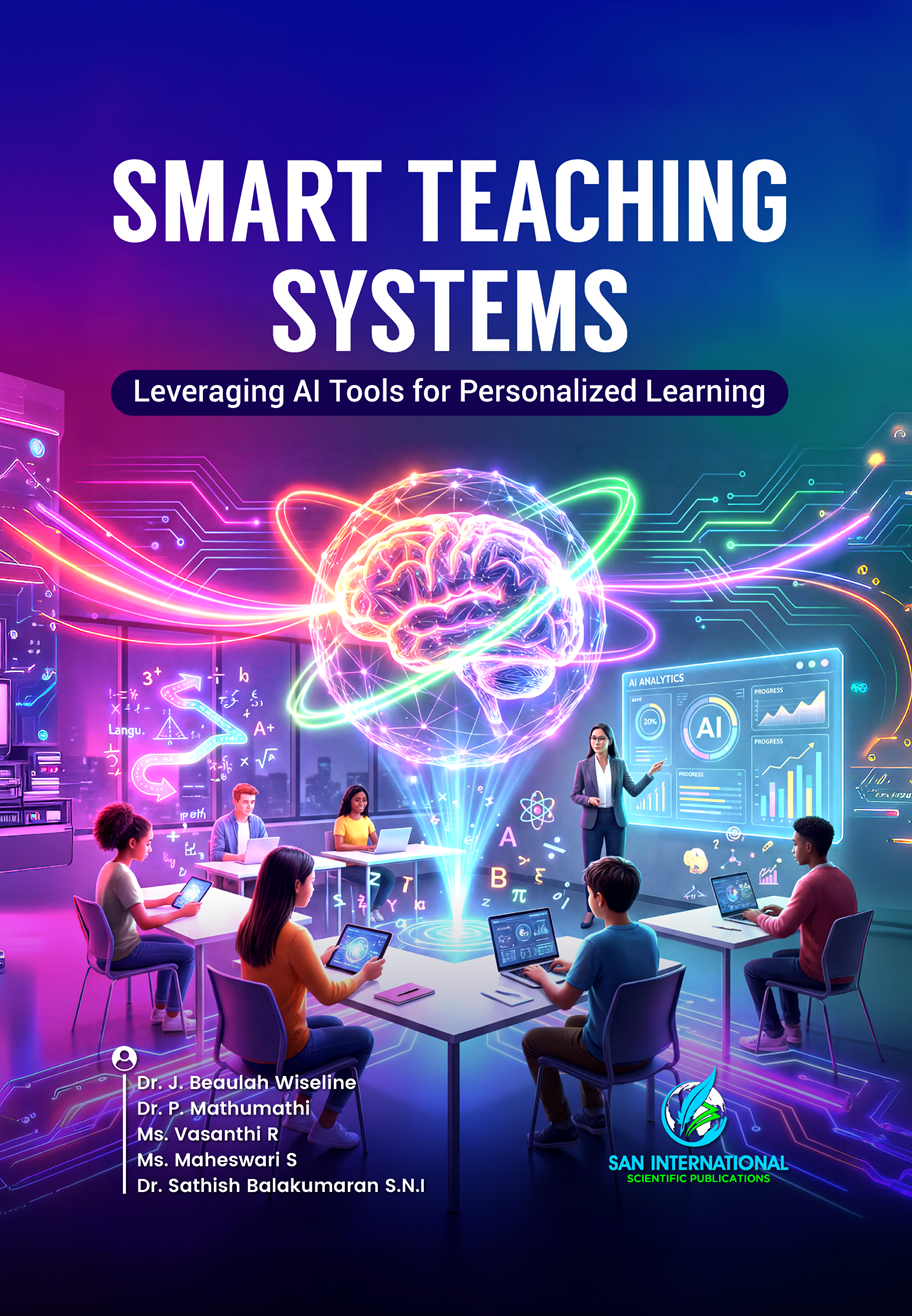
Smart Teaching Systems: Leveraging AI Tools for Personalized Learning
Authors: Dr. J. Beaulah Wiseline, Dr. P. Mathumathi, Ms. Vasanthi R, Ms. Maheswari S, and Dr. Sathish Balakumaran S.N.I
ISBN: 978-81-69297-46-2
DOI: https://doi.org/10.59646/640
Date of Publication: March 25, 2026
Cite this book: J.B. Wiseline, P. Mathumathi, Vasanthi R, Maheswari S, and Sathish B.S.N.I, (2026), Smart Teaching Systems: Leveraging AI Tools for Personalized Learning, San International Scientific Publications, ISBN: 978-81-69297-46-2, DOI: https://doi.org/10.59646/640
Preface
The Smart Teaching Systems: Leveraging AI Tools for Personalized Learning offers an in-depth and forward-looking examination of how education is undergoing a profound transformation through the integration of advanced digital technologies and Artificial Intelligence. Moving beyond the limitations of one-size-fits-all instruction, this book situates smart teaching systems as dynamic, data-driven ecosystems that seamlessly connect learners, educators, content, and intelligent technologies. It begins by tracing the evolution of teaching paradigms—from traditional teacher-centered models to digital learning platforms and, ultimately, to intelligent systems capable of understanding, predicting, and responding to individual learner needs in real time. The text carefully unpacks the architecture of these systems, illustrating how components such as learner models, adaptive engines, analytics pipelines, and human interfaces interact within cyber–physical–human environments to support meaningful and personalized educational experiences. A central theme of the book is the role of AI technologies—including machine learning, deep learning, natural language processing, and generative AI—in enabling personalization at scale. It explores how these technologies power recommendation systems, intelligent tutoring, automated feedback, and adaptive assessments, while also making complex processes such as knowledge tracing, learner profiling, and content generation both efficient and responsive. The book distinguishes between personalized, adaptive, and individualized learning approaches, providing clarity on their theoretical foundations and practical implications. Drawing on established pedagogical theories such as constructivism, mastery learning, and competency-based education, it demonstrates how AI can enhance—not replace—effective teaching practices. Further, the text delves into the design and implementation of learner modeling systems that capture cognitive, behavioral, and affective dimensions of learning, enabling continuous adaptation of instructional pathways. It emphasizes the importance of instructional design strategies, including microlearning, multimodal content delivery, and AI-driven scaffolding, to create engaging and inclusive learning environments. Through the lens of learning analytics, the book highlights how real-time data can inform decision-making, support early intervention for at-risk learners, and refine teaching strategies through predictive and prescriptive insights. In addition to technological and pedagogical perspectives, the book critically addresses the ethical, legal, and societal dimensions of smart teaching systems. It discusses challenges related to data privacy, bias, transparency, accountability, and governance, advocating for responsible AI practices and enhanced digital literacy among educators and learners. The integration of smart classrooms, IoT-enabled environments, and cloud-based platforms is also explored, with attention to scalability, interoperability, and institutional readiness. Concluding with a vision of the future, the book explores emerging trends such as autonomous learning systems, AI-powered lifelong learning companions, and the convergence of education with immersive technologies like AR/VR and digital twins. It reimagines the roles of teachers as facilitators and co-creators of knowledge, and learners as active participants in personalized learning journeys. Ultimately, this book serves as both a foundational guide and a strategic roadmap for educators, researchers, policymakers, and technology developers seeking to harness the full potential of intelligent systems to create equitable, adaptive, and transformative educational experiences in the years leading up to—and beyond—2035.