
Smart Learning Environments: Artificial Intelligence in Pedagogy
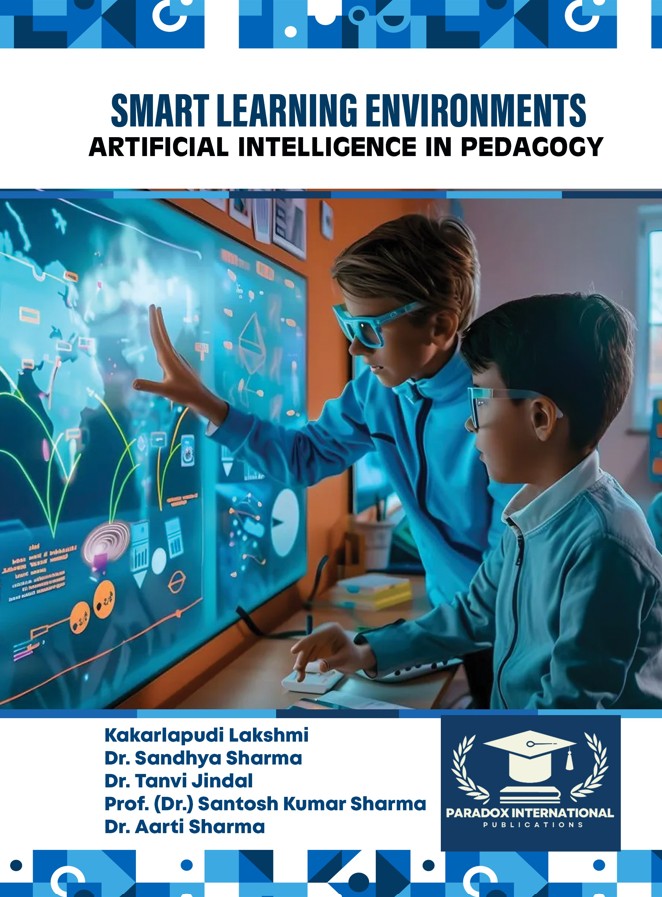
Smart Learning Environments: Artificial Intelligence in Pedagogy
Authors: Kakarlapudi Lakshmi, Dr. Sandhya Sharma, Dr. Tanvi Jindal, Prof. (Dr.) Santosh Kumar Sharma, Dr. Aarti Sharma
ISBN: 978-93-7183-573-2
DOI: https://doi.org/10.59646/568
Date of Publication: January 18, 2026
About the Book:
The rapid evolution of digital technologies has ushered in a transformative era for teaching and learning. Among these advancements, Artificial Intelligence (AI) has emerged as a powerful force reshaping educational environments, pedagogy, and learner engagement. Smart Learning Environments: Artificial Intelligence in Pedagogy is designed to explore this dynamic intersection — where human teaching expertise meets machine intelligence — and to provide educators, researchers, and policy makers with a comprehensive, evidence-informed understanding of how AI can enhance educational practices.
This textbook was born from a recognition that traditional educational models, while effective in many contexts, are increasingly challenged by diverse learner needs, rapidly changing skill demands, and the global push toward inclusive, personalized learning. AI-powered systems — from adaptive tutoring and intelligent feedback mechanisms to data-driven learner analytics — offer the potential not only to optimize instructional practices, but also to extend educational opportunities to a broader range of learners in ways that are responsive, equitable, and scalable.
Our goal in compiling this text is to strike a careful balance between theoretical foundations, practical applications, and critical inquiry. The chapters provide a structured exploration of key concepts such as learner modelling, adaptive learning design, ethical considerations in AI deployment, and the role of data in shaping pedagogical decisions.
At the same time, the book offers case studies, real-world implementations, and insights from diverse educational contexts — from traditional classrooms to online and hybrid environments — illustrating how AI-based solutions are being adopted and evaluated in practice.
A central premise of this book is that AI is not a replacement for human educators, but rather a complementary tool that can augment human decision-making, streamline laborious tasks, and support meaningful learning interactions. As such, the contributions here emphasize both the opportunities and the responsibilities associated with AI in education: how to design systems that are transparent, fair, and aligned with learners’ needs; how to interpret and act on learning analytics in ways that respect privacy and diversity; and how to prepare educators to work effectively with intelligent systems.
This book is intended for a broad audience — undergraduate and graduate students in education, instructional technology, and computer science; faculty and teacher leaders engaged in digital transformation; instructional designers; and institutional decision makers. While readers may come from varied backgrounds, all will find value in the integrated perspective offered here: one that foregrounds pedagogical purpose in every discussion of technological innovation.
We extend our gratitude to the many educators, researchers, and students whose insights and experiences shaped this work. It is our hope that Smart Learning Environments: Artificial Intelligence in Pedagogy will not only inform and inspire, but also serve as a catalyst for thoughtful implementation of AI in education — ultimately contributing to learning environments that are more adaptive, equitable, and learner-centered.