
Script, Symbol, and Sovereignty in Ancient Indian Epigraphs
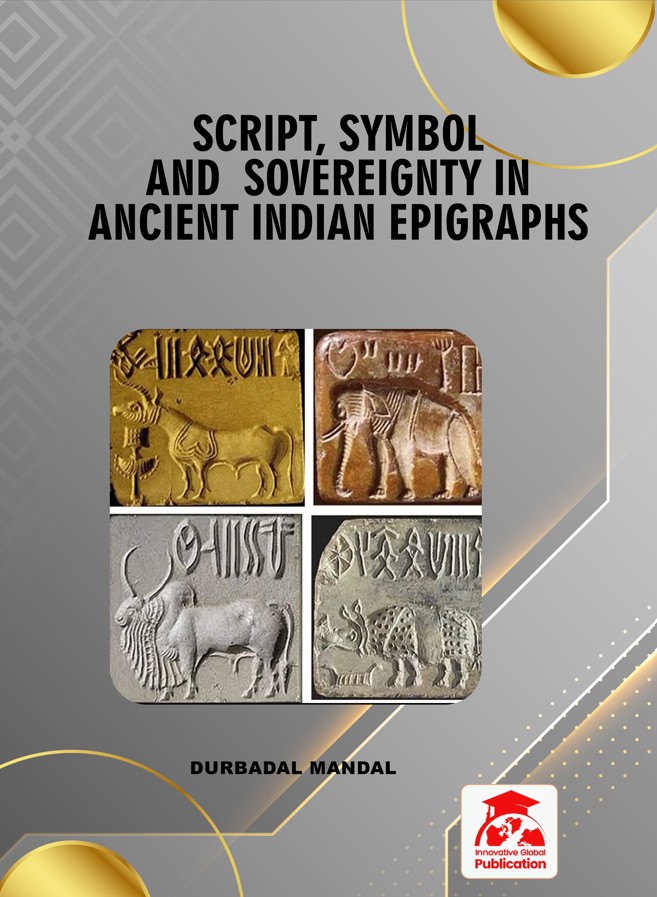
Script, Symbol, and Sovereignty in Ancient Indian Epigraphs
Author: Durbadal Mandal
ISBN: 978-81-993810-0-1
DOI: https://doi.org/10.59646/463
Date of Publication: September 26, 2025
About the Book:
The study of epigraphy is more than an engagement with stone and script; it is a dialogue with voices etched across centuries. Inscriptions are not merely relics of antiquity but living documents that reveal how societies conceived of power, faith, culture, and identity. In the Indian context, epigraphs occupy a unique position as they bridge the material and the symbolic, the temporal and the transcendental, the royal decree and the personal devotion. This book, Script, Symbol, and Sovereignty in Ancient Indian Epigraphs, seeks to unravel these dimensions by presenting a comprehensive exploration of the textual, visual, and semiotic layers embedded in India’s epigraphic heritage.
The impetus for this work arises from the recognition that epigraphy is not simply an auxiliary discipline to Sanskrit mainly and History but an independent field of inquiry that combines linguistics, archaeology, Sanskrit language and literature, art history, political thought, and cultural studies. Ancient Indian inscriptions reveal not only dynastic genealogies and administrative decrees but also the nuanced interplay between script and sovereignty, between symbolic authority and lived cultural practice. By examining epigraphy through these multiple lenses, this book aims to foreground the intellectual richness and methodological complexity of the field.
The structure of the book reflects both chronological progression and thematic depth. Part I introduces the foundational concepts, tracing the historical development of scripts in India and exploring the material contexts of inscriptional practices. Part II moves into the realm of symbolism, examining how signs, languages, and motifs operated as conveyors of authority and identity. Part III situates epigraphy within the matrix of sovereignty, analyzing inscriptions as instruments of political communication, legal administration, and religious legitimation. Part IV turns to historiography and methodology, addressing questions of decipherment, interpretation, and the role of digital technologies in the preservation and analysis of inscriptions. Finally, Part V offers case studies – ranging from the Mauryan and Chola records to cross-cultural influences – that exemplify the richness and diversity of epigraphic traditions in the subcontinent.
This work is designed to serve both as an academic reference and as a pedagogical companion. For students, it offers a structured syllabus that provides conceptual clarity alongside historical detail. For researchers, it offers critical engagement with debates on semiotics, sovereignty, and cross-cultural exchange. For the general reader with an interest in India’s past, it seeks to make inscriptions intelligible as cultural texts that continue to shape our understanding of heritage and identity. Although Epigraphy or Inscriptions are covered in this book for the Undergraduate level, this book has primarily been written to address the Postgraduate syllabus. At the same time, I have made a conscious effort to ensure that it also proves useful for research purposes. I sincerely hope that the book will be of great value to students of Sanskrit as well as Ancient History.
This book stands as an indispensable resource for anyone who is seeking a deeper understanding and research of Epigraphy, Inscriptions, Palaeography, and Ancient Indian History. If it serves its purpose for all, my efforts will truly be worthwhile.
Writing a book of this scope requires drawing on the intellectual legacy of earlier epigraphists, historians, linguists, and archaeologists. The contributions of scholars from James Prinsep to modern researchers in digital humanities have informed and inspired the present work. At the same time, the book aims to contribute an interpretive synthesis that highlights the dialogic relationship between script, symbol, and sovereignty.
It is my hope that Script, Symbol, and Sovereignty in Ancient Indian Epigraphs will encourage readers to view inscriptions not merely as records of the past but as enduring testimonies of human imagination, authority, and cultural negotiation. If this work sparks new questions, fresh debates, or innovative approaches in the study of epigraphy and Inscription, it will have achieved its purpose.