Role of Forensic Evidence in Criminal Cases
Role of Forensic Evidence in Criminal Cases
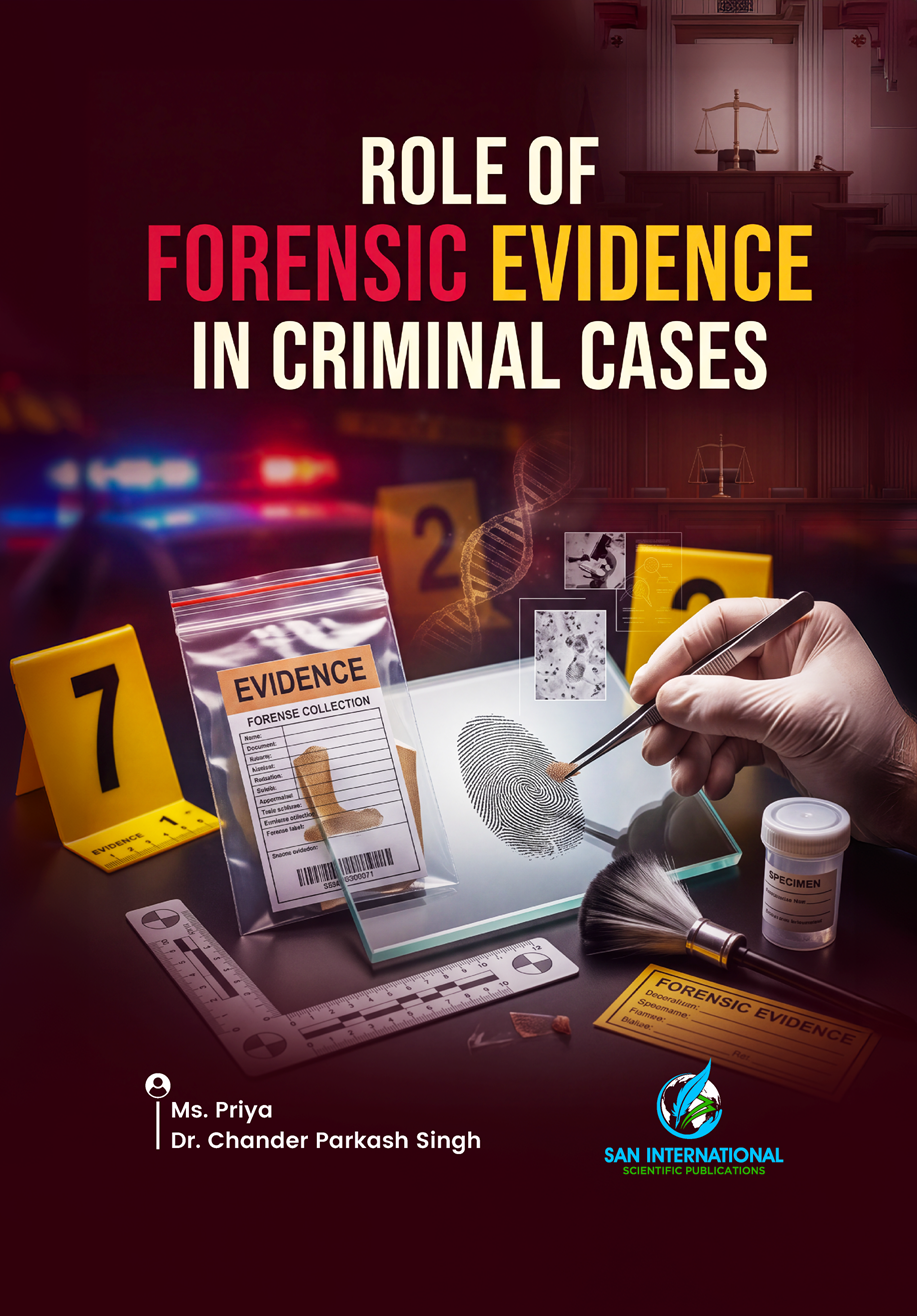
Authors: Ms. Priya and Dr. Chander Parkash Singh
ISBN: 978-81-69857-91-8
DOI: https://doi.org/10.59646/847
Date of Publication: October 12, 2026
Preface
Forensic evidence has become an indispensable component of modern criminal justice, providing scientific support for criminal investigations, legal proceedings, and judicial decision-making. The systematic examination of physical, biological, chemical, and digital evidence enables investigators to reconstruct crime scenes, establish connections between suspects and victims, verify witness statements, and distinguish facts from assumptions. The book Role of Forensic Evidence in Criminal Cases explores the scientific, legal, and practical dimensions of forensic evidence, emphasizing its significance in promoting fair trials, strengthening criminal investigations, and ensuring justice through reliable and objective findings.
This book presents a comprehensive examination of the constitutional and legislative framework governing forensic evidence in India, with particular reference to the Bharatiya Sakshya Adhiniyam, 2023, the Bharatiya Nagarik Suraksha Sanhita, 2023, and the Bharatiya Nyaya Sanhita, 2023. It discusses the admissibility and reliability of forensic reports, the responsibilities of expert witnesses, the importance of maintaining the chain of custody, and the role of forensic institutions and laboratories in criminal investigations. Special attention is given to DNA profiling, fingerprint examination, forensic toxicology, ballistic analysis, forensic pathology, handwriting examination, cyber forensics, and the authentication of electronic and digital evidence. The book also examines landmark judicial decisions from India, the United States, and the United Kingdom to illustrate how courts evaluate scientific evidence and address questions concerning its credibility, interpretation, and evidentiary value.
Beyond scientific applications and legal provisions, the book critically examines the challenges associated with the use of forensic evidence, including inadequate laboratory infrastructure, delays in forensic examinations, inconsistent analytical standards, shortages of trained professionals, evidence contamination, and weaknesses in evidence-handling procedures. It also considers important concerns relating to individual privacy, constitutional safeguards, expert accountability, and the possibility of wrongful convictions arising from the misinterpretation or misuse of scientific findings. Through a comparative analysis of international forensic frameworks, the book highlights opportunities to strengthen institutional capacity, improve quality assurance, promote standardized procedures, and enhance the integration of scientific investigation with judicial processes.
The concluding discussions emphasize the need for continuous development in forensic technologies, professional training, inter-agency coordination, and evidence-based judicial practices. By bringing together scientific principles, statutory provisions, judicial perspectives, and practical challenges, this book seeks to provide a valuable resource for law students, forensic science scholars, legal practitioners, police officers, researchers, judicial professionals, and policymakers. It is intended to encourage a deeper understanding of how forensic evidence can contribute to accurate fact-finding, protect the rights of individuals, and support the administration of criminal justice. Ultimately, the effective use of forensic science depends not merely on technological sophistication but also on scientific integrity, procedural fairness, and the responsible interpretation of evidence. It is hoped that this book will contribute to informed academic discussion and the continued strengthening of a transparent, reliable, and scientifically supported criminal justice system.