Research Methodology: Concepts, Methods, and Analysis
Research Methodology: Concepts, Methods, and Analysis
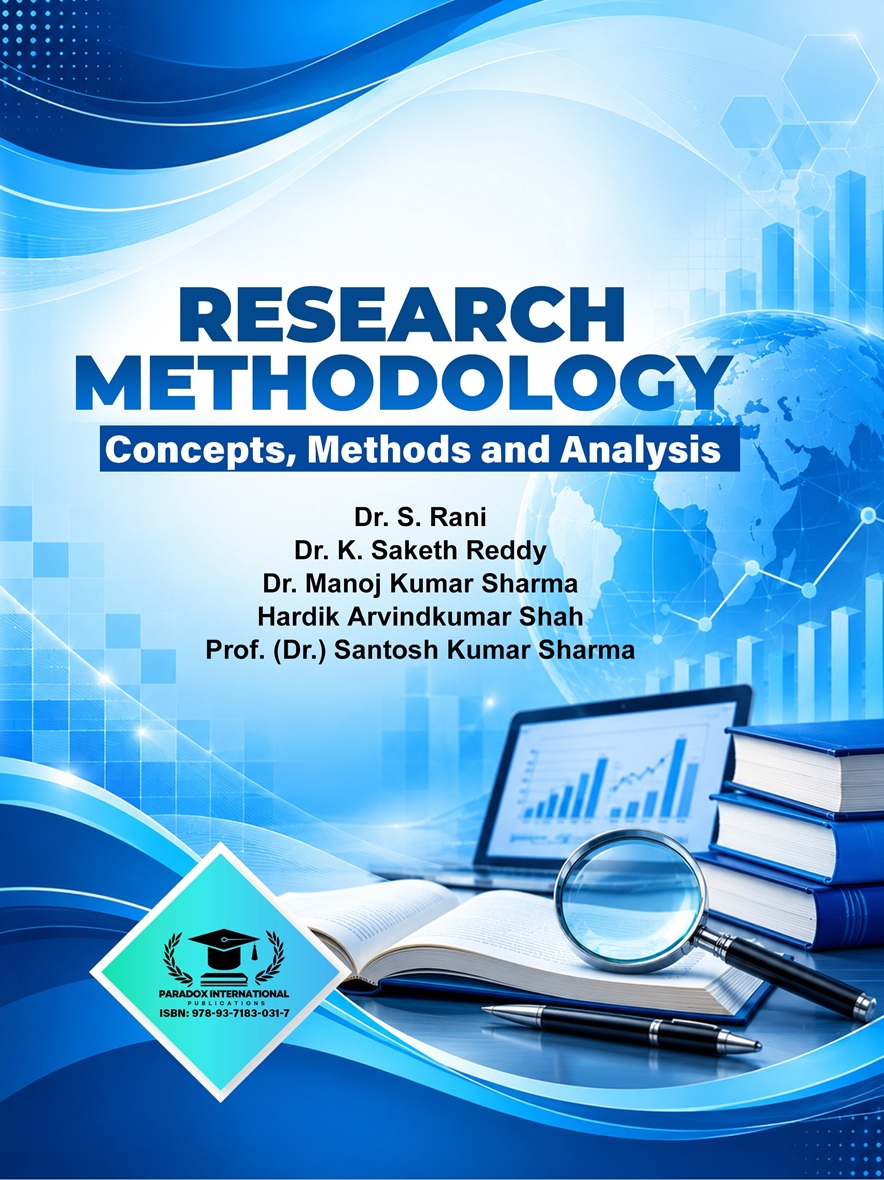
Authors: Dr. S. Rani, Dr. K. Saketh Reddy, Dr. Manoj Kumar Sharma, Hardik Arvindkumar Shah and Prof. (Dr.) Santosh Kumar Sharma
ISBN: 978-93-7183-031-7
DOI: https://doi.org/10.59646/835
Date of Publication: September 25, 2026
Preface
Research is a systematic and disciplined process of inquiry that contributes to the advancement of knowledge, understanding, and evidence-based decision-making. In an increasingly complex academic, social, scientific, and business environment, the ability to formulate meaningful research questions, select appropriate methods, collect reliable evidence, and interpret findings critically has become essential for students, researchers, academicians, professionals, and practitioners. Research Methodology: Concepts, Methods, and Analysis has been developed with the objective of providing a comprehensive and accessible foundation in the principles and practices of research.
This textbook introduces readers to the fundamental concepts of research methodology while gradually developing their understanding of the different stages involved in conducting a research study. It explains the nature, scope, objectives, and significance of research and provides a clear understanding of research problems, questions, objectives, hypotheses, variables, and conceptual frameworks. Particular attention is given to the importance of systematic planning and methodological rigor in ensuring the quality, reliability, and validity of research outcomes.
The book covers major approaches to research, including qualitative, quantitative, and mixed-methods research. It discusses different research designs and methods and helps readers understand how methodological choices should be aligned with research objectives and questions. The textbook also introduces important techniques of sampling, data collection, questionnaire and interview design, observation, scaling, measurement, and the use of primary and secondary sources. These concepts are presented in a structured manner to facilitate both theoretical understanding and practical application.
A significant component of the book focuses on data analysis and interpretation. Readers are introduced to the principles of data preparation, classification, tabulation, descriptive analysis, and commonly used statistical techniques. The book also provides an overview of inferential methods and explains the role of statistical reasoning in drawing meaningful conclusions from research data. Emphasis is placed not merely on the application of analytical techniques but also on understanding their relevance, assumptions, interpretation, and appropriate use in different research contexts. The textbook further recognizes that contemporary research extends beyond traditional methodological practices. The increasing use of digital technologies, statistical software, online databases, research-management tools, and artificial intelligence has transformed the way researchers identify information, collect and analyze data, communicate findings, and collaborate across disciplines. Accordingly, the book encourages readers to develop methodological awareness alongside technological competence while maintaining academic integrity, transparency, and responsible research practices.
Research ethics forms another important dimension of this textbook. Ethical research requires honesty, objectivity, respect for participants, confidentiality, informed consent, responsible data management, and appropriate acknowledgment of sources. The book highlights issues such as plagiarism, fabrication, falsification, conflicts of interest, authorship, intellectual property, and responsible use of digital and artificial intelligence-based tools. These principles are essential for maintaining trust and credibility in academic and professional research.
The book is designed to support undergraduate and postgraduate students, research scholars, faculty members, and professionals who wish to strengthen their understanding of research methodology. It may also serve as a useful reference for learners preparing research proposals, dissertations, theses, project reports, journal articles, and other scholarly works. The concepts have been organized progressively so that readers can move from foundational principles to more advanced aspects of research design, analysis, interpretation, and reporting.
The ultimate purpose of research methodology is not simply to teach techniques but to develop a research-oriented way of thinking. Effective researchers must be able to identify relevant problems, question assumptions, evaluate evidence, make informed methodological choices, analyze information objectively, and communicate conclusions clearly. This textbook therefore seeks to encourage analytical thinking, methodological discipline, intellectual curiosity, and responsible scholarship.
It is hoped that Research Methodology: Concepts, Methods, and Analysis will serve as a practical and academically valuable resource for readers at different stages of their research journey. By combining conceptual clarity with methodological application, the book aims to help learners approach research with greater confidence, competence, and integrity.
The authors gratefully acknowledge the contributions of scholars, researchers, educators, and institutions whose work has enriched the field of research methodology. We hope that this textbook will inspire readers not only to understand the processes of research but also to become thoughtful and responsible contributors to the generation and application of knowledge.