
Research in English Studies: Emerging Trends & Strategies
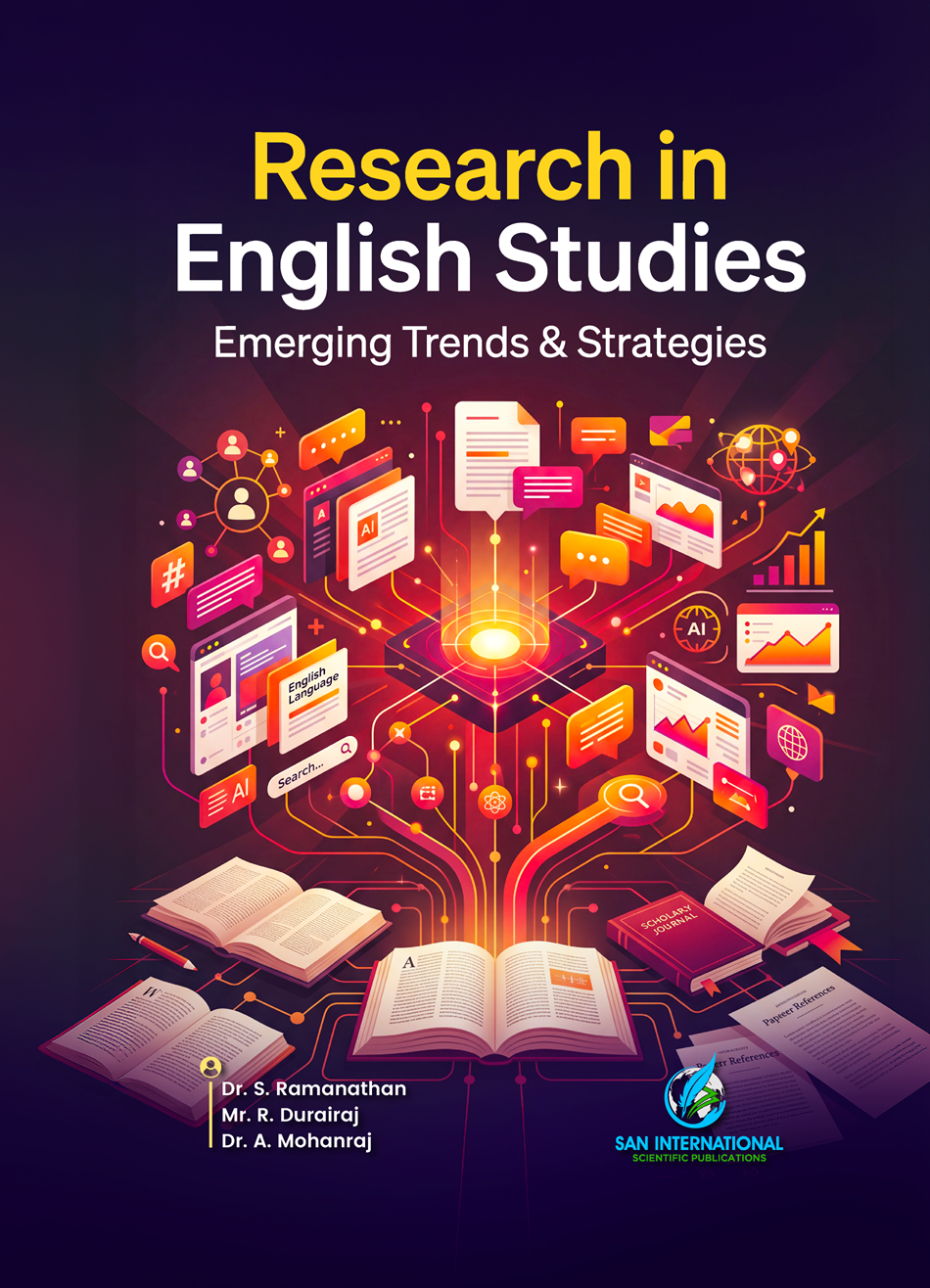
Research in English Studies: Emerging Trends & Strategies
Editors: Dr. S. Ramanathan, Mr. R. Durairaj, and Dr. A. Mohanraj
ISBN: 978-81-69857-45-1
DOI: https://doi.org/10.59646/793
Date of Publication: August 12, 2026
Cite this book: S. Ramanathan, R. Durairaj, and A. Mohanraj, (2026), Research in English Studies: Emerging Trends & Strategies, San International Scientific Publications, ISBN: 978-81-69857-45-1, DOI: https://doi.org/10.59646/793
Chapters and Authors
Chapter 1: The Geography of Resistance: Patriarchal Enclosures and Empowered Exodus in Bharati Mukherjee’s Desirable Daughters and Miss New India – Dr. Bhuvaneswari P
Chapter 2: The Immolation of Innocence: A Study of Billy Budd, Sailor as the Marginalized Subject – Dr. Dillip Kumar Pattanayak
Chapter 3: The Inside of An Individual: A New Historic Reading of Olga Tokarczuk’s Flights – Dr. Elakiya V and Dr. Samuel Morris V
Chapter 4: Negotiating Identity and Belonging in Zadie Smith’s White Teeth: A Cultural Studies Perspective – Mrs. M. Kanimozhi, and Dr. A. Venkateshkumar
Chapter 5: Reclaiming the Silenced Sovereign: A Postcolonial Reading of Chitra Banerjee Divakaruni’s the Last Queen – Dr. P. Kiruthika
Chapter 6: Silent Strength and Subtle Resistance: Reconfiguring Female Agency in the Selected Novels of Jhumpa Lahiri – Dr. Neetu Sangwan
Chapter 7: Caste, Body, and Power: Reflections of Dystopia in the Select Novels of Perumal Murugan – G. Ramakrishnan, and Dr. R. Meena
Chapter 8: Posthuman Consciousness in Kazuo Ishiguro’s Klara and the Sun – Dr. P. Sankavi
Chapter 9: Hood Feminism: The Feminism I Needed Growing Up – S. Santhiya
Chapter 10: Digital Rituals: How Social Media is Reshaping Indian Cultural Practices – Dr. V.G. Sadh
Chapter 11: Reconfiguring Dalit Identity and the Dynamics of Social Hierarchy in Ajay Navaria’s Worlds Within Worlds – Dr. R. Saradha
Chapter 12: Women’s Agency and Self-Realization – Dr. N. R. Shrinithi
Chapter 13: Ordinary Lives, Human Dignity and the Denial of Justice in Banu Mushtaq’s Heart Lamp – Dr. Sindhu Nair
Chapter 14: Nature’s Lessons for Sustainable Living in Delia Owens’ Where the Crawdads Sing – Sridevi. S
Chapter 15: The Village as a Site of Social Control and Resistance in Joseph Macwan’s The Stepchild – Dr Yash Pal Singh
Chapter 16: Femininity and Abjection in Sayaka Murata’s Convenience Store Woman – Jemima Lily J
Chapter 17: Repetition’s Dual Edge: Pleasure, Pressure, and Authentic Learning in the Classroom – Mr. T. Ajith, Dr. M. Ramesh, and Dr. S. Senthil Kumar
Chapter 18: The Linguistic Construction of Gender Roles – Ms. Geetha Sharon M, and Dr. P. Preethi
Chapter 19: Skill Profiling of Engineering Students’ Communicative Competence: A Data-Driven CEFR-Based Quantitative Performance Analysis in Technical Education – Dr. S. Marithai, and Dr. S. Maheswari
Chapter 20: Reading Booktok: Social Media as an Informal Literary Classroom – Ms. Rithikeerthi A, and Dr. P. Preethi
Preface
The research in English Studies has undergone a remarkable transformation with the advent of various disciplines like Medicine, Biology, Ecology, Sociology, Anthropology into the literary arena, and Linguistics, Information Technology, and Psychology in English language studies. During the previous years, research in literature has centred around the analysis of canonical texts and traditional linguistic theories. Contemporary research is no longer dependent on mere textual and grammatical analysis; it has undergone a multidimensional approach in the present century.
One of the most significant developments in literary studies is the growth of Digital Humanities, an interdisciplinary field which integrates computational technologies with traditional literary scholarship. Researchers at present employ text mining, digital mapping, and corpus analysis to analyse extensive literary texts. Digital archives assist scholars in accessing rare books and historical and anthropological documents, thereby facilitating comprehensive research. Likewise, Ecocriticism has become a broader field of Environmental Humanities. Researchers are very keen on the developments in this field, such as eco-consciousness, environmental justice, climate change, biodiversity, and the loss or degradation of flora and fauna, as well as the present El -Nino. Post humanism investigates the human–machine interface. Literary works depicting cyborgs, robots, virtual reality, and biotechnology are analysed to understand the concept of mechanical colonisation and ethics in the technological era.
In addition to Gender Studies, there is a significant development in its subgenre, Queer Studies, which represents lesbian, gay, and transsexual representations and identities. Scholars analyse and critique the established social norms on par with literary texts, which inevitably focus on LGBTQIA+ issues. In recent years, research in Postcolonial and Decolonial Studies continues to flourish. Scholars do focus on marginalised voices, indigeneity, cultural ambivalence, and hybridity. They also focus on regional literatures which were once neglected in the field of literary research. Another significantly and encouragingly growing area of literary research is Trauma and Memory Studies, which examines war narratives, violence, historical injustices, and so on. Researchers analyse various literary genres such as memoirs, autobiographies, refugee narratives, and the like in the light of how memory shapes narratives and the lives of the people, concerned.
With the advent of Artificial Intelligence (AI), English language teaching has taken a new shape, and the field has experienced a sea change. We have AI assisted writing assistants, spell and grammar checkers, and automated assessment tools. All these software applications and tools have transformed language learning and teaching to achieve an entirely newfangled phenomenon. Developments in the field of Linguistics, such as Corpus Linguistics, Sociolinguistics, and Pragmatics have sufficiently impacted the research in language studies. Corpus-based studies substantially contribute to research in grammar, vocabulary, and discourse analysis language teaching and lexicology by providing reliable empirical data rather than depending upon intuition. It is useful in analysing political speeches, mass communication, media interactions, and institutional discourse. The development in Sociolinguistics examines language variations, which in turn help researchers analyse diasporic discourses and indigenous narratives. Also there are researches in the power-based language politics as a part of Sociolinguistics.
The present collection of research articles by various scholars across the country, India shows a meticulousness in selecting themes and explicating concepts for analysing the selected content. These scholars have put in more efforts in their endeavour. The selection ranges from traditional textual analysis to posthumanism and cultural studies. Also, there are some dexterous research articles on English language studies which are more experimental rather than theoretical. This anthology offers a variety and diversity of conceptualisations and helpful for the budding scholars to fulfil their research expectations and to the academicians to import knowledge to the future generation.
All the Concepts and views thereon are attributed to the authors, concerned. The editors, or the publisher are in no way responsible for the views expressed in the article or any kind of plagiarism associated with the articles.