Research and Publication Ethics
Research and Publication Ethics
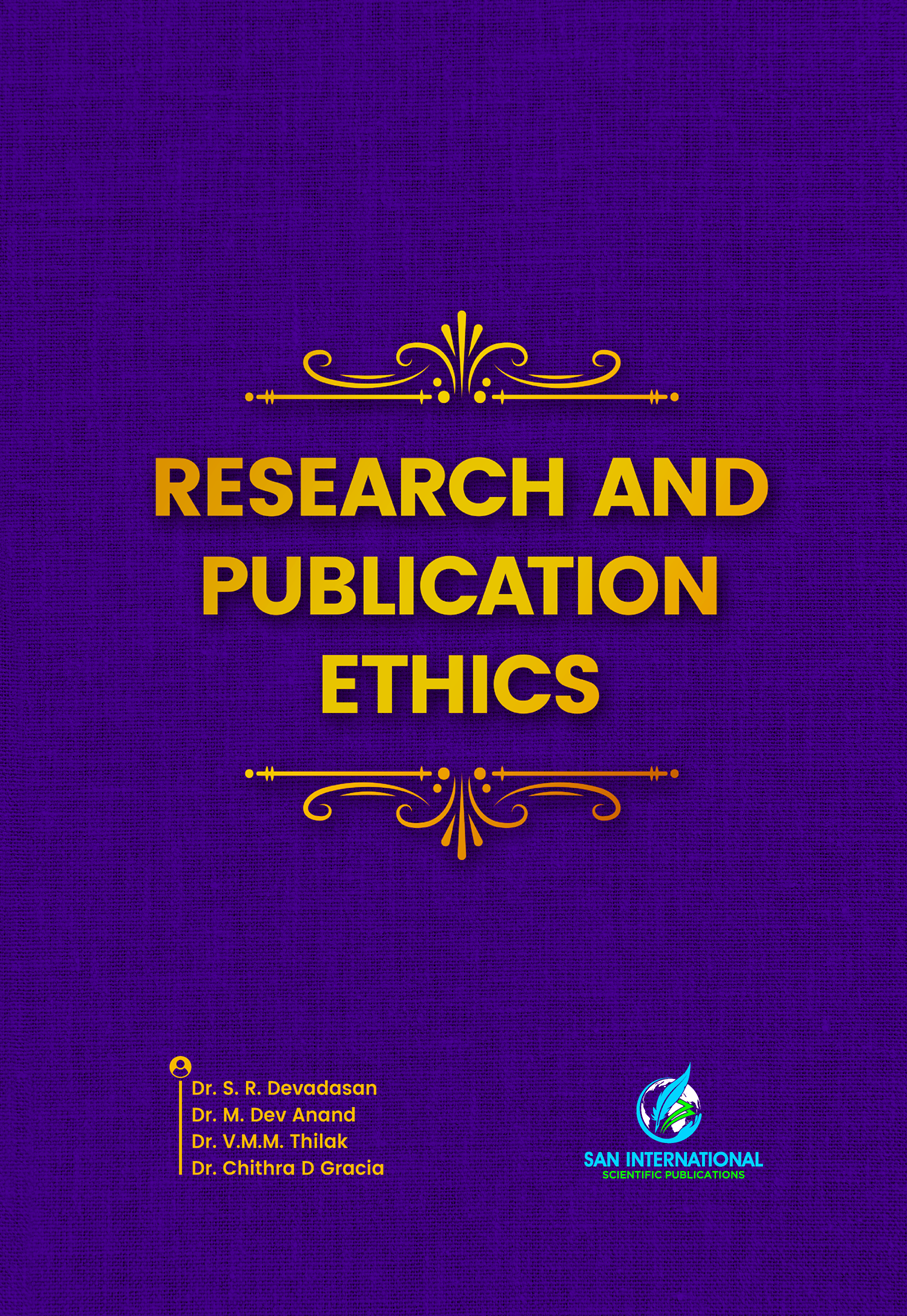
Authors: Dr. S. R. Devadasan, Dr. M. Dev Anand, Dr. V.M.M. Thilak, and Dr. Chithra D Gracia
ISBN: 978-81-69857-90-1
DOI: https://doi.org/10.59646/842
Date of Publication: October 11, 2026
Preface
Research is a systematic pursuit of knowledge in which the credibility, reliability, and impact of scholarly work depend fundamentally on integrity, transparency, accountability, and ethical responsibility. Research and Publication Ethics has been designed as a comprehensive academic resource to develop a clear understanding of the ethical foundations of research, responsible scientific conduct, scholarly publishing, open-access practices, publication misconduct, emerging technological challenges, and responsible research assessment. The book adopts a progressive unit-wise structure, beginning with the philosophical foundations of ethics and extending toward contemporary issues involving artificial intelligence, digital publishing, research databases, bibliometric indicators, and global academic recognition. It is intended to support students, research scholars, faculty members, supervisors, authors, reviewers, editors, and academic institutions in understanding and applying ethical principles throughout the research and publication lifecycle.
Unit I – Philosophy and Ethics establishes the conceptual and philosophical foundation required for understanding ethical research behaviour. It introduces the definition, nature, scope, concept, and branches of philosophy before progressing to ethics and moral philosophy. The unit examines the nature of moral judgements, their structural elements, the distinction between judgements of fact and value, classical philosophical perspectives, and the nature and functions of moral reactions. Particular emphasis is placed on the relationship between moral reasoning and scientific conduct, including the moral consequences of scientific misconduct and the manifestation of ethical and unethical behaviour in research and publication.
Unit II – Scientific Conduct focuses on the principles and practices that sustain integrity in scientific research. It examines ethics with respect to science and research, foundational principles across scientific disciplines, disciplinary and international variations, the historical evolution of research ethics, and emerging ethical risks. The unit provides detailed treatment of intellectual honesty and research integrity at individual and institutional levels. Major forms of scientific misconduct, particularly fabrication, falsification, and plagiarism (FFP), are examined together with redundant publications, duplicate publication, text recycling, data re-use, salami slicing, selective reporting, and misrepresentation of data. The unit also considers systemic pressures such as career progression and the “publish or perish” culture, institutional mechanisms for investigation and adjudication, preventive strategies, and practical case studies involving research misconduct.
Unit III – Publication Ethics examines the ethical framework governing scholarly communication and academic publishing. It introduces the conceptual scope of publication ethics and explores the responsibilities of authors, reviewers, editors, publishers, institutions, and other stakeholders. The unit discusses internationally recognized standards and initiatives associated with COPE, WAME, and ICMJE, together with conflicts of interest, financial and non-financial interests, institutional conflicts, publication misconduct, authorship and contributorship, inappropriate authorship practices, authorship disputes, complaints and appeals, reviewer misconduct, peer-review manipulation, predatory publishing, and article retraction. Case studies provide practical perspectives on data falsification, multiple submissions, citation manipulation, ghost authorship, editorial misconduct, compromised peer review, and retraction-related issues, thereby connecting ethical principles with realistic publishing situations.
Unit IV – Open Access Publishing addresses the transformation of scholarly communication through open-access models and digital publishing practices. It covers the historical evolution of open access, the major declarations and initiatives, copyright principles, Creative Commons licensing, subscription and open-access publishing models, rights-retention approaches, and major open-access publishers. The unit introduces SHERPA/RoMEO and explains its role in understanding publisher copyright and self-archiving policies. It further examines journal-finder and journal-suggestion tools, methods for identifying legitimate journals, predatory publishers, fake journals, cloned and hijacked journals, false indexing claims, and misleading bibliometric indicators. Regulatory and institutional initiatives for improving journal quality and protecting researchers from deceptive publishing practices are also discussed.
Unit V – Publication Misconduct provides a practical and contemporary examination of unethical practices in scholarly publishing. It uses group discussions and structured scenarios to examine fabrication, falsification, plagiarism, authorship and contributorship problems, conflicts of interest, and discipline-specific ethical dilemmas. The unit also discusses complaints and appeals, research fraud cases from India and abroad, and software-based approaches for identifying misconduct. Detailed attention is given to plagiarism-detection technologies, including similarity analysis and the interpretation of reports generated by tools such as Turnitin, iThenticate, and other plagiarism-detection systems. A major contemporary component is the ethical use of artificial intelligence in research, covering generative AI, authorship, hallucinated information, fabricated evidence, plagiarism, reproducibility, intellectual property, copyright, confidentiality, disclosure, and responsible AI deployment. Case studies further explore AI-generated evidence, peer-review confidentiality breaches, paper mills, citation cartels, plagiarism-evasion techniques, statistical detection of falsified datasets, and dual-use research concerns.
Unit VI – Databases and Research Metrics focuses on the systems through which scholarly research is indexed, measured, disseminated, evaluated, and recognized. It introduces major indexing and citation databases, including Web of Science and Scopus, and examines database architecture, citation networks, author identification, persistent identifiers, and research discoverability. The unit then explores citation databases and major research metrics, including the Journal Impact Factor, CiteScore, IPP, SNIP, SJR, h-index, g-index, m-quotient, i10-index, and altmetrics. Step-by-step sample calculations provide practical understanding of bibliometric indicators, while discussions of Goodhart’s Law, metric manipulation, citation practices, and responsible research assessment highlight the ethical limitations of quantitative evaluation. Frameworks such as DORA, the Leiden Manifesto, and the Hong Kong Principles provide broader perspectives on responsible assessment. The unit also examines academic platforms, researcher profiles, social media for scholarly dissemination, professional visibility, reviewing activities, editorial appointments, international recognition, and major researcher-recognition frameworks.
Taken together, the six units present research and publication ethics as a continuous and interconnected process rather than as a set of isolated rules. The journey begins with philosophical reasoning and moral judgement, progresses through responsible scientific conduct and publication ethics, develops an understanding of open-access and journal-selection practices, addresses publication misconduct and the ethical use of emerging technologies, and ultimately examines the databases and metrics through which scholarly contributions become visible and evaluated. The book therefore emphasizes that research excellence cannot be measured solely by the number of publications, citations, or academic indicators; it must also be grounded in honesty, originality, transparency, responsible authorship, appropriate attribution, rigorous peer review, respect for intellectual property, and accountability for published knowledge.
In an increasingly competitive and digitally connected research environment, ethical awareness has become an essential component of scholarly competence. Researchers must not only know how to design experiments, analyse data, write manuscripts, select journals, and disseminate findings, but must also understand the ethical consequences of every decision made during these processes. Research and Publication Ethics seeks to provide that broader perspective by combining conceptual foundations, practical guidelines, institutional frameworks, technological tools, contemporary challenges, case studies, and research-metric practices. The ultimate purpose of this book is to encourage a culture in which integrity is not treated merely as a requirement for publication or academic compliance, but as a fundamental professional value underlying the creation, communication, evaluation, and advancement of knowledge.