Redefining HR and HRM for the Modern Workplace
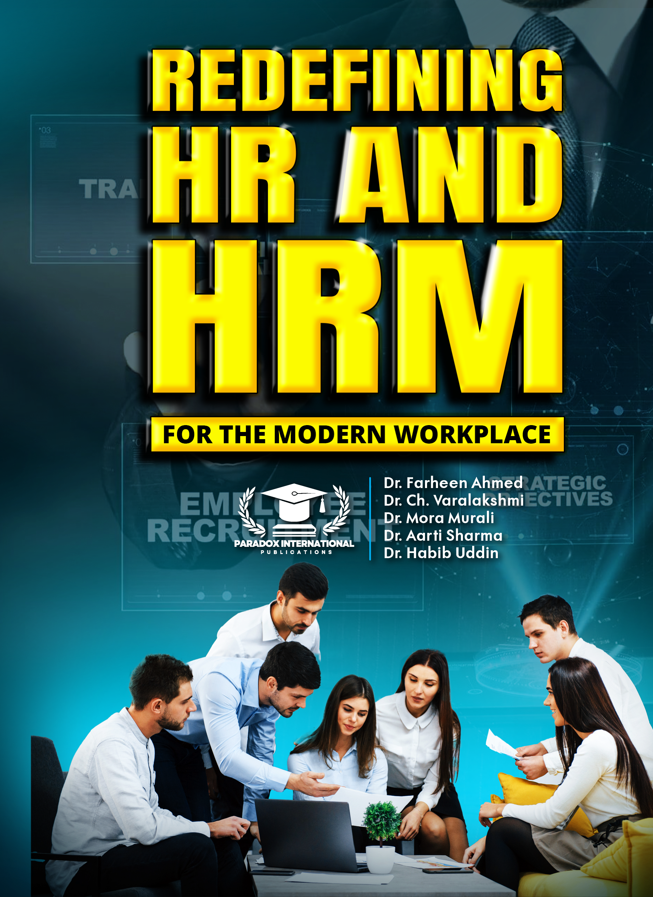
Redefining HR and HRM for the Modern Workplace
Authors: Dr. Farheen Ahmed, Dr. Ch. Varalakshmi, Dr. Mora Murali, Dr. Aarti Sharma and Dr. Habib Uddin
ISBN: 978-81-986047-3-6
DOI: https://doi.org/10.59646/hr/328
Date of Publication: March 09, 2025
About the Book:
Human Resource Management (HRM) has long been the backbone of organizational success, evolving from its traditional administrative roots to a dynamic, strategic function. In an era of rapid technological advancements, workforce transformations, and shifting employee expectations, the role of HRM is more critical than ever. The modern workplace is no longer confined by geographical boundaries, rigid hierarchies, or conventional employment models. Instead, it thrives on agility, innovation, and people-centric strategies. This book, Redefining HR and HRM for the Modern Workplace, seeks to explore this evolution, providing an in-depth analysis of the challenges and opportunities shaping the future of HRM.
As authors from diverse academic and professional backgrounds, we bring together our collective expertise to examine the multifaceted dimensions of modern HRM. Our objective is to bridge the gap between traditional HR practices and emerging trends, offering a comprehensive guide for scholars, practitioners, and business leaders. Each chapter delves into key areas of transformation, from HR technology and analytics to strategic workforce planning, diversity and inclusion, employee experience, and ethical considerations.
The book begins by tracing the historical origins of HRM, highlighting its gradual evolution and the paradigm shift towards a strategic business function. We then explore the profound impact of digitalization, artificial intelligence, and data analytics on HR practices, emphasizing the growing need for data-driven decision-making. As remote work and the gig economy redefine employment structures, we address the challenges and best practices for managing a hybrid workforce. In addition, we underscore the importance of fostering an inclusive workplace, prioritizing employee well-being, and adapting HR policies to meet the changing expectations of a diverse workforce. Through real-world case studies, theoretical frameworks, and practical insights, this book serves as a roadmap for HR professionals navigating the complexities of the modern workplace. The final chapters look ahead, forecasting emerging HR trends and preparing organizations for future workforce challenges. Our collective vision is to empower HR leaders with the knowledge and tools necessary to drive meaningful change and enhance organizational resilience. We extend our deepest gratitude to the researchers, practitioners, and industry experts who have contributed to the ever-growing body of knowledge in HRM. We also acknowledge the professionals and students who continue to push the boundaries of HR innovation, ensuring that this field remains dynamic and forward-thinking. We hope this book sparks insightful discussions, inspires new HR strategies, and serves as a valuable resource for those committed to shaping the future of work.
References
- Argyris, C. (1998). Empowerment: The Emperor’s New Clothes. Harvard Business Review.
- Armstrong, M. (2020). Armstrong’s Handbook of Human Resource Management Practice (15th ed.). Kogan Page.
- Ashford, S. J., George, E., & Blatt, R. (2007). Old Assumptions, New Work: The Gig Economy and Employment Relationships in the 21st Century. Academy of Management Annals.
- Bersin, J. (2018). Employee Experience: The Definitive Guide. Deloitte Insights.
- Bock, L. (2015). Work Rules! Insights from Inside Google That Will Transform How You Live and Lead. Twelve.
- Boudreau, J. W., & Ramstad, P. M. (2007). Beyond HR: The New Science of Human Capital. Harvard Business Review Press.
- Bratton, J., & Gold, J. (2017). Human Resource Management: Theory and Practice (6th ed.). Palgrave Macmillan.
- Caldwell, R. (2003). The Changing Roles of Personnel Managers: Old Ambiguities, New Uncertainties. Journal of Management Studies.
- Cappelli, P. (2008). Talent on Demand: Managing Talent in an Age of Uncertainty. Harvard Business Press.
- Chamorro-Premuzic, T., & Bersin, J. (2021). The Future of Work: How Artificial Intelligence and Automation Are Transforming HR. MIT Press.
- Cooper, C. L., & Cartwright, S. (2013). Healthy Mind, Healthy Organization: The Impact of Stress and Well-Being on Employee Performance. Wiley.
- Dessler, G. (2022). Human Resource Management (17th ed.). Pearson.
- Dobbin, F., & Kalev, A. (2022). Getting to Diversity: What Works and What Doesn’t. Harvard University Press.
- Edwards, M. R., & Edwards, K. (2016). Predictive HR Analytics: Mastering the HR Metric. Kogan Page.
- Ferdman, B. M., & Deane, B. R. (2014). Diversity at Work: The Practice of Inclusion. Wiley.
- Fitz-enz, J. (2010). The New HR Analytics: Predicting the Economic Value of Your Company’s Human Capital Investments. AMACOM.
- Guenole, N., Ferrar, J., & Feinzig, S. (2017). The Power of People: Learn How Successful Organizations Use Workforce Analytics to Improve Business Performance. Pearson.
- Jesuthasan, R., & Boudreau, J. (2022). Work Without Jobs: How to Reboot Your Organization’s Work Operating System. MIT Press.
- Kahn, W. A. (1990). Psychological Conditions of Personal Engagement and Disengagement at Work. Academy of Management Journal.
- Kotter, J. P. (2012). Leading Change. Harvard Business Review Press.
- Lepak, D. P., & Gowan, M. (2018). Human Resource Management: Managing Employees for Competitive Advantage (3rd ed.). Chicago Business Press.
- Marr, B. (2018). Data-Driven HR: How to Use Analytics and Metrics to Drive Performance. Kogan Page.
- Meijerink, J., Bondarouk, T., & Looise, J. C. (2013). Value Creation Through HR Shared Services: A Multi-Stakeholder Perspective. Palgrave Macmillan.
- Mor Barak, M. E. (2016). Managing Diversity: Toward a Globally Inclusive Workplace (4th ed.). Sage.
- Morgan, J. (2017). The Employee Experience Advantage: How to Win the War for Talent by Giving Employees the Workspaces They Want, the Tools They Need, and a Culture They Can Celebrate. Wiley.
- Parry, E., & Tyson, S. (2017). Managing People in a Contemporary Context. Routledge.
- Pease, G., Byerly, B., & Fitz-enz, J. (2012). Human Capital Analytics: How to Harness the Potential of Your Organization’s Greatest Asset. Wiley.
- Pfeffer, J. (2018). Dying for a Paycheck: How Modern Management Harms Employee Health and Company Performance—and What We Can Do About It. Harper Business.
- Roberson, Q. (2012). The Oxford Handbook of Diversity and Work. Oxford University Press.
- Schuler, R., & Jackson, S. (2014). Strategic Human Resource Management (2nd ed.). Wiley.
- SHRM (2021). HR Competency Model: The Knowledge, Skills, and Abilities Needed for HR Success. SHRM Press.
- Spreitzer, G., Cameron, L., & Garrett, L. (2017). Alternative Work Arrangements: The New World of Work. Academy of Management Perspectives.
- Storey, J. (2007). Human Resource Management: A Critical Text (3rd ed.). Cengage Learning.
- Sullivan, J. (2018). HR Metrics and Analytics: Use Data to Drive Performance & Improve HR Effectiveness. Kogan Page.
- Sutherland, W., & Jarrahi, M. H. (2018). The Gig Economy and Information Infrastructure: The Case of Uber and the Self-Employed Workforce. International Journal of Information Management.
- Thomas, D. A., & Ely, R. J. (1996). Making Differences Matter: A New Paradigm for Managing Diversity. Harvard Business Review.
- Torrington, D., Hall, L., Taylor, S., & Atkinson, C. (2020). Human Resource Management (11th ed.). Pearson.
- Ulrich, D. (2016). Victory Through Organization: Why the War for Talent Is Failing Your Company and What You Can Do About It. McGraw-Hill.
- Ulrich, D., Younger, J., Brockbank, W., & Ulrich, M. (2012). HR from the Outside In: Six Competencies for the Future of Human Resources. McGraw-Hill.
- Vaiman, V., & Haslberger, A. (2013). Talent Management of Self-Initiated Expatriates: A Neglected Source of Global Talent. Palgrave Macmillan.