Python Programming: A Practical Approach to Learn and Build Projects
Python Programming: A Practical Approach to Learn and Build Projects
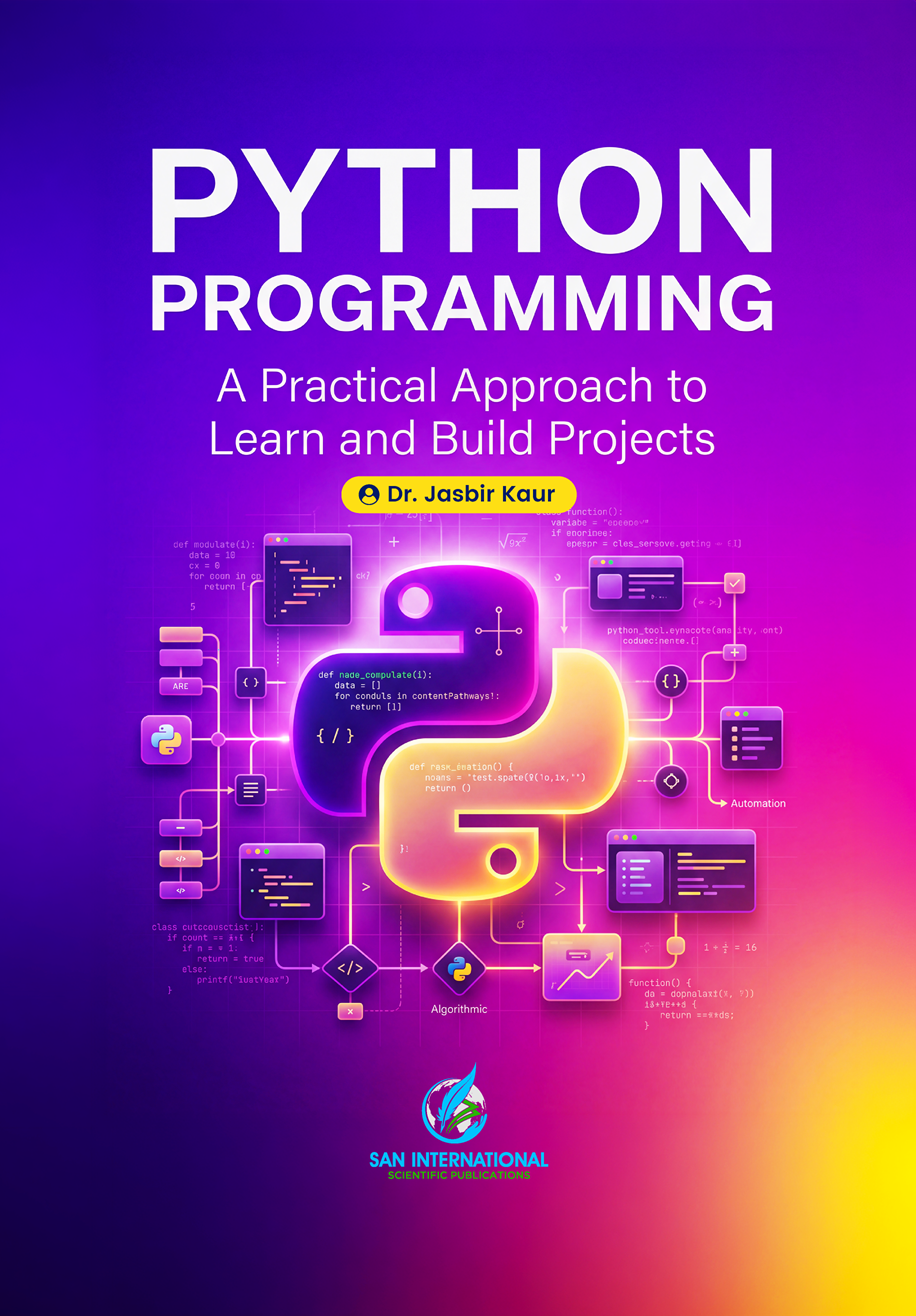
Author: Dr. Jasbir Kaur
ISBN: 978-81-69857-59-8
DOI: https://doi.org/10.59646/806
Date of Publication: August 31, 2026
Cite this book: Jasbir K, (2026), Python Programming: A Practical Approach to Learn and Build Projects, San International Scientific Publications, ISBN: 978-81-69857-59-8, DOI: https://doi.org/10.59646/806
Preface
Python has emerged as one of the most versatile, accessible, and widely used programming languages in modern computing. Its clear syntax, extensive ecosystem, and broad range of applications make it an important language for students, educators, researchers, developers, and professionals across diverse disciplines. Python Programming: A Practical Approach to Learn and Build Projects has been developed to provide a systematic and practical pathway for learning Python, beginning with fundamental programming concepts and progressing towards advanced programming, data analysis, web development, artificial intelligence, machine learning, and professional application development.
This book is designed to bridge the gap between learning programming concepts and applying them to real-world problems. The content is organized into ten comprehensive units that gradually develop the learner’s knowledge and programming skills. The initial units establish a strong foundation in Python syntax, variables, data types, operators, conditional statements, loops, functions, debugging, and fundamental data structures. The book then progresses to modules, packages, object-oriented programming, file handling, exception management, data persistence, APIs, and database programming.
The later units introduce important areas of contemporary Python development, including NumPy, Pandas, data visualization, web development with Flask, RESTful APIs, web scraping, automation, artificial intelligence, and machine learning. Advanced Python concepts such as iterators, generators, decorators, context managers, concurrency, asynchronous programming, type hints, dataclasses, regular expressions, and secure coding are also covered. The final unit focuses on professional software development practices, including project architecture, version control, testing, debugging, optimization, documentation, packaging, deployment, and cloud fundamentals.
The approach adopted throughout this book emphasizes conceptual clarity, practical application, progressive learning, and project-based development. Each unit is intended to help learners move from understanding individual programming concepts to integrating those concepts into functional applications. The book can therefore serve as a useful resource for undergraduate and postgraduate students, beginners in programming, self-learners, and anyone seeking to develop practical Python programming skills. It is hoped that this book will encourage readers to approach programming not merely as the study of syntax and commands, but as a structured process of logical thinking, problem-solving, experimentation, and application development. By combining foundational knowledge with contemporary tools and project-oriented learning, Python Programming: A Practical Approach to Learn and Build Projects aims to provide learners with the confidence and skills necessary to progress from writing their first Python program to developing meaningful, reliable, and intelligent applications.