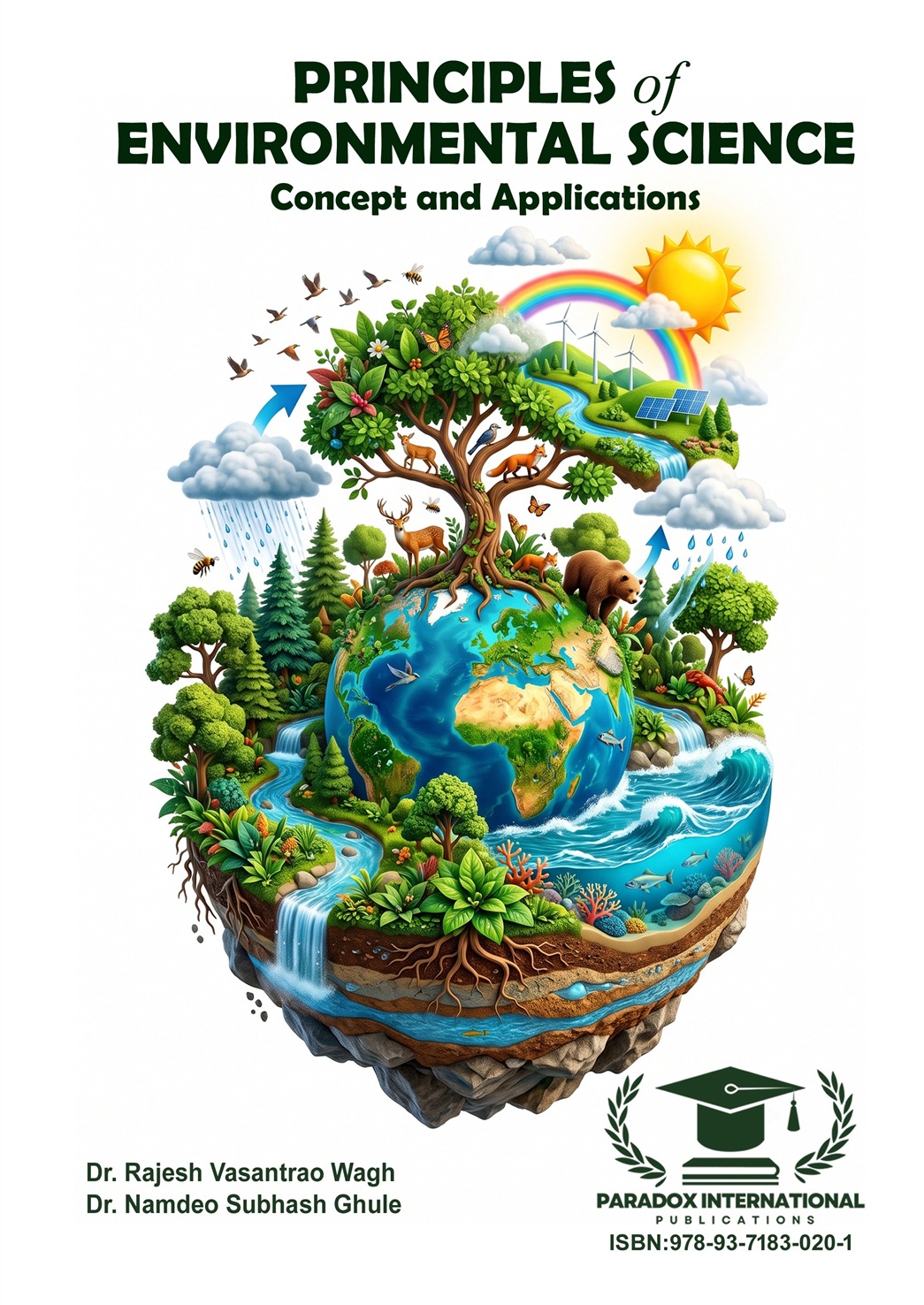
Principles of Environmental Science: Concept and Applications
Principles of Environmental Science: Concept and Applications
Authors: Dr. Rajesh Vasantrao Wagh, and Dr. Namdeo Subhash Ghule
ISBN: 978-93-7183-020-1
DOI: https://doi.org/10.59646/812
Date of Publication: August 31, 2026
Cite this book: Rajesh VW, and Namdeo SG, (2026), Principles of Environmental Science: Concept and Applications, Paradox International Publications & San International Scientific Publications, ISBN: 978-93-7183-020-1, DOI: https://doi.org/10.59646/812
Preface
Environmental science has emerged as one of the most important fields of study in the twenty-first century as societies confront increasingly complex challenges related to climate change, biodiversity loss, pollution, resource depletion, population growth, urbanisation, and sustainable development. These challenges are not confined to any particular region or discipline. They influence economies, communities, public health, agriculture, industry, governance, and the quality of life of present and future generations. A meaningful understanding of environmental science therefore requires not only knowledge of ecological principles but also an appreciation of how scientific concepts are connected with human activities, technological development, economic systems, and social choices.
Principles of Environmental Science: Concepts and Applications has been developed to provide a systematic foundation for understanding the environment and the dynamic relationships between human societies and natural systems. The textbook introduces fundamental environmental concepts while emphasizing their practical relevance to contemporary environmental problems. It is designed to help learners move beyond memorizing definitions and processes toward understanding, analysing, and responding to environmental challenges. The book begins with the basic principles of environmental science, including the structure and functioning of ecosystems, energy flow, nutrient cycling, biodiversity, and ecological interactions. It subsequently examines natural resources such as forests, water, soil, minerals, and energy, with particular attention to their sustainable utilization and conservation. Major forms of environmental pollution—including air, water, soil, noise, and marine pollution—are discussed along with their sources, impacts, monitoring approaches, and management strategies.
A significant portion of the textbook focuses on contemporary global environmental concerns. Climate change, global warming, ozone-layer depletion, deforestation, desertification, biodiversity loss, and ecological degradation are examined from scientific and societal perspectives. The book also explores environmental health, disaster management, population dynamics, urban environmental issues, and the environmental consequences of industrialisation and changing consumption patterns.
Sustainability forms a central theme throughout the textbook. Concepts such as sustainable development, circular economy, renewable energy, waste minimisation, green technologies, environmental management, and responsible consumption are presented as important pathways toward balancing economic development with ecological protection. The textbook also introduces the role of environmental policies, legislation, institutions, environmental impact assessment, and international cooperation in addressing environmental problems.
Particular emphasis is placed on concepts and applications. Real-world situations, environmental case studies, examples, analytical activities, and application-oriented discussions are incorporated to help learners connect theoretical knowledge with practical environmental concerns. Contemporary technologies, including geographic information systems, remote sensing, environmental sensors, data analytics, and emerging digital tools, are also considered in relation to environmental monitoring, conservation, and sustainable resource management.
The textbook adopts an interdisciplinary approach because environmental issues cannot be adequately understood through a single academic perspective. Biology, chemistry, geography, economics, sociology, technology, public policy, and management all contribute to environmental understanding and problem-solving. This interdisciplinary orientation is particularly relevant for students preparing for careers in science, commerce, management, education, social sciences, environmental studies, and other professional fields.
The book is intended for undergraduate and postgraduate students, teachers, researchers, and readers seeking a comprehensive introduction to environmental science. It may also serve as a supplementary resource for courses dealing with environmental studies, sustainability, ecology, natural-resource management, climate change, environmental management, and sustainable development.
Each chapter is structured to facilitate progressive learning and includes learning objectives, key concepts, conceptual explanations, examples, applications, case studies, review questions, analytical questions, and suggested activities. These features are intended to encourage critical thinking and active engagement with environmental issues rather than passive learning.
The environmental challenges facing humanity are substantial, but they also provide opportunities for innovation, collaboration, and responsible action. Scientific knowledge can contribute to better decisions, but lasting environmental progress also requires ethical responsibility, institutional commitment, community participation, and individual awareness. Education has a vital role in developing environmentally responsible citizens who can understand these challenges and contribute meaningfully to sustainable solutions.
Principles of Environmental Science: Concepts and Applications is therefore not merely an introduction to environmental concepts; it is an attempt to connect scientific understanding with practical action. It encourages readers to view the environment as an interconnected system and to recognize that sustainable development depends upon maintaining a responsible balance between human aspirations and the ecological limits of our planet.
It is hoped that this textbook will serve as a useful academic resource and inspire students and readers to develop a deeper understanding of environmental systems, evaluate environmental problems critically, and participate actively in building a more sustainable and resilient future.