Pedagogy 5.0: Teaching and Learning in Digital Age
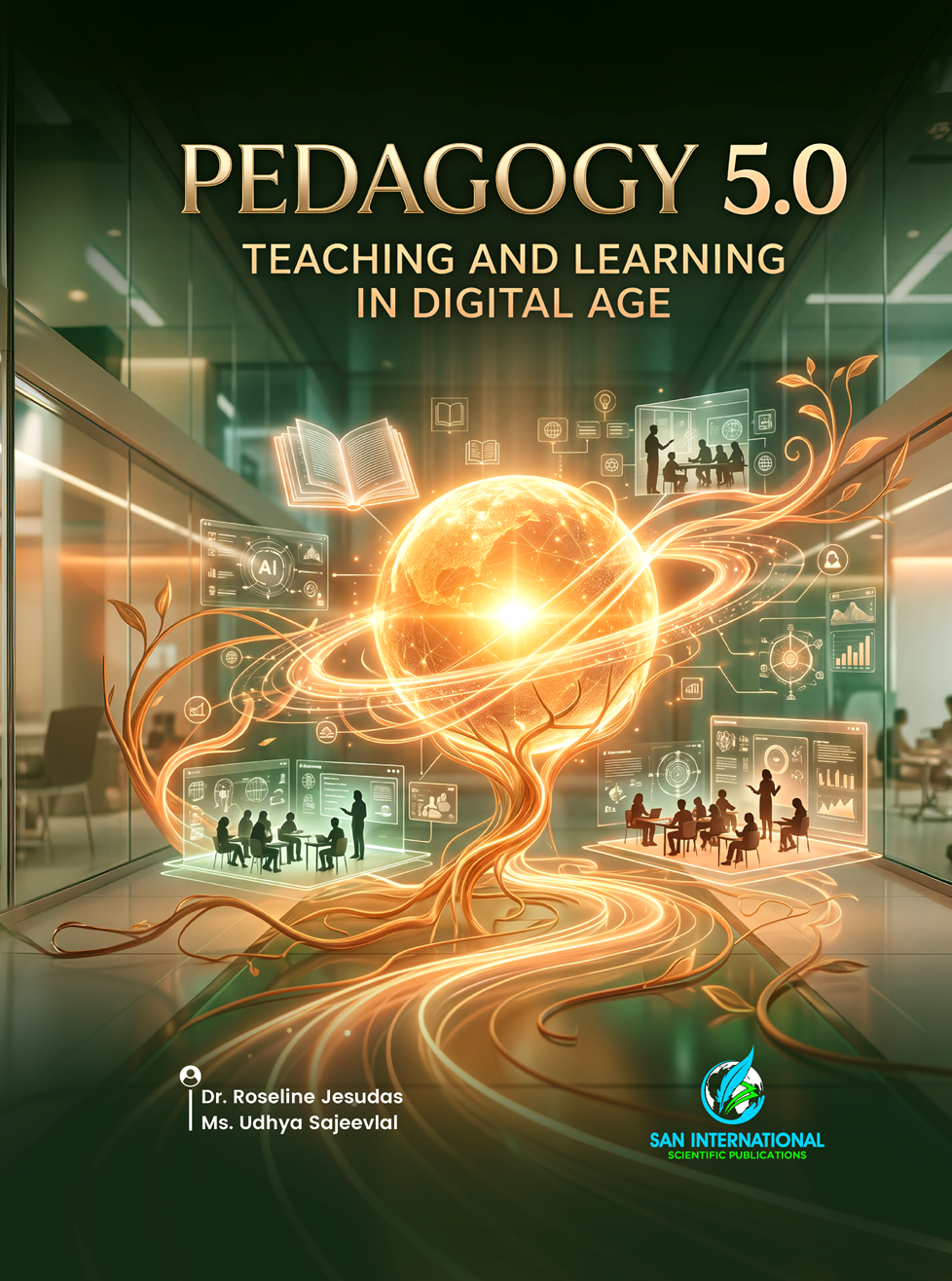
Pedagogy 5.0: Teaching and Learning in Digital Age
Authors: Dr. Roseline Jesudas, and Ms. Udhya Sajeevlal
ISBN: 978-81-69857-25-3
DOI: https://doi.org/10.59646/762
Date of Publication: August 05, 2026
Cite this book: Roseline J, and Udhya S, (2026), Pedagogy 5.0: Teaching and Learning in Digital Age, San International Scientific Publications, ISBN: 978-81-69857-25-3, DOI: https://doi.org/10.59646/762
Preface
This book, Pedagogy 5.0: Teaching and Learning in Digital Age, has been conceived to address the rapidly transforming landscape of education in an era defined by digital innovation, artificial intelligence, data-driven decision-making, and human-centered learning. Education has evolved beyond the traditional boundaries of classrooms and textbooks into dynamic, technology-enabled ecosystems where learning is personalized, collaborative, immersive, and lifelong. The emergence of Pedagogy 5.0 represents a significant paradigm shift that integrates advanced technologies with human values, creativity, empathy, and critical thinking to prepare learners for the challenges and opportunities of the twenty-first century. As societies move toward intelligent, connected, and sustainable futures, educators are called upon to reimagine teaching not merely as the transmission of knowledge but as the facilitation of meaningful learning experiences that empower individuals to innovate, adapt, and contribute responsibly to global development. This book aims to provide a comprehensive understanding of these transformative educational practices by combining foundational theories, contemporary pedagogical models, emerging technologies, and future-oriented educational strategies within a coherent and practical framework.
The content of this book is carefully structured into eight comprehensive units that collectively explore the evolution, implementation, and future directions of Pedagogy 5.0. It begins by tracing the historical progression of educational philosophies from Pedagogy 1.0 to Pedagogy 5.0, highlighting how technological advancements and societal transformations have reshaped teaching and learning. The discussion extends to human-centric education, learner-driven ecosystems, competency-based learning, values-oriented education, and the integration of Education 5.0 and Society 5.0 principles. Building upon these foundations, the book examines classical and contemporary learning theories, including constructivism, connectivism, heutagogy, experiential learning, cognitive science, neuroscience, and learner psychology, demonstrating how these theories continue to influence digital learning environments. The instructional design unit presents modern teaching-learning models such as blended learning, flipped classrooms, hybrid education, project-based learning, inquiry-driven instruction, Universal Design for Learning, and curriculum alignment through outcome-based education, enabling educators to design flexible, inclusive, and learner-centered educational experiences.
Recognizing that technology has become an integral component of modern education, the book explores the design and management of technology-enabled classrooms, including smart learning environments, Learning Management Systems, educational data analytics, artificial intelligence, augmented and virtual reality, mobile learning, collaborative digital platforms, and open educational resources. Rather than viewing technology as a replacement for teachers, the book emphasizes its role as an enabler that enhances engagement, accessibility, creativity, and evidence-based instructional decision-making. Equally important is the transformation of assessment practices in Pedagogy 5.0, where traditional examination-centric systems are gradually being replaced by authentic, competency-based, formative, and performance-oriented assessments supported by AI-assisted evaluation, digital feedback mechanisms, learning analytics, reflective portfolios, and continuous improvement strategies. These approaches encourage deeper learning while promoting academic integrity, ethical assessment practices, and meaningful learner development.
A distinguishing feature of Pedagogy 5.0 is its commitment to personalization, inclusivity, and lifelong learning. Accordingly, this book discusses adaptive learning pathways, assistive technologies, accessible digital environments, emotion-aware learning systems, self-regulated learning, metacognitive skill development, workplace learning, informal and non-formal education, and lifelong reskilling and upskilling models. It recognizes that every learner possesses unique abilities, aspirations, and learning preferences, and therefore advocates educational systems that promote equity, diversity, accessibility, and social responsibility. In parallel, the evolving role of educators is explored through discussions on teacher digital competence, professional development, AI-enhanced teaching, interdisciplinary collaboration, instructional leadership, ethical responsibilities, well-being, and institutional readiness. The teacher of the future is envisioned not simply as an instructor but as a facilitator, mentor, coach, instructional designer, researcher, innovator, and lifelong learner capable of nurturing both intellectual and emotional growth among students.
The final unit presents an insightful exploration of future educational trends and policy perspectives, examining AI-driven education systems, national and international educational reforms, the implementation of NEP 2020, micro-credentials, MOOCs, alternative certification pathways, sustainability education, global citizenship, educational governance, ethics, privacy, and emerging research directions in learning sciences. The vision presented throughout the book aligns with the broader goal of creating intelligent, inclusive, sustainable, and human-centered educational ecosystems capable of preparing learners for an increasingly interconnected and rapidly evolving world. By integrating pedagogical innovation with technological advancement, the book highlights how education can contribute meaningfully to economic development, social transformation, environmental sustainability, and responsible global citizenship.
This book is intended to serve as a valuable resource for undergraduate and postgraduate students, teacher educators, faculty members, educational administrators, instructional designers, curriculum developers, researchers, policymakers, and professionals engaged in educational innovation. Every effort has been made to present the subject matter in a systematic, comprehensive, and accessible manner while maintaining academic rigor and practical relevance. The concepts discussed throughout the book are supported by contemporary educational practices, emerging technologies, and globally recognized pedagogical frameworks, enabling readers to bridge theoretical understanding with real-world implementation. It is our sincere hope that this book will inspire educators and learners to embrace continuous innovation, reflective practice, ethical responsibility, and lifelong learning while contributing to the development of resilient, inclusive, and future-ready education systems. As education continues to evolve alongside technological progress, Pedagogy 5.0 offers not merely a new instructional approach but a transformative philosophy that places human potential, collaboration, creativity, and sustainable development at the center of teaching and learning in the digital age.