NBA GAPC V4.0: Outcome-Based Education Faculty Handbook – A Practical Textbook for Course Planning, Assessment, Attainment and Continuous Improvement (2026–2027 Faculty Reference Edition)
NBA GAPC V4.0: Outcome-Based Education Faculty Handbook – A Practical Textbook for Course Planning, Assessment, Attainment and Continuous Improvement (2026–2027 Faculty Reference Edition)
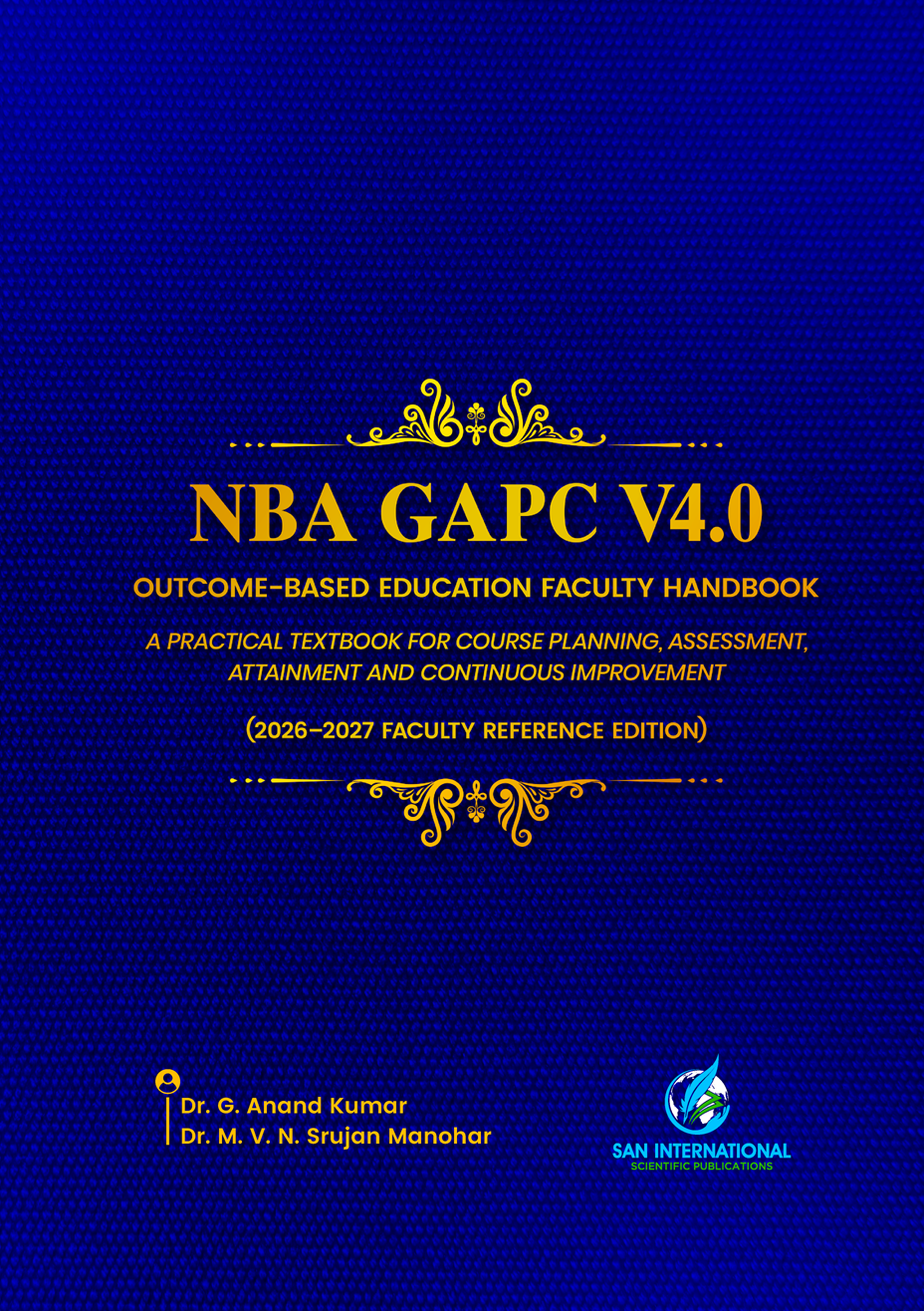
Authors: Dr. G. Anand Kumar, and Dr. M. V. N. Srujan Manohar
ISBN: 978-81-17787-01-4
DOI: https://doi.org/10.59646/855
Date of Publication: October 21, 2026
Preface
Outcome-Based Education (OBE) has become a significant framework for strengthening academic quality, improving teaching effectiveness, and demonstrating student learning through measurable outcomes and verifiable evidence. In the context of the National Board of Accreditation (NBA) and its Graduate Attributes and Programme Criteria (GAPC) framework, faculty members are expected to move beyond conventional teaching practices and establish a systematic relationship between course outcomes, assessment strategies, attainment calculations, programme outcomes, and continuous improvement. The NBA GAPC V4.0: Outcome-Based Education Faculty Handbook – A Practical Textbook for Course Planning, Assessment, Attainment and Continuous Improvement (2026–2027 Faculty Reference Edition) has been developed as a practical academic resource to support faculty members in implementing these responsibilities with clarity, consistency, and confidence.
This handbook provides a structured explanation of the essential processes involved in planning, implementing, documenting, and reviewing outcome-based academic activities. Beginning with the foundations of OBE and the development of a reliable course-file evidence chain, it guides readers through course profiles, student performance analysis, course outcome formulation, assessment architecture, question-paper blueprint preparation, and course outcome tagging. Particular attention is given to CO–PO/WA–WK mapping, direct and indirect attainment calculations, the contribution of course outcomes to programme-level attainment, and the systematic organization of supporting evidence. Through these interconnected topics, the book emphasizes that effective OBE implementation requires not merely the preparation of documents but also the establishment of a traceable and academically meaningful relationship between teaching, assessment, learning achievement, and improvement.
A distinctive feature of this handbook is its use of a worked Industrial Robotics course example to demonstrate how OBE principles can be translated into practical academic procedures. The example connects course planning, outcome formulation, assessment design, attainment analysis, and continuous improvement within a consistent framework. Faculty members can use this worked example to understand calculation procedures, examine attainment results, identify learning gaps, and formulate appropriate improvement measures. The accompanying templates, checklists, evidence registers, calculation worksheets, and documentation workflows further support the application of these procedures to different engineering and technology courses. These resources are intended to reduce ambiguity in academic documentation, improve consistency across faculty members, and make course files easier to review, verify, and maintain throughout the academic cycle.
The handbook also addresses the importance of continuous improvement and the need to close the loop between assessment findings and subsequent teaching practices.
Attainment values become meaningful when they are interpreted carefully and used to guide decisions about instructional methods, assessment design, student support, course delivery, and curriculum alignment. Accordingly, the chapters on evidence management, common documentation errors, auditability, and faculty implementation provide practical guidance for maintaining reliable academic records and preventing inconsistencies in calculations and reporting. The implementation roadmap for 2026–2027 encourages faculty members and departments to distribute documentation responsibilities across the semester rather than postponing essential work until accreditation reviews or academic audits. Such an approach can strengthen institutional preparedness while promoting a sustained culture of evidence-based academic development.
This book is intended primarily for engineering and technology faculty members, course coordinators, programme coordinators, Heads of Departments, academic administrators, internal quality assurance teams, and faculty members responsible for NBA-related documentation and OBE implementation. It may also serve as a reference for newly appointed faculty members who require a practical introduction to outcome-based course planning and for experienced academics seeking to refine existing assessment and attainment practices. The appendices provide reusable templates and reference materials that can be adapted to institutional requirements, approved academic regulations, and applicable accreditation documentation practices. Since accreditation terminology, reporting expectations, and institutional procedures may change, readers should verify all applicable requirements against the latest official NBA publications and their institution’s approved policies before using the handbook for formal submissions.
Ultimately, this handbook seeks to establish a practical connection between academic planning, measurable learning outcomes, reliable evidence, and continuous educational improvement. By presenting OBE as an integrated academic process rather than an isolated accreditation activity, it encourages faculty members to adopt systematic documentation practices, make informed academic decisions, and use assessment findings to enhance student learning. It is hoped that this reference edition for 2026–2027 will support faculty development, strengthen departmental coordination, improve the quality of course-file documentation, and contribute to a more transparent, accountable, and outcome-oriented system of higher education.