
JAVA: A Practitioner Approach Towards Conceptualization
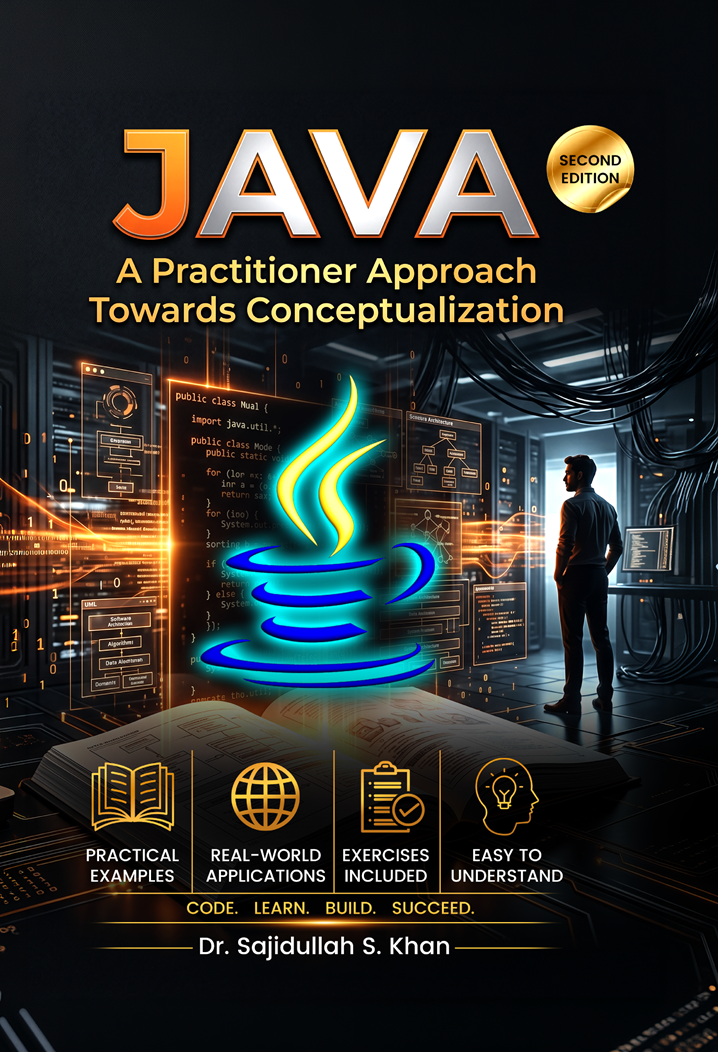
JAVA: A Practitioner Approach Towards Conceptualization
Author: Dr. Sajidullah S. Khan
ISBN: 978-81-69297-27-1
DOI: https://doi.org/10.59646/682
Date of Publication: May 13, 2016
Cite this book: Sajidullah SK, (2026), JAVA: A Practitioner Approach Towards Conceptualization, San International Scientific Publications, ISBN: 978-81-69297-27-1, DOI: https://doi.org/10.59646/682
Preface
In today’s rapidly evolving technological landscape, programming has become an essential skill for students and professionals alike. Among the many programming languages available, Java has established itself as one of the most versatile, reliable, and widely used languages for developing a variety of applications ranging from desktop software to enterprise-level systems. This book, JAVA: A Practitioner Approach Towards Conceptualization, has been written with the objective of providing a clear, structured, and practical understanding of Java programming, enabling readers to build a strong conceptual foundation as well as hands-on expertise.
The book begins with the fundamental concepts of Java, including its history, features, and basic syntax, and gradually progresses towards object-oriented programming principles such as classes, objects, methods, and inheritance. It emphasizes the importance of understanding how real-world problems can be modeled using objects and how effective solutions can be designed using structured programming techniques. The content is carefully organized to ensure a smooth learning curve, making it suitable for both beginners and those looking to strengthen their programming skills.
In addition to core programming concepts, this book covers important topics such as arrays, exception handling, file handling, multithreading, applets, graphical user interface development using AWT and Networking in Java. These topics are essential for building real-world applications and provide readers with a broader understanding of Java’s capabilities. The explanations are supported with examples and practical demonstrations to enhance clarity and comprehension. A distinctive feature of this book is its strong focus on practice-oriented learning. The inclusion of 130 programs along with detailed solutions and mini projects provides readers with ample opportunities to apply their knowledge and develop problem-solving skills. This approach helps bridge the gap between theory and practice, enabling learners to gain confidence in writing and understanding programs independently.
This book is designed to cater to students of various academic programs such as B.Sc., BCA, M.Sc., MCA, B.Tech., and M.Tech., as well as anyone interested in learning Java programming. It aims to serve as both a textbook for academic courses and a reference guide for self-learners. The language used throughout the book is simple and easy to understand, ensuring accessibility for readers from diverse backgrounds.
I sincerely hope that this book will help readers develop a strong foundation in Java programming and inspire them to explore further advancements in the field of software development. Suggestions and feedback from readers are always welcome and will be highly appreciated for improving future editions of this work.