Innovative Approaches in Multidisciplinary Research and Development (IAMRD)
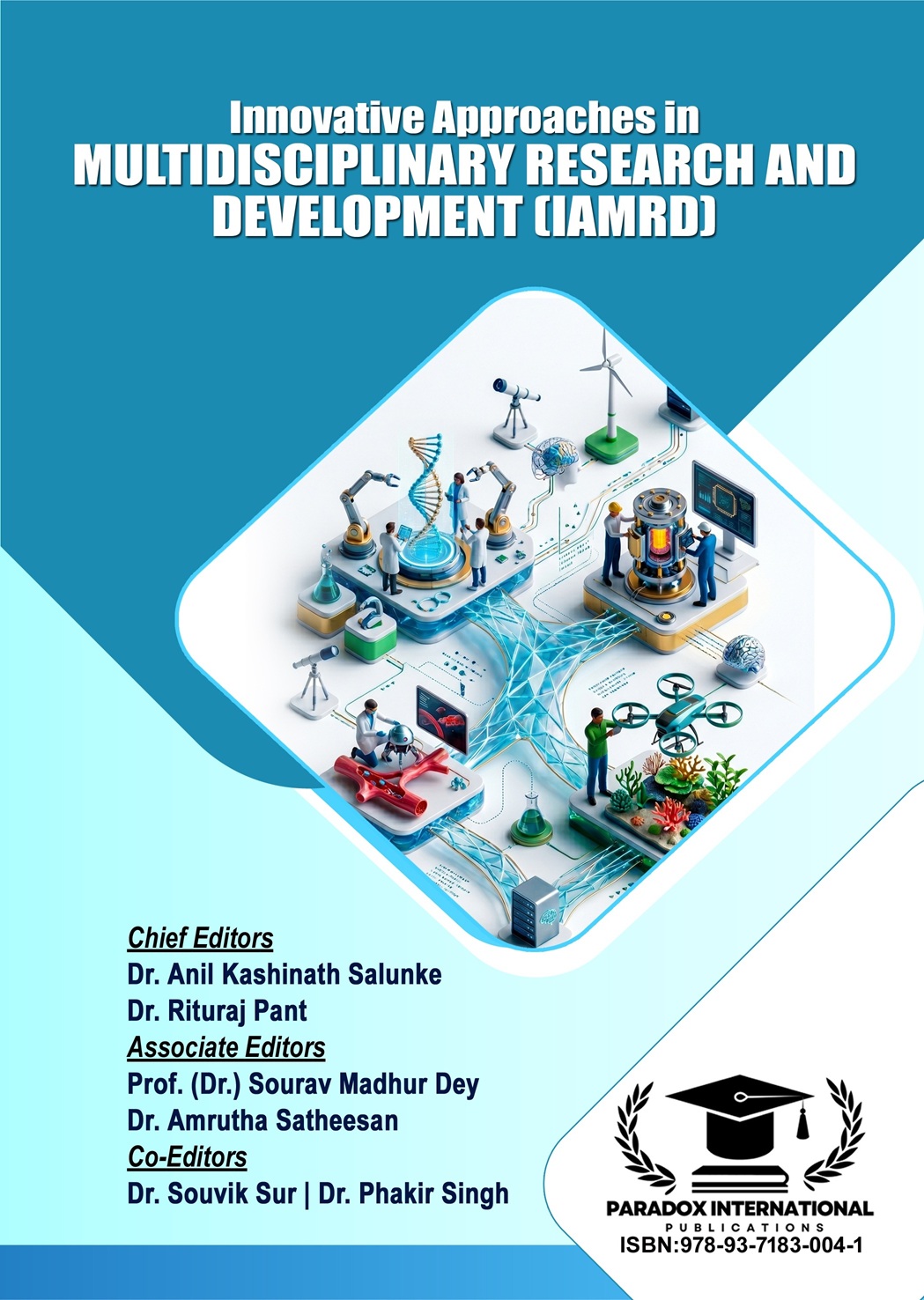
Innovative Approaches in Multidisciplinary Research and Development (IAMRD)
Chief Editors: Dr. Anil Kashinath Salunke and Dr. Rituraj Pant
Associate Editors: Prof. (Dr.) Sourav Madhur Dey and Dr. Amrutha Satheesan
Co-Editors: Dr. Souvik Sur and Dr. Phakir Singh
ISBN: 978-93-7183-004-1
DOI: https://doi.org/10.59646/708
Date of Publication: May 30, 2026
Cite this book: Anil KS and Rituraj P, (2026), Innovative Approaches in Multidisciplinary Research and Development (IAMRD), Paradox International Publications & San International Scientific Publications, ISBN: 978-93-7183-004-1, DOI: https://doi.org/10.59646/708
Chapters and Authors
Chapter 5: Green Economics and AI: Technology for Sustainable Growth – Dr. Jagdish Kumar Sahu
Chapter 10: Strategic Talent Management for The Future of Work – Dr. Jagdish Kumar Sahu
Chapter 14: Sustainable Tourism Development in Post-Pandemic Destinations – Dr. N. Thyagaraju
Chapter 15: Nonlinear Wave Propagation in Inhomogeneous Media – Dr. Santosh Govindrao Bodkhe
Chapter 21: Mapping Memory: Public History and the Politics of Monuments – Dr. Kartika Saharan
Preface
Innovative Approaches in Multidisciplinary Research and Development (IAMRD) emerges as a timely and significant contribution to the expanding landscape of contemporary scholarship, where the boundaries between traditional academic disciplines are increasingly dissolving in favor of collaborative, integrative, and solution-oriented research. In an era characterized by rapid technological advancement, environmental uncertainty, digital transformation, and evolving societal needs, the pursuit of knowledge can no longer remain confined within isolated disciplinary frameworks. Instead, meaningful progress requires the convergence of diverse perspectives, methodologies, and domains of expertise. This edited volume embodies that spirit by bringing together a rich collection of research studies that span environmental sciences, ecology, artificial intelligence, education, business management, economics, technology, healthcare, humanities, conservation biology, tourism, and social sciences. The chapters included in this book collectively demonstrate how multidisciplinary inquiry serves as a catalyst for innovation, enabling researchers to address complex global challenges through holistic understanding and collaborative problem-solving.
The contributions featured in this volume reflect the dynamic nature of modern research and the growing importance of interdisciplinary engagement in generating impactful knowledge. From ecological interpretations of contemporary cinema and studies on wildlife adaptation to investigations into environmental indicators, biodiversity conservation, and sustainable tourism, the book highlights the critical role of environmental awareness in shaping future development strategies. At the same time, several chapters explore the transformative influence of artificial intelligence and digital technologies across diverse sectors, including education, business, economics, marketing, knowledge creation, and decision-making. These studies illustrate how emerging technologies are redefining traditional practices while simultaneously presenting new opportunities and challenges for organizations, educators, policymakers, and communities. A notable strength of this volume lies in its ability to bridge theoretical insights with practical applications. The chapters on green economics, strategic talent management, entrepreneurship, business planning, workplace mental health, corporate governance, and innovation management provide valuable perspectives for academics and practitioners alike. They emphasize the importance of sustainable growth, ethical leadership, organizational resilience, and human-centered approaches in navigating an increasingly competitive and uncertain global environment. Similarly, contributions focusing on digital pedagogy, web-based learning, generative artificial intelligence in curriculum design, and contemporary educational practices demonstrate how technology-enhanced learning environments are transforming educational systems and preparing learners for the future workforce. Equally significant are the contributions from the humanities and social sciences, which offer critical reflections on culture, identity, memory, history, and human behavior. Chapters examining public history, monument politics, femininity in digital spaces, behavioral economics, and societal responses to technological change provide nuanced insights into the complex relationship between individuals, institutions, and evolving socio-cultural realities. By incorporating these perspectives, the book reinforces the understanding that technological and scientific advancements must be accompanied by critical social inquiry to ensure equitable and inclusive development.
The volume also addresses emerging areas of strategic importance, including the metaverse, digital marketing, influencer credibility, crisis management, resource optimization, and complex network systems. These topics illustrate the growing interconnectedness of technological innovation, organizational strategy, and societal transformation. Through rigorous analysis and forward-looking perspectives, the contributors explore how organizations and communities can adapt to disruptive changes while fostering innovation, resilience, and sustainability. What makes this collection particularly valuable is the diversity of its contributors, who represent varied academic backgrounds, research traditions, and professional experiences. Their collective efforts demonstrate that multidisciplinary research is not merely the combination of different fields but the creation of new pathways for understanding and addressing complex issues. Each chapter contributes a unique perspective while collectively advancing the broader objective of promoting innovation-driven research and development. The book serves as a platform for intellectual exchange, encouraging readers to think beyond disciplinary boundaries and embrace collaborative approaches to knowledge generation.
This volume is intended for researchers, academicians, students, policymakers, industry professionals, and practitioners seeking comprehensive insights into contemporary issues and innovative solutions. It aims to inspire future research initiatives, foster interdisciplinary collaboration, and contribute meaningfully to the ongoing discourse on sustainable development, technological advancement, social transformation, and scientific progress. As the world continues to confront multifaceted challenges that demand integrated responses, the studies presented in this book reaffirm the indispensable role of multidisciplinary research in shaping a more informed, innovative, and sustainable future.
We express our sincere appreciation to all authors for their scholarly contributions, dedication, and commitment to advancing knowledge through rigorous research. Their work has enriched this volume and strengthened its multidisciplinary foundation. It is our hope that Innovative Approaches in Multidisciplinary Research and Development (IAMRD) will serve as a valuable academic resource, stimulate meaningful dialogue across disciplines, and inspire future generations of researchers to pursue innovative pathways that transcend conventional academic boundaries in the quest for knowledge, discovery, and societal progress.