Indian Knowledge System in Context of Chemistry and Mathematics
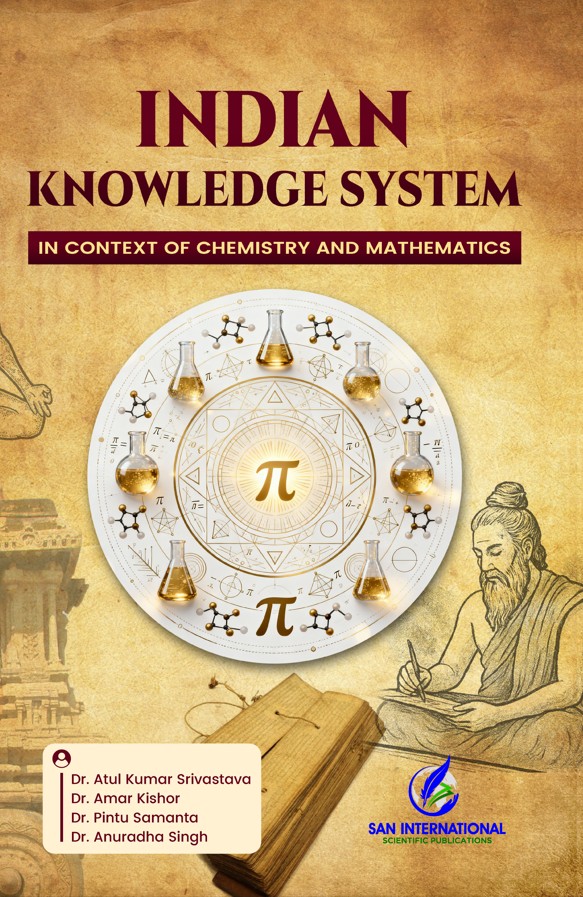
Indian Knowledge System in Context of Chemistry and Mathematics
Authors: Dr. Atul Kumar Srivastava, Dr. Amar Kishor, Dr. Pintu Samanta and Dr. Anuradha Singh
ISBN: 978-81-993993-8-9
DOI: https://doi.org/10.59646/485
Date of Publication:September 30, 2025
About the Book:
The Indian Knowledge System (IKS) is a treasure trove of intellectual, scientific, philosophical, and cultural insights that have evolved over thousands of years. At its heart, IKS represents a vision of knowledge that transcends the boundaries of modern disciplinary divisions. Rather than compartmentalizing knowledge into isolated fields, IKS emphasizes the interconnectedness of all intellectual domains, where philosophy, science, mathematics, and spirituality mutually reinforce one another. This integrated approach has shaped India’s rich intellectual heritage and continues to offer profound insights into how we can approach learning, inquiry, and knowledge application in the modern world.
Indian Knowledge System in Context of Chemistry and Mathematics seeks to explore this interconnectedness by delving deeply into the roles that chemistry and mathematics play within IKS. This book is both an exploration and an invitation to rethink how ancient Indian knowledge can inform contemporary scientific understanding. By examining the foundational principles of IKS, its contributions to chemistry and mathematics, and the holistic approach embedded in these traditions, this book highlights the enduring relevance of IKS in today’s scientific landscape.
The first section of the book focuses on the core foundations of IKS, looking at the essential sources of knowledge such as the Vedas, Upanishads, Ayurveda, Arthaśāstra, and other key texts. These texts provide a framework for understanding the world around us, blending empirical observation with metaphysical exploration. The concept of knowledge in IKS is not a mere accumulation of facts but a holistic system that integrates logical reasoning with ethical and philosophical reflection. The book also explores how this system of knowledge influenced education in ancient India, where learning was experiential, interdisciplinary, and rooted in both intellectual rigor and ethical responsibility.
The second part of the book delves into the application of IKS to chemistry, focusing on alchemical practices and early chemical knowledge. The principles of Rasa Shastra and the advanced metallurgical techniques of ancient India are discussed in depth, showcasing the remarkable understanding of materials such as iron, zinc, and gold. Central to these practices is the belief in the interconnectedness of the elements—earth, water, fire, air, and ether—and their influence on chemical processes. This section also explores the contributions of Indian material science, from Wootz steel to dyeing techniques, cosmetics, and glass-making, demonstrating how IKS bridged theoretical knowledge with practical application.
The third section turns its attention to the field of mathematics, where India made revolutionary contributions that continue to influence the world today. The invention of zero, the development of the decimal system, and the sophisticated rules for arithmetic and geometry are just some of the key mathematical innovations that have shaped both Indian and global thought. The work of mathematicians such as Aryabhata, Brahmagupta, Bhaskara II, and Srinivasa Ramanujan is explored, with a focus on their contributions to trigonometry, algebra, and calculus. These ideas were not confined to abstract theory; they were applied in astronomy, architecture, music, and engineering, demonstrating the profound practical utility of mathematics in the Indian context.
The final section of the book examines the integration of chemistry and mathematics within IKS. The precise mathematical measurements used in metallurgy and Ayurvedic formulations show how these two fields were deeply interconnected. Moreover, astrology, which was an integral part of ancient Indian thought, influenced both chemical processes and material selection, reinforcing the holistic nature of Indian knowledge. This section also looks at how the principles of IKS can inform modern education and research, offering opportunities to bridge ancient wisdom with contemporary scientific methodologies.
Ultimately, this book aims to not only highlight the contributions of IKS to chemistry and mathematics but also to offer a vision for integrating these ancient practices into modern education and research. The interdisciplinary and holistic nature of IKS presents valuable lessons for addressing today’s global challenges, fostering innovation, and encouraging a deeper appreciation for the interconnectedness of all forms of knowledge. By examining these connections, we hope to inspire a renewed interest in IKS, fostering an intellectual environment where ancient wisdom and modern science can coexist, complement, and enrich one another.