
History of Western Civilization
History of Western Civilization
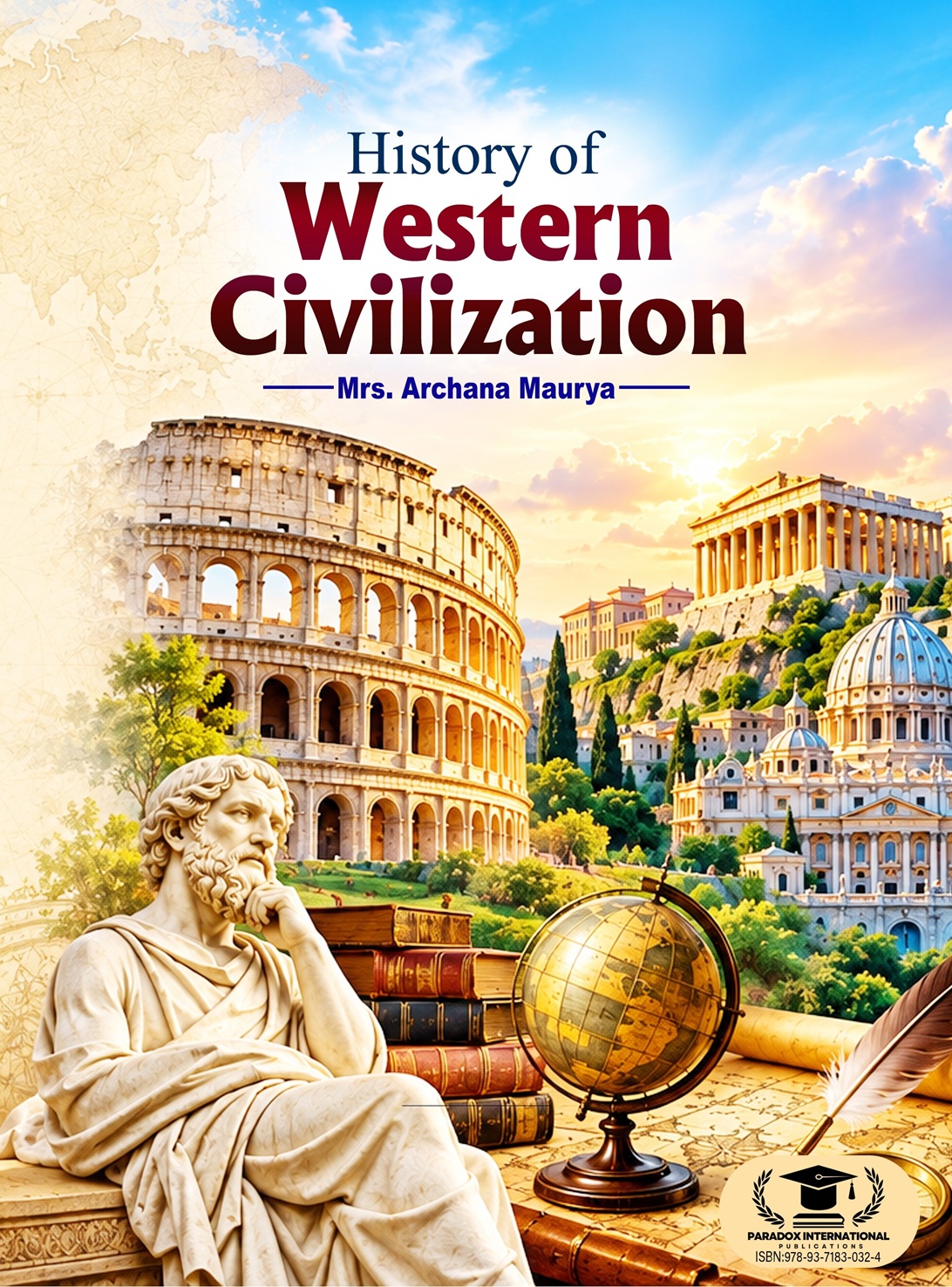
Author: Mrs. Archana Maurya
ISBN: 978-93-7183-032-4
DOI: https://doi.org/10.59646/845
Date of Publication:September 01, 2026
Preface
The history of Western civilization is a remarkable story of human creativity, intellectual inquiry, political transformation, social change, cultural interaction, and technological advancement. From the civilizations of ancient Greece and Rome to the Renaissance, the Reformation, the Enlightenment, the Industrial Revolution, and the modern global era, Western history represents a complex and evolving journey shaped by ideas, institutions, conflicts, discoveries, and encounters among diverse peoples. Studying this history provides valuable insights into the foundations of many political, economic, social, philosophical, scientific, and cultural institutions that continue to influence the contemporary world.
The textbook History of Western Civilization has been prepared to provide students and readers with a systematic understanding of the major developments that shaped Western civilization. Rather than presenting history merely as a chronological sequence of events, the book seeks to examine the relationships between political power, economic structures, social institutions, intellectual movements, religion, art, science, and technological change. Such an approach enables learners to understand not only what happened in the past, but also why historical transformations occurred and how their consequences continue to shape the present.
The book begins with the foundations of Western civilization in the ancient world. It examines the contributions of ancient Mesopotamia, Egypt, Greece, and Rome, with particular attention to the development of political institutions, philosophy, law, literature, art, and scientific thought. The transition from the ancient world to the medieval period is then explored through the rise of Christianity, the development of European kingdoms, feudalism, the Byzantine world, and the intellectual and cultural contributions of medieval society.
Subsequent sections examine the Renaissance and the Reformation, two transformative movements that profoundly influenced European intellectual, religious, artistic, and political life. The emergence of humanism, the revival of classical learning, the Protestant Reformation, and the Catholic response are considered within their broader historical contexts. The book further explores the Scientific Revolution and the Enlightenment, highlighting the development of rational inquiry, scientific thinking, individual liberty, political philosophy, and new conceptions of society and government.
The transition to the modern world is examined through the major political and economic revolutions of the eighteenth and nineteenth centuries. The American and French Revolutions, the Industrial Revolution, nationalism, liberalism, socialism, imperialism, and the growth of modern nation-states are discussed as interconnected developments. These transformations altered patterns of production, social organization, political authority, urbanization, and international relations.
The twentieth century introduced further profound changes through the two World Wars, the Russian Revolution, fascism, Nazism, the Holocaust, the rise of the United States and the Soviet Union, the Cold War, European integration, decolonization, and the emergence of a more interconnected global society. The book also considers developments in science, technology, mass communication, popular culture, and social movements that contributed to the formation of contemporary Western societies.
An important objective of this textbook is to encourage students to approach history critically. Historical events can rarely be understood from a single perspective. Political decisions, economic interests, cultural values, religious beliefs, social inequalities, technological developments, and individual choices frequently interact in shaping historical outcomes. Therefore, the study of Western civilization requires an appreciation of multiple perspectives and an awareness of both achievements and contradictions within historical processes.
The textbook also recognizes that Western civilization did not develop in isolation. Its history was continuously influenced by interactions with civilizations and societies across Asia, Africa, the Middle East, and the Americas. Trade, migration, intellectual exchange, warfare, colonialism, cultural diffusion, and technological transfer connected Western societies with the wider world. Understanding these interactions is essential for developing a balanced and historically informed understanding of Western civilization.
Particular attention is also given to the experiences of ordinary people and groups whose contributions have sometimes received limited attention in traditional historical narratives. The experiences of women, workers, minorities, religious communities, migrants, and marginalized populations provide important perspectives on social change, inequality, resistance, and cultural transformation. This broader approach helps students recognize history as a multidimensional human experience rather than simply a record of political leaders and major events.
The textbook is intended for undergraduate and postgraduate students, teachers, researchers, and readers interested in history, political science, sociology, literature, philosophy, international relations, and related disciplines. The content has been organized in a manner that facilitates classroom teaching, independent study, academic discussion, and further research. Important concepts, historical developments, movements, personalities, and institutions are presented in a structured manner to support effective learning.
The study of history ultimately encourages us to reflect on the relationship between the past and the present. Many contemporary debates concerning democracy, human rights, nationalism, economic inequality, technological change, social justice, cultural identity, and international cooperation have historical roots. By understanding these roots, students can develop a more informed perspective on the challenges and opportunities of the modern world.
It is hoped that History of Western Civilization will not merely provide knowledge of historical events but will stimulate curiosity, critical thinking, historical awareness, and intellectual engagement. The past is not simply a collection of events that have already ended; it is an essential source for understanding the institutions, ideas, identities, and challenges of the present. A thoughtful study of Western civilization can therefore contribute to a deeper appreciation of human diversity, historical change, and the continuing quest for a more informed and just society.