Green Technologies for Sustainable Development
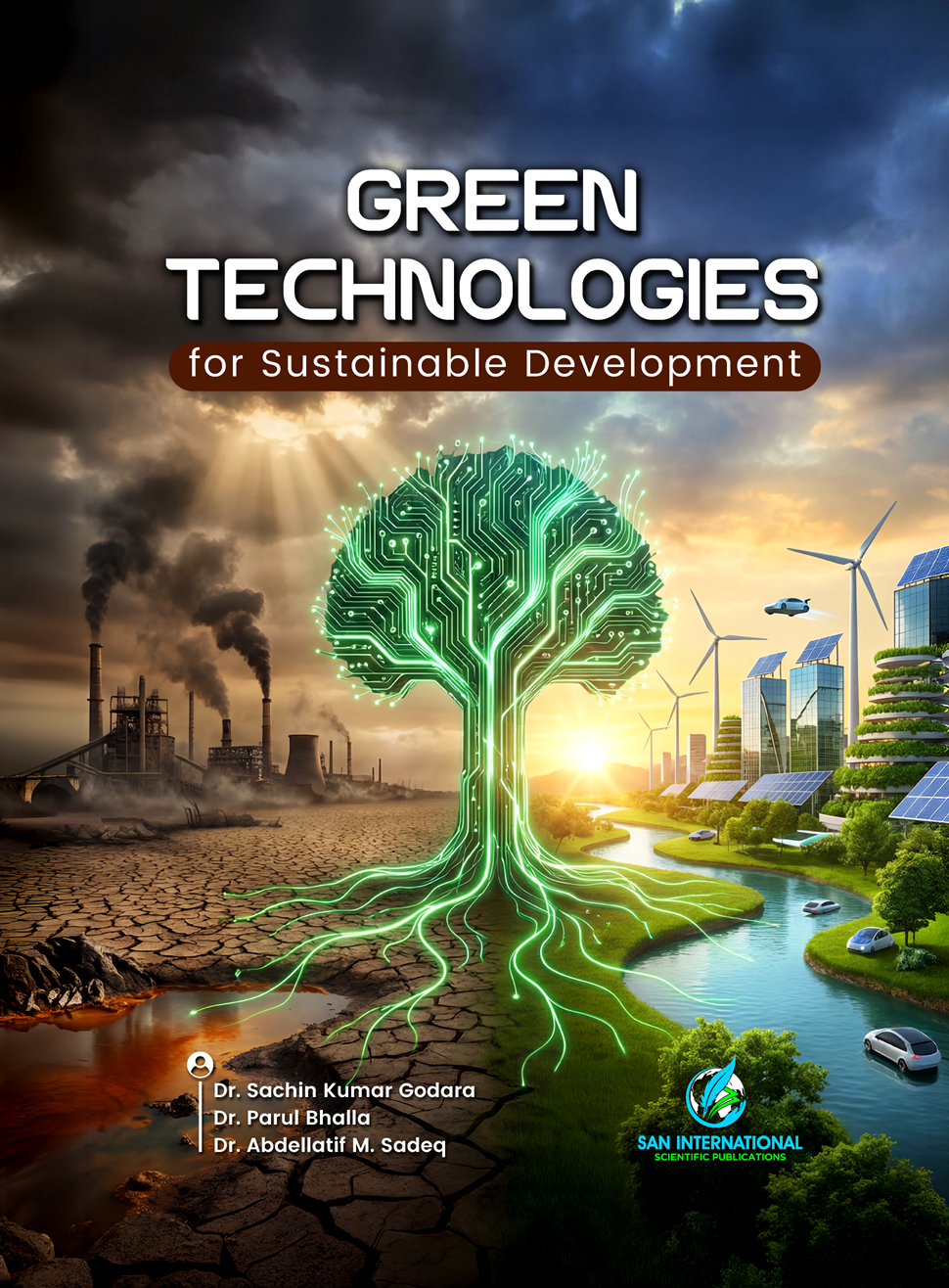
Green Technologies for Sustainable Development
Authors: Dr. Sachin Kumar Godara, Dr. Parul Bhalla, and Dr. Abdellatif M. Sadeq
ISBN: 978-81-69297-49-3
DOI: https://doi.org/10.59646/644
Date of Publication: March 27, 2026
Cite this book: Sachin KG, Parul B, and Abdellatif MS, (2026), Green Technologies for Sustainable Development, San International Scientific Publications, ISBN: 978-81-69297-49-3, DOI: https://doi.org/10.59646/644
Preface
The book Green Technologies for Sustainable Development is designed as an extensive, interdisciplinary, and forward-thinking resource that addresses one of the most critical imperatives of the 21st century—achieving sustainable development through technological innovation and responsible resource management. In an era marked by escalating climate change, environmental degradation, rapid industrialization, and widening socio-economic disparities, this book seeks to provide a holistic understanding of how green technologies can serve as transformative tools to balance environmental protection, economic growth, and social well-being. Beginning with the foundational principles of sustainability, the text explores the evolution of green technologies and their role in shaping resilient systems, while emphasizing the interconnectedness of environmental, economic, and social dimensions. It delves deeply into global sustainability challenges such as resource scarcity, ecosystem stress, pollution, and climate risks, and aligns these concerns with international frameworks like the Sustainable Development Goals.
The book further examines critical methodologies including life-cycle thinking, environmental impact assessment, and systems approaches, enabling readers to evaluate technologies from a comprehensive sustainability perspective. Expanding into applied domains, it provides detailed coverage of renewable energy technologies, energy efficiency strategies, smart grids, sustainable transportation systems, green materials, and advanced manufacturing processes, alongside water and wastewater treatment innovations and modern waste management practices grounded in circular economy principles. Additionally, it highlights sustainable infrastructure development, green building technologies, and environmental risk management strategies, offering insights into both technological solutions and policy frameworks. Recognizing the importance of emerging trends, the text also explores cutting-edge advancements such as artificial intelligence, IoT-enabled systems, hydrogen energy, digital twins, and bio-inspired technologies, illustrating their potential to accelerate sustainability transitions. Structured into comprehensive thematic units that progressively build knowledge from fundamental concepts to advanced applications , this book aims to equip students, researchers, engineers, policymakers, and industry professionals with the analytical tools, practical knowledge, and innovative mindset required to design and implement sustainable solutions. Ultimately, it aspires to inspire a paradigm shift toward a regenerative, low-carbon, and inclusive future, where technology not only minimizes environmental impact but actively contributes to the restoration and long-term health of our planet and society.