
Geospatial Sentiment Mapping for Hyperlocal Brand Engagement: Proposing the Geo-Behavioral Engagement Index (GBEI)
Geospatial Sentiment Mapping for Hyperlocal Brand Engagement: Proposing the Geo-Behavioral Engagement Index (GBEI)
Authors: Dr. Anitha Kumari. B, Dr. Vimaladevi M, and Dr. Vidhya B
ISBN: 978-81-69857-71-0
DOI: https://doi.org/10.59646/828
Date of Publication: September 21, 2026
Preface
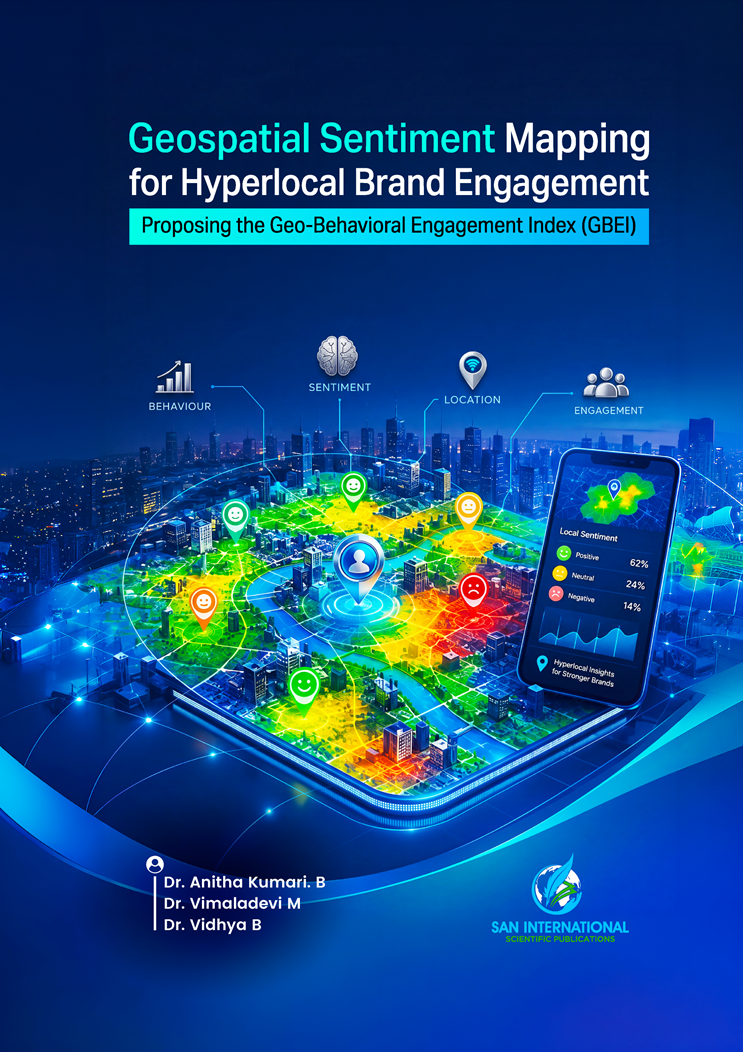
The rapid convergence of artificial intelligence, geospatial technologies, digital platforms, and behavioural analytics is transforming the way organizations understand consumers and engage with brands. Traditional marketing intelligence has increasingly moved beyond demographic and transactional analysis toward real-time, location-sensitive, emotionally informed, and predictive approaches. In this evolving digital ecosystem, understanding where consumers are, how they behave, what they feel, and how they interact with brands has become essential for developing effective hyperlocal engagement strategies. The present book, Geospatial Sentiment Mapping for Hyperlocal Brand Engagement: Proposing the Geo-Behavioral Engagement Index (GBEI), addresses this emerging interdisciplinary domain by integrating geospatial analytics, artificial intelligence, sentiment intelligence, consumer behaviour, and advanced marketing analytics into a unified research-oriented framework.
The book begins by establishing the conceptual foundations of geo-behavioral marketing. It traces the evolution of marketing intelligence from Marketing 1.0 to contemporary AI-enabled marketing, while examining the growth of hyperlocal commerce, changing consumer behaviour, and the expanding digital ecosystem. The subsequent discussions introduce behavioural intelligence through the perspectives of consumer psychology, behavioural economics, decision science, emotional intelligence, and AI-driven behaviour prediction. The fundamentals of Geographic Information Systems (GIS), location intelligence, heat maps, consumer movement analytics, spatial clustering, and geo-fencing further establish the technological foundation required for understanding the spatial dimensions of consumer engagement.
A major focus of the book is the application of artificial intelligence to hyperlocal consumer analytics. Machine learning, deep learning, recommendation systems, predictive analytics, explainable AI, natural language processing, emotion detection, voice analytics, image sentiment, and multimodal sentiment analysis are explored as important mechanisms for transforming heterogeneous consumer data into actionable intelligence. The discussion of social listening further expands this perspective by incorporating digital footprints, customer reviews, online communities, influencer analytics, and real-time feedback systems. Together, these components demonstrate how consumer sentiment and behaviour can be interpreted within specific geographical and commercial contexts.
An important contribution of this book is its emphasis on original conceptual and analytical frameworks. The proposed Geo-Behavioral Engagement Index (GBEI) provides a structured approach for integrating spatial, behavioural, emotional, social, and engagement-related variables into a measurable index. Alongside GBEI, the book introduces the Hyperlocal Brand Resonance Model, Consumer Emotional Density Score (CEDS), and Dynamic Consumer Interaction Quotient (DCIQ) as complementary frameworks for examining brand visibility, emotional affinity, location influence, social trust, purchase intention, loyalty, consumer emotions, interaction frequency, AI engagement, voice commerce, and immersive digital interactions. These frameworks are intended to provide researchers and practitioners with new avenues for conceptualization, measurement, validation, and empirical investigation.
The book also examines the role of emerging technologies in shaping the future of geo-behavioral intelligence, with particular attention to smart retail, Internet of Things (IoT), digital twins, edge AI, retail sensors, smart stores, metaverse commerce, spatial commerce, voice commerce, conversational AI, and AI shopping agents. The practical relevance of these technologies is demonstrated through applications across healthcare, tourism, education, smart cities, and financial services, illustrating how geospatial sentiment intelligence can support context-specific decision-making and hyperlocal brand engagement.
The final part of the book adopts a strong research and analytics orientation by addressing scale development, questionnaire design, pilot studies, reliability, validity, structural equation modelling, machine learning, spatial regression, cluster analysis, and predictive modelling. Ethical and responsible use of geo-behavioral data is given equal importance through discussions of consumer privacy, GDPR, AI ethics, and responsible AI. The book concludes by examining future directions including autonomous marketing, agentic AI, digital humans, predictive consumer ecosystems, and emerging research opportunities.
Overall, this book is intended to serve as a valuable academic and professional resource for researchers, faculty members, students, marketing professionals, data scientists, business strategists, technology practitioners, and policymakers interested in the intersection of geospatial intelligence, artificial intelligence, consumer behaviour, sentiment analytics, and hyperlocal marketing. By combining established knowledge with proposed measurement frameworks and future-oriented applications, the book seeks to contribute to the development of a more intelligent, spatially aware, emotionally responsive, and responsible approach to consumer-brand engagement.