
Fundamentals of Neural Networks
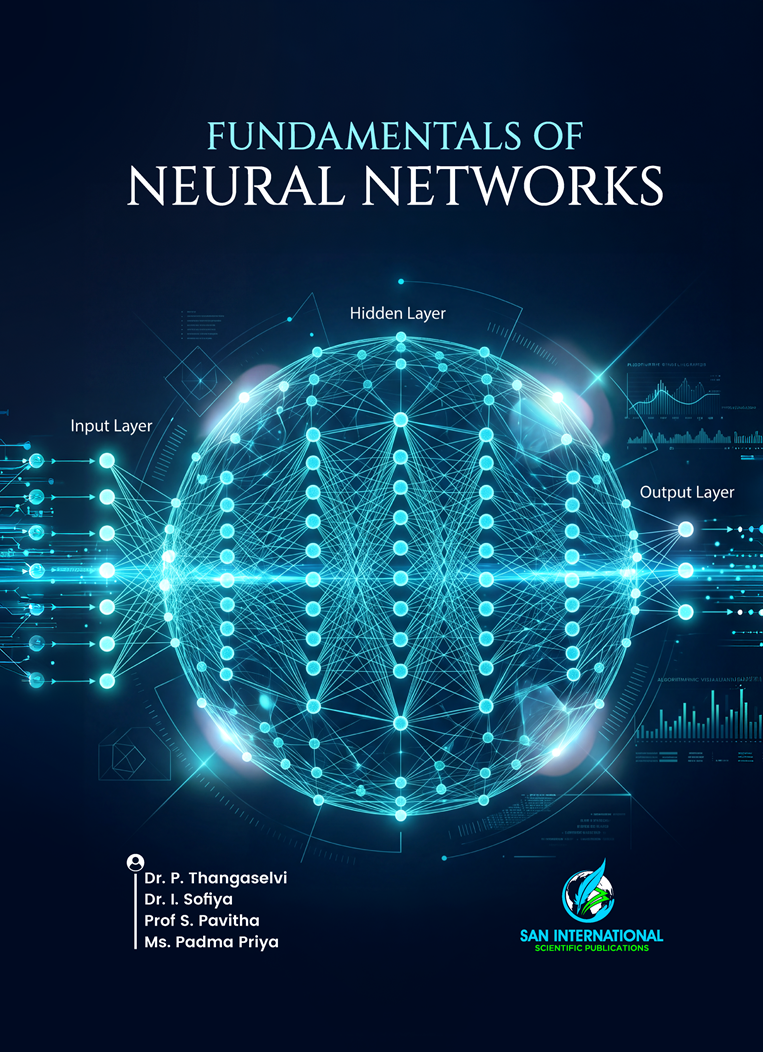
Fundamentals of Neural Networks
Authors: Dr. P. Thangaselvi, Dr. I. Sofiya, Prof. S. Pavitha, and Ms. Padma Priya
ISBN: 978-81-69297-79-0
DOI: https://doi.org/10.59646/739
Date of Publication: June 26, 2026
Cite this book: P. Thangaselvi, I. Sofiya, S. Pavitha, and P. Priya, (2026), Fundamentals of Neural Networks, San International Scientific Publications, ISBN: 978-81-69297-79-0, DOI: https://doi.org/10.59646/739
Preface
This book is designed as a comprehensive journey through artificial neural networks — the engine of modern artificial intelligence. Whether you are a student approaching the subject for the first time or a practitioner seeking to deepen your theoretical foundations, the sixteen chapters that follow will guide you from the historical origins of the field through cutting-edge architectures and the ethical challenges that shape the future of AI.
The text balances intuition with rigor. Each concept is introduced with motivating examples and explained with the mathematical precision necessary for genuine understanding. Key terms are defined in glossary tables at the close of each chapter. Callout boxes highlight critical insights and common pitfalls.
The chapters are ordered for progressive learning. We begin with the intellectual history and biological inspiration, establish the mathematical toolkit, build understanding of individual neurons and small networks, then scale progressively to the deep architectures powering today’s most capable AI systems. The final chapters address real-world application and the ethical responsibilities that accompany this powerful technology.
How to Use This Book:
Readers with strong mathematical backgrounds may move quickly through Chapters 4 and 5, focusing attention on the novel architectural concepts in Chapters 7 onwards. Readers new to the subject are encouraged to work through all chapters in order, pausing at the key-term tables to consolidate vocabulary before proceeding.
Supplementary exercises, code examples, and datasets are available through the companion website. Implementing the algorithms described here — even in simplified toy examples — is the single most effective way to develop genuine understanding.