
Foundations of Machine Learning & Intelligent Systems
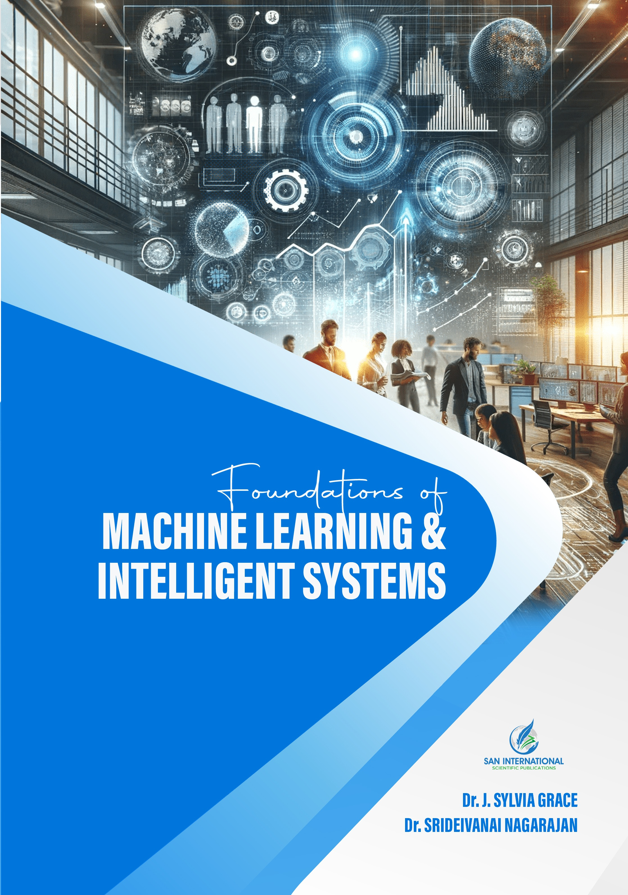
Foundations of Machine Learning & Intelligent Systems
Authors: Dr. J. Sylvia Grace and Dr. Srideivanai Nagarajan
ISBN: 978-81-988877-3-3
DOI: https://doi.org/10.59646/ml/394
Date of Publication: June 17, 2025
About the Book:
This book, Foundations of Machine Learning & Intelligent Systems, is a comprehensive guide designed to introduce readers to the core principles, algorithms, and applications of machine learning in a structured and systematic manner. It begins with an in-depth introduction to key concepts such as classification, regression, clustering, reinforcement learning, and the various forms of learning, including supervised, unsupervised, and reinforcement paradigms. The book explores essential theoretical aspects like the bias-variance tradeoff, overfitting vs. underfitting, evaluation metrics, and the growing field of self-supervised learning and Explainable AI (XAI). Subsequent chapters delve into supervised learning models, covering regression techniques, decision trees, ensemble methods, support vector machines, and neural networks including perceptrons, multi-layer architectures, and backpropagation. Unsupervised learning methods are detailed through clustering algorithms, dimensionality reduction techniques like PCA and ICA, and representation learning strategies. The section on probabilistic graphical models and structured prediction provides insights into Bayesian networks, Markov chains, HMMs, and graph-based models like CRFs and GNNs, with applications in NLP and structured inference. The final unit introduces reinforcement learning frameworks including value-based and policy-based methods, actor-critic algorithms, and model-based approaches, while also discussing cutting-edge topics such as quantum machine learning, edge computing, ethical AI, bias mitigation, and the pursuit of Artificial General Intelligence (AGI). This book is intended for students, researchers, and professionals who seek a strong theoretical foundation along with exposure to practical and emerging trends in intelligent systems. It aims to empower readers to build robust, interpretable, and forward-looking machine learning solutions in the evolving landscape of Industry 5.0. Furthermore, the book incorporates intuitive explanations supported by mathematical formulations and algorithmic procedures to aid in deep comprehension. Each chapter progresses logically from basic to advanced topics, enabling readers to build conceptual clarity and analytical skills step by step. Real-world examples and application contexts have been integrated to illustrate how theoretical models translate into industry use cases. Special emphasis is placed on the interpretability and ethical implications of AI systems, fostering a responsible and human-centric view of technology. The book also highlights the convergence of ML with other domains such as quantum computing, edge AI, and cognitive architectures. Readers will gain insights into the design of self-learning systems that adapt and evolve with minimal human intervention. Through this interdisciplinary lens, the book nurtures a futuristic outlook toward machine learning, preparing learners for the challenges and innovations of the next digital revolution. With its comprehensive coverage and contemporary relevance, this book serves as both a foundational textbook and a reference manual for academic, research, and industry applications in machine learning and intelligent systems.