
Foundations of Financial Technology: Systems, Markets, and Innovation
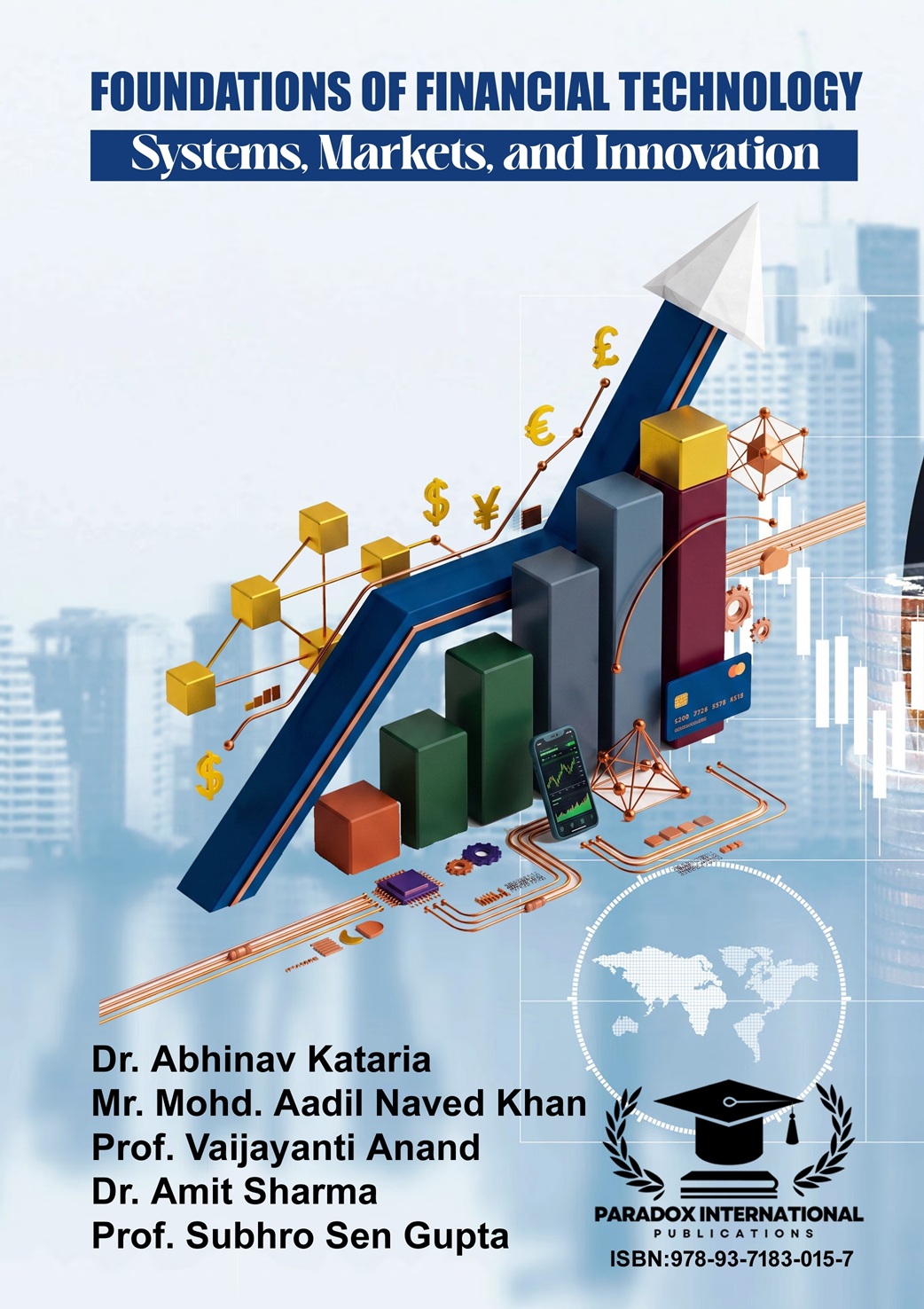
Foundations of Financial Technology: Systems, Markets, and Innovation
Authors: Dr. Abhinav Kataria, Mr. Mohd. Aadil Naved Khan, Prof. Vaijayanti Anand, Dr. Amit Sharma, and Prof. Subhro Sen Gupta
ISBN: 978-93-7183-015-7
DOI: https://doi.org/10.59646/769
Date of Publication: July 17, 2026
Cite this book: Abhinav K, Mohd. ANK, Vaijayanti A, Amit S, and Subhro SG, (2026), Foundations of Financial Technology: Systems, Markets, and Innovation, Paradox International Publications & San International Scientific Publications, ISBN: 978-93-7183-015-7, DOI: https://doi.org/10.59646/769
Preface
The financial services industry is undergoing one of the most profound transformations in its history. Rapid advancements in digital technologies have fundamentally altered how financial products are designed, delivered, and consumed. Financial Technology, commonly known as FinTech, has emerged as a dynamic field that integrates finance, information technology, data analytics, artificial intelligence, blockchain, and digital innovation to create efficient, secure, and customer-centric financial solutions. From mobile banking and digital payments to decentralized finance and intelligent investment platforms, FinTech has become a driving force behind the modernization of global financial systems.
Foundations of Financial Technology: Systems, Markets, and Innovation has been developed to provide students, researchers, educators, and professionals with a comprehensive understanding of the principles, technologies, and applications that define the FinTech ecosystem. The textbook bridges the gap between traditional financial concepts and emerging digital innovations, enabling readers to appreciate both the theoretical foundations and the practical implications of technology-driven financial transformation.
The primary objective of this book is to present FinTech as a multidisciplinary field that combines economics, finance, computer science, information systems, business analytics, cybersecurity, and regulatory frameworks. The content has been carefully organized to build knowledge progressively, beginning with the evolution of financial systems and digital finance before advancing to contemporary topics such as blockchain technology, cryptocurrencies, digital banking, artificial intelligence, machine learning, open banking, cybersecurity, regulatory technology, and sustainable financial innovation.
The textbook is divided into five comprehensive units, each focusing on a critical dimension of Financial Technology. The first unit introduces readers to the foundations of FinTech, financial systems, digital ecosystems, and enabling technologies. The second unit explores digital banking, electronic payment systems, financial infrastructure, and the evolution of customer-centric banking services. The third unit examines innovations such as blockchain, cryptocurrencies, decentralized finance, crowdfunding, wealth technology, insurance technology, and regulatory technology. The fourth unit focuses on artificial intelligence, machine learning, big data analytics, cybersecurity, fraud detection, and digital risk management in financial institutions. The final unit discusses financial regulations, ethical issues, sustainability, entrepreneurial innovation, global FinTech developments, and future trends shaping the financial industry.
Special emphasis has been placed on the role of emerging technologies in promoting financial inclusion, operational efficiency, transparency, and customer empowerment. The book also highlights how governments, central banks, regulatory agencies, startups, and established financial institutions are collaborating to create resilient and inclusive financial ecosystems. Contemporary themes such as embedded finance, central bank digital currencies (CBDCs), digital identity, cloud computing, application programming interfaces (APIs), and intelligent automation are integrated throughout the text to ensure relevance to today’s rapidly evolving financial landscape.
In addition to conceptual explanations, the book encourages analytical thinking by incorporating real-world examples, industry case studies, discussion questions, practical applications, and emerging global trends. Readers are encouraged to critically evaluate both the opportunities and challenges associated with technological disruption in financial services, including cybersecurity threats, data privacy concerns, ethical considerations, regulatory compliance, and responsible innovation.
The textbook has been designed in accordance with the curriculum requirements of undergraduate and postgraduate programmes in Commerce, Management, Finance, Banking, Business Administration, Economics, Information Technology, Computer Applications, and Financial Engineering. It also serves as a valuable reference for researchers, policymakers, banking professionals, financial analysts, entrepreneurs, technology developers, and anyone interested in understanding the digital transformation of finance.
As financial technologies continue to evolve at an unprecedented pace, lifelong learning and continuous innovation have become essential for academic and professional success. It is our sincere hope that this textbook will equip readers with the knowledge, analytical skills, and strategic perspectives necessary to understand the changing financial landscape and contribute meaningfully to the future of digital finance. By integrating theoretical foundations with practical insights and contemporary developments, this book aims to inspire innovation, responsible leadership, and sustainable growth within the global financial ecosystem.
We express our sincere gratitude to academic colleagues, researchers, industry experts, reviewers, students, and practitioners whose scholarly contributions and practical experiences have influenced the development of this textbook. We also acknowledge the invaluable work of financial institutions, technology innovators, regulatory authorities, and international organizations whose ongoing efforts continue to shape the future of Financial Technology.
We hope that Foundations of Financial Technology: Systems, Markets, and Innovation will serve as a reliable academic resource and an enduring guide for learners and professionals seeking to understand, innovate, and lead in the rapidly evolving world of FinTech.