
Foundations of AI and Machine Learning: Mathematical Models and Computational Methods
Foundations of AI and Machine Learning: Mathematical Models and Computational Methods
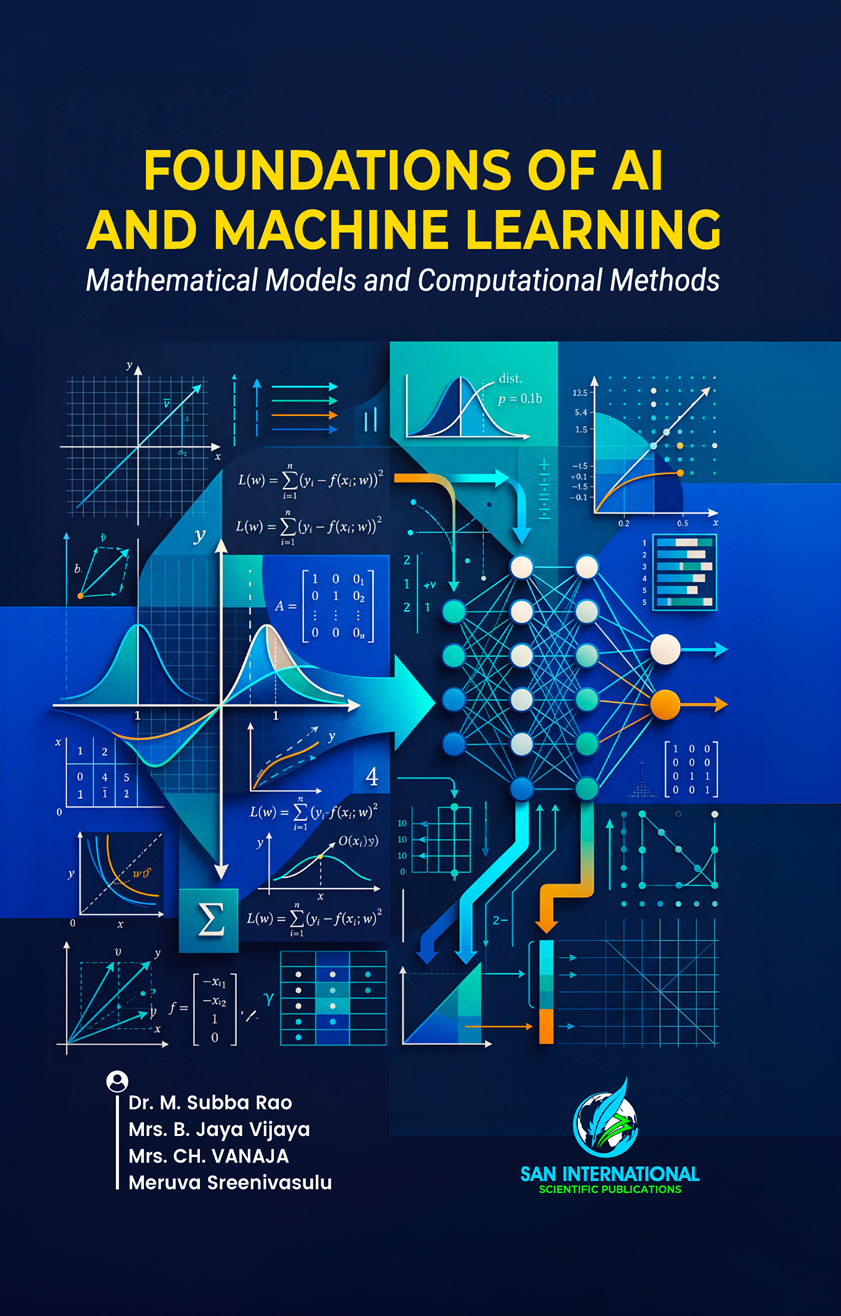
Authors: Dr. M. Subba Rao, Bandi Jaya Vijaya, Chalamcharla Vanaja, Meruva Sreenivasulu
ISBN: 978-81-69857-70-3
DOI: https://doi.org/10.59646/822
Date of Publication: September 28, 2026
Preface
Artificial Intelligence (AI) and Machine Learning (ML) have evolved from algorithmic disciplines into computational sciences that increasingly depend on mathematical modelling, numerical optimization, efficient computation, and rigorous uncertainty analysis. The rapid growth of large-scale learning systems, generative models, distributed intelligence, edge computing, and emerging quantum and neuromorphic paradigms has created a need for deeper understanding of the computational principles underlying modern AI. Foundations of AI and Machine Learning: Mathematical Models and Computational Methods has been developed to provide a systematic treatment of these principles, moving beyond introductory algorithms toward the mathematical structures and computational techniques that support contemporary intelligent systems. The book begins with optimization as a fundamental computational mechanism in machine learning. It examines first- and second-order optimization, coordinate and proximal methods, stochastic and mini-batch optimization, adaptive algorithms, Lagrangian formulations, Karush–Kuhn–Tucker conditions, and convex and non-convex optimization landscapes. These concepts establish the mathematical basis for understanding how learning problems are formulated and solved efficiently. The subsequent discussion of representation learning introduces manifold-based representations, kernel methods, metric learning, sparse coding, dictionary learning, tensor decomposition, and graph-based representations, thereby connecting mathematical structures with computational models capable of extracting meaningful patterns from complex data.
A major focus of the book is computational scalability. Large-scale AI requires algorithms that operate effectively under constraints involving time, memory, communication, and numerical precision. Accordingly, the book addresses parallel and distributed computation, CUDA-oriented principles, randomized algorithms, random projections, computational sketching, memory-efficient model execution, mixed-precision computation, quantization-aware methods, and resource-constrained edge intelligence. These topics provide a computational perspective on the challenges associated with deploying increasingly complex AI models across heterogeneous hardware and distributed environments. The book further explores computational methods associated with next-generation AI. Differentiable programming, differentiable optimization, symbolic–numeric computation, neuro-symbolic frameworks, quantum computational methods, neuromorphic principles, hybrid classical–quantum architectures, and efficient computation for large-scale generative models are examined as emerging directions in computational intelligence. Autonomous computational pipelines are also considered in the context of reproducible and scalable AI research. These discussions are complemented by advanced optimization architectures involving bilevel and multilevel optimization, multi-objective optimization, evolutionary search, surrogate-assisted optimization, derivative-free methods, continual parameter optimization, and distributed asynchronous optimization.
The final unit addresses uncertainty and reliability, which are essential when AI systems are applied to scientific, engineering, and other high-consequence computational settings. The book discusses aleatoric and epistemic uncertainty, uncertainty propagation, sensitivity analysis, robust optimization, out-of-distribution detection, risk-sensitive modelling, and uncertainty-aware scientific computation. By bringing together optimization, representation learning, scalable computation, emerging computational architectures, adaptive optimization, and uncertainty quantification, this book presents AI and ML as mathematical and computational disciplines rather than merely collections of algorithms.
The material is intended for postgraduate students, researchers, academicians, engineers, and practitioners seeking a deeper understanding of the mathematical and computational mechanisms behind modern AI and ML systems. It can also serve as a reference for researchers developing computationally efficient learning algorithms and intelligent systems. The organization of the book is designed to encourage progression from foundational optimization principles toward scalable, adaptive, emerging, and uncertainty-aware computational methodologies.