Entrepreneurial Skills & Pesticides in Chemistry
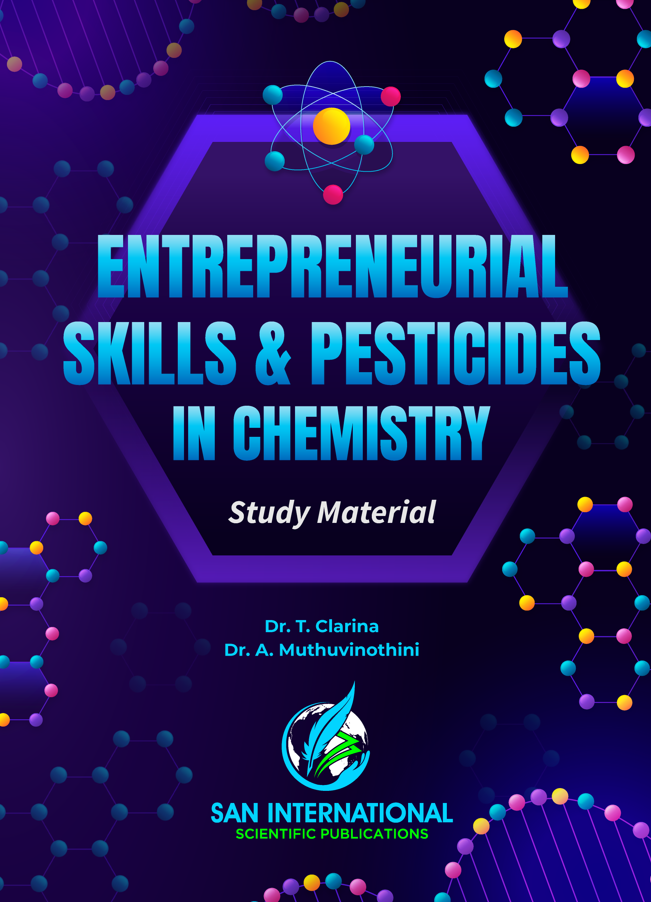
Entrepreneurial Skills & Pesticides in Chemistry
Author: Dr. T. Clarina and Dr. A. Muthuvinothini
ISBN: 978-81-975393-5-0
DOI: https://doi.org/10.59646/esp/211
Date of Publication: June 18, 2024
Syllabus:
Entrepreneurial Skills in Chemistry
Unit 1 – Food Chemistry
Food adulteration-contamination of food items with clay stones, water and toxic chemicals – Common adulterants. Food additives, Natural and synthetic anti-oxidants, glazing agents (hazardous effect), food colourants, Preservatives, leavening agents, Baking powder and baking soda, yeast, MSG, vinegar. Dyes: Classification – Natural, synthetic dyes and their characteristics – basic methods and principles of dyeing
Unit 2 – Hands on Experience (Students can choose any four)
Detection of adulterants in food items like coffee, tea, pepper, chilli powder, turmeric powder, butter, ghee, milk, honey etc., by simple techniques. Preparation of Jam, squash and Jelly, Gulkand, cottage cheese. Preparation of products like candles, soap, detergents, cleaning powder, shampoos, pain balm, tooth paste/powder and disinfectants on a small scale. Extraction of oils from spices and flowers. Testing of water samples using a testing kit. Dyeing – cotton fabrics with natural and synthetic dyes. Printing – tie and dye, batik.
Pesticide Chemistry
Unit I – Introduction
History of pesticides. Chemistry of Pesticides: Brief introduction to classes of pesticides (Chemical class, targets), structures, chemical names, physical and chemical properties. Toxicity of pesticides: Acute and chronic toxicity in mammals, birds, aquatic species etc. Methods of analysis of pesticides. Insecticides: Classification and study of following insecticides with respect to structure, chemical name, physical properties, chemical properties, synthesis, degradation, metabolism, formulations, Mode of action, uses, toxicity. Organophosphates and Phosphothionates: Acephate, Chlorpyriphos, Monocrotophos, and parathion-methyl. Organochlorine – Endosulfan, heptachlor; Carbamate: Cartap hydrochloride, Methomyl, Propoxur.
Unit II – Pesticides residues
Introduction- application of agrochemicals, dissemination pathways of pesticides, causes of pesticide residues, remedies. Pesticides residues in atmosphere- entry into atmosphere, action of pesticides, effects on environments. Pesticides residues in water – entry into water systems, action and effect in aquatic environments. Pesticides residues in soil. entry into soil, absorption, retention and transport in soil, effects on microorganism, soil condition and fertility, decomposition and degradation by climatic factors and microorganism. Pesticide Residues effect and analysis: Effects of pesticides residue on human life, birds and animals- routes for exposure to pesticides, action of pesticides on the living system. Analysis of pesticides residues- sample preparation, extraction of pesticides residues (soil, water and vegetables/fruits) simple methods and schemes of analysis, multi-residue analysis.
Unit III – Biopesticides
Pheromones, attractants, repellents – Introduction, types and application (8- Dodecen-1-ol, 10-cis-12-hexadecadienoic, Trimedlure, Cue-lure, methyl eugenol, N,N- Diethyl-m-toluamide, Dimethyl phthalate, Icaridin). Baits- Metaldehyde, Iron (II) phosphate, Indoxacarb, Zinc Phosphide, Bromadiolone.