
Education Under One Umbrella: Creating Inclusive Schools for Every Learner
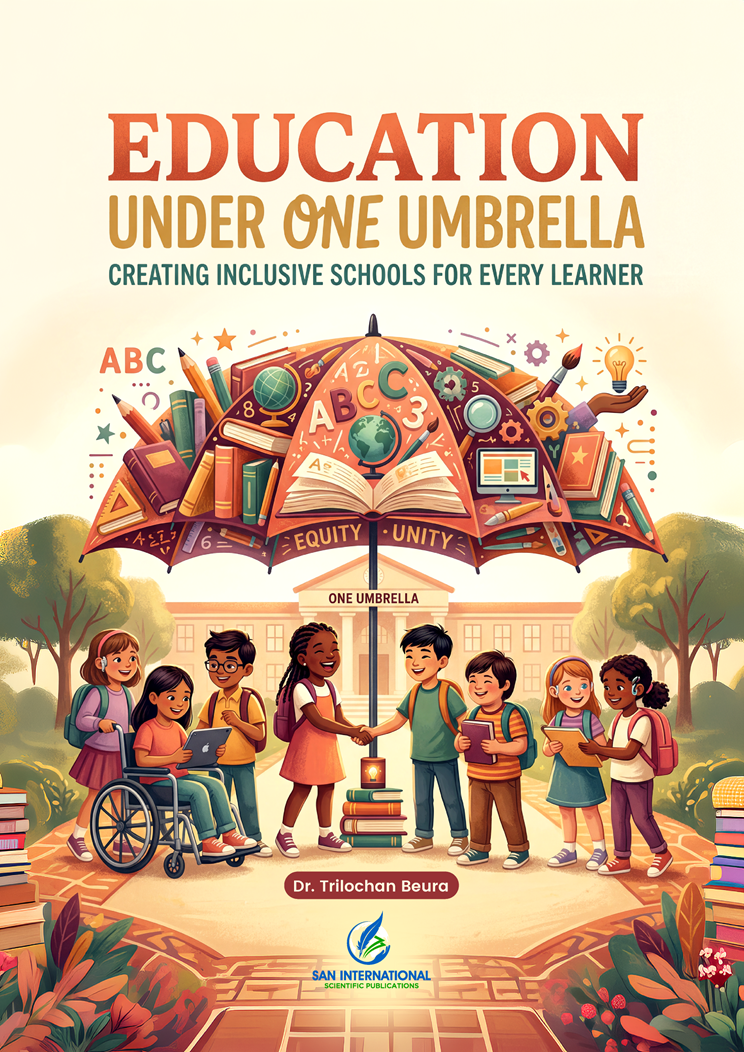
Education Under One Umbrella: Creating Inclusive Schools for Every Learner
Author: Dr. Trilochan Beura
ISBN: 978-81-69297-21-9
DOI: https://doi.org/10.59646/711
Date of Publication: May 30, 2026
Cite this book: Trilochan B, (2026), Education Under One Umbrella: Creating Inclusive Schools for Every Learner, San International Scientific Publications, ISBN: 978-81-69297-21-9, DOI: https://doi.org/10.59646/711
Preface
Education is not a fixed activity. It changes with the needs of learners, society, knowledge, technology, and time. A teacher, therefore, cannot remain only a transmitter of information. A teacher must also become an observer, thinker, problem-solver, and reflective practitioner. This is where research becomes important in education.
This book, Education Under One Umbrella, has been prepared with the purpose of helping students understand research in a simple, clear, and practical manner. It is mainly designed for students of teacher education and education courses, including B.Ed., M.Ed., B.A. Education, and M.A. Education. The content has been written in such a way that learners with little or no previous background in research can also understand the basic ideas comfortably.
The book begins with the foundation of educational research. It explains the meaning, characteristics, need, scope, and historical development of educational research. These topics help students understand why research is necessary in the field of education and how it contributes to the improvement of teaching, learning, curriculum, evaluation, administration, and student support. The next part of the book deals with the basic elements of research. It discusses research problem, variables, review of related literature, hypothesis, research questions, population, sample, and sampling techniques. These are essential concepts for any student who wishes to understand or conduct a research study.
Special care has been taken to explain these concepts in simple language with suitable educational illustrations. The later units focus on action research. Action research is especially important for teachers because it begins with real classroom problems and aims at immediate improvement. It helps teachers examine their own practices, identify difficulties, plan suitable actions, observe results, reflect on outcomes, and make necessary changes. In this way, action research connects educational theory with classroom practice.
The language has been kept simple, direct, and student-friendly so that the book may be useful for classroom learning, examination preparation, assignments, seminar work, and research projects. Every effort has been made to present the subject matter in a clear and organised form. Important points, possible examination questions, keywords, glossary, and references have been included to support learning and revision. The book is intended to serve both as a textbook and as a practical guide for students and teacher-trainees. I hope this book will help learners develop a positive attitude towards research. Research should not be seen as a difficult or distant academic activity. It should be understood as a thoughtful and systematic way of improving educational practice. A good teacher does not simply teach; a good teacher observes, questions, reflects, and improves. This spirit lies at the heart of action research.
I express my sincere hope that this book will be useful to students, teachers, teacher educators, and all those who are interested in improving education through reflective and research-based practice.