
Economic Interpretation of Law
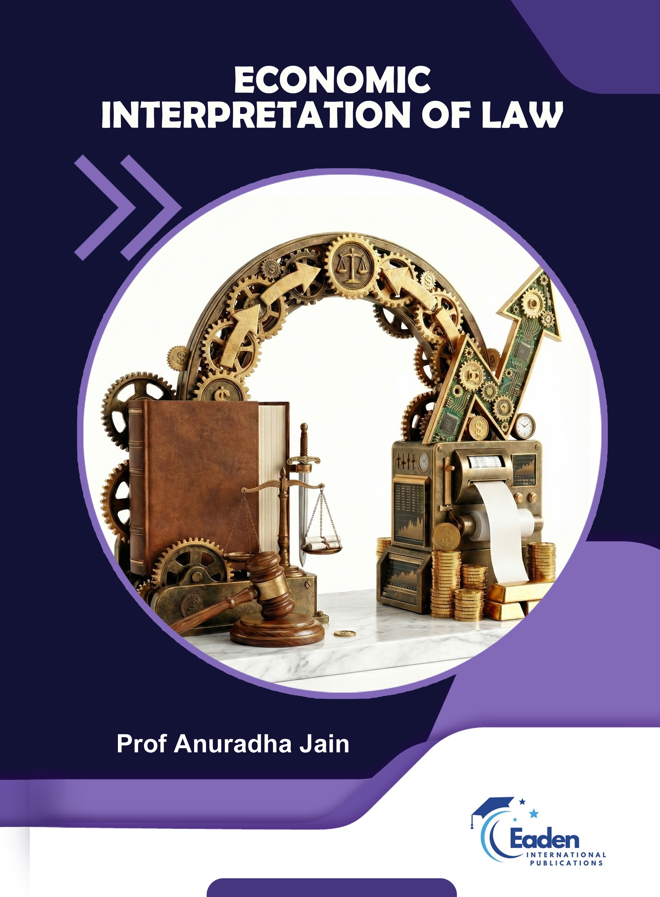
Economic Interpretation of Law
Author: Prof Anuradha Jain
ISBN: 978-81-997985-6-4
DOI: https://doi.org/10.59646/587
Date of Publication: January 29, 2026
Preface
Law and economics are deeply interconnected disciplines that together shape social behaviour, market efficiency, and institutional governance. Legal rules influence economic outcomes, while economic principles offer powerful tools for understanding, evaluating, and improving legal systems. The textbook Economic Interpretation of Law is designed to explore this dynamic relationship by applying economic reasoning to the analysis of legal rules, institutions, and judicial decisions.
This book introduces readers to the economic approach to law, emphasizing how concepts such as efficiency, incentives, cost–benefit analysis, externalities, and rational choice theory can be used to interpret legal doctrines and policy outcomes. Rather than viewing law solely as a normative or doctrinal framework, the text presents law as a system of incentives that affects individual and organizational behaviour in predictable economic ways.
The scope of this book spans key areas of law—including property law, contract law, torts, criminal law, constitutional law, and regulatory frameworks—through an economic lens. Each chapter integrates theoretical foundations with practical illustrations, case references, and policy discussions to help readers understand how economic analysis informs legislative design, judicial reasoning, and regulatory effectiveness. Special attention is given to contemporary challenges such as market regulation, competition policy, public choice, and the economic implications of legal reforms.
This textbook is intended for undergraduate and postgraduate students of law, economics, management, and public policy, as well as researchers and practitioners interested in interdisciplinary legal analysis. The content is presented in a clear and accessible manner, assuming no prior specialization in economics, while gradually building analytical depth.
By bridging legal theory with economic logic, Economic Interpretation of Law aims to foster critical thinking and equip readers with analytical tools necessary for evaluating legal rules in terms of social welfare, efficiency, and economic impact. It is hoped that this work will contribute to a deeper understanding of law as an instrument not only of justice but also of economic organization and societal development.