Digital English: AI, Text Analytics & the Next Frontier of Literature
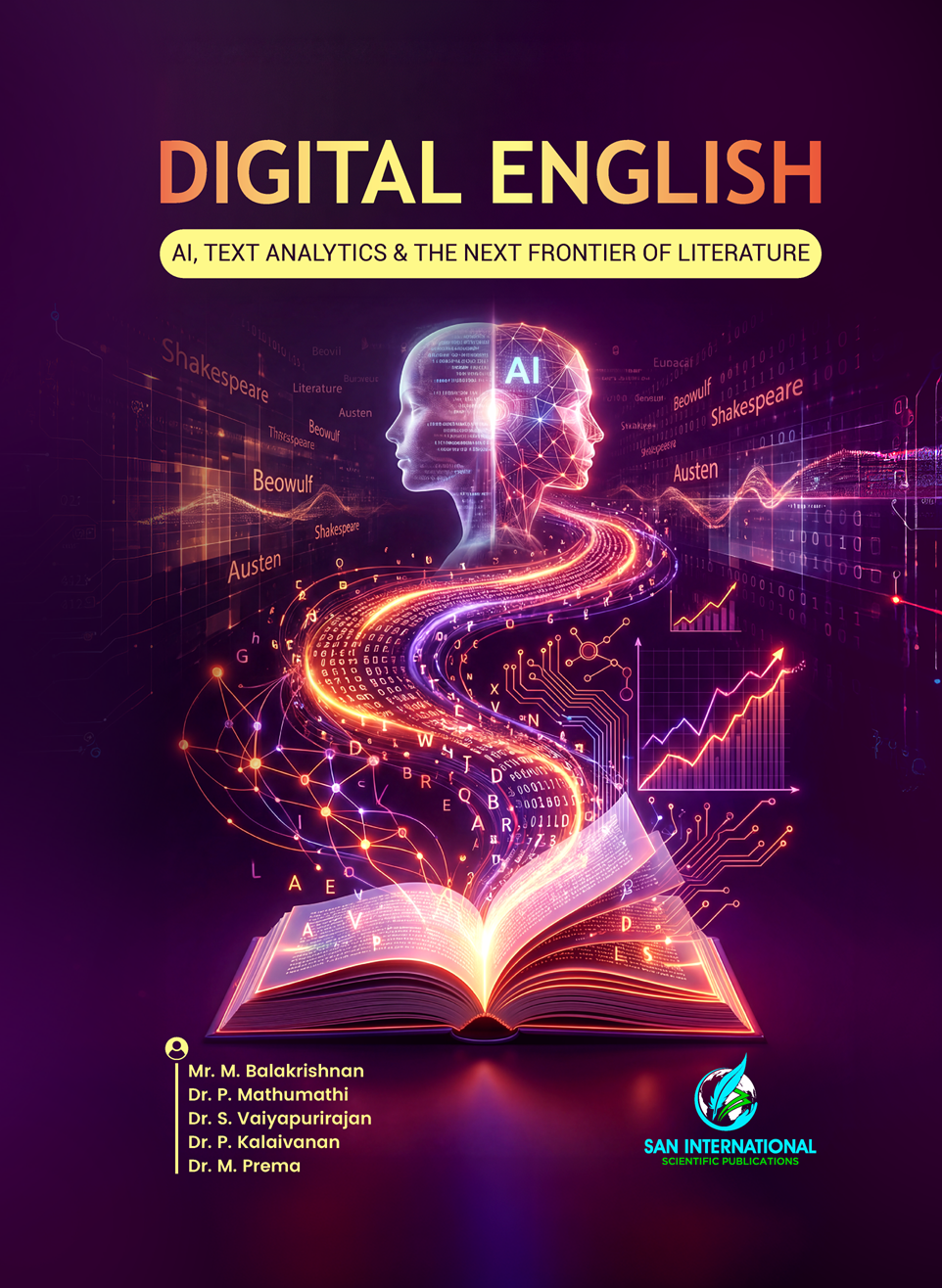
Digital English: AI, Text Analytics & the Next Frontier of Literature
Authors: Mr. M. Balakrishnan, Dr. P. Mathumathi, Dr. S. Vaiyapurirajan, Dr. P. Kalaivanan, Dr. M. Prema
ISBN: 978-81-69297-93-6
DOI: https://doi.org/10.59646/629
Date of Publication: March 25, 2026
Cite this book: M. Balakrishnan, P. Mathumathi, S. Vaiyapurirajan, P. Kalaivanan, M. Prema, (2026), Digital English: AI, Text Analytics & the Next Frontier of Literature, San International Scientific Publications, ISBN: 978-81-69297-93-6, DOI: https://doi.org/10.59646/629
Preface
The Digital English: AI, Text Analytics & the Next Frontier of Literature emerges at a pivotal moment in the evolution of English studies, where the traditional boundaries of literature, language, and criticism are being profoundly reshaped by digital technologies and artificial intelligence. This book seeks to map that transformation by tracing the shift from human-centered interpretive practices to data-driven, computationally enhanced modes of inquiry that redefine how texts are produced, analyzed, and understood. Moving from the foundational “digital turn” in the humanities to the complex workings of natural language processing, text analytics, and machine learning, the volume explores how language itself is being reconfigured in an age where algorithms can generate meaning, simulate voice, and even challenge long-held notions of authorship and creativity. It examines the methodological transition from close reading to distant reading, the rise of corpus linguistics and cultural analytics, and the growing significance of large-scale textual data in uncovering patterns that were once invisible to human readers. At the same time, the book remains attentive to the ethical, philosophical, and cultural questions that accompany these innovations—interrogating issues of authenticity, intellectual ownership, bias, and the preservation of humanistic values in increasingly automated environments. Through diverse case studies ranging from digitized literary archives and sentiment analysis of canonical texts to AI-generated narratives and interactive storytelling platforms, the work demonstrates how English studies is no longer confined to the printed page but is dynamically interwoven with digital media, gaming, and transmedia experiences. It also addresses the implications of these changes for pedagogy, highlighting the role of AI-assisted learning tools, digital classrooms, and evolving standards of academic integrity. Ultimately, this book envisions a future in which English is not diminished but expanded by technology—a field where human insight and machine intelligence coexist in productive tension, opening new frontiers for creativity, interpretation, and critical thought in the digital age.