
Different Rare-Earth-Doped Ni–Zn Ferrites and Their Multifunctional Application
Different Rare-Earth-Doped Ni–Zn Ferrites and Their Multifunctional Application
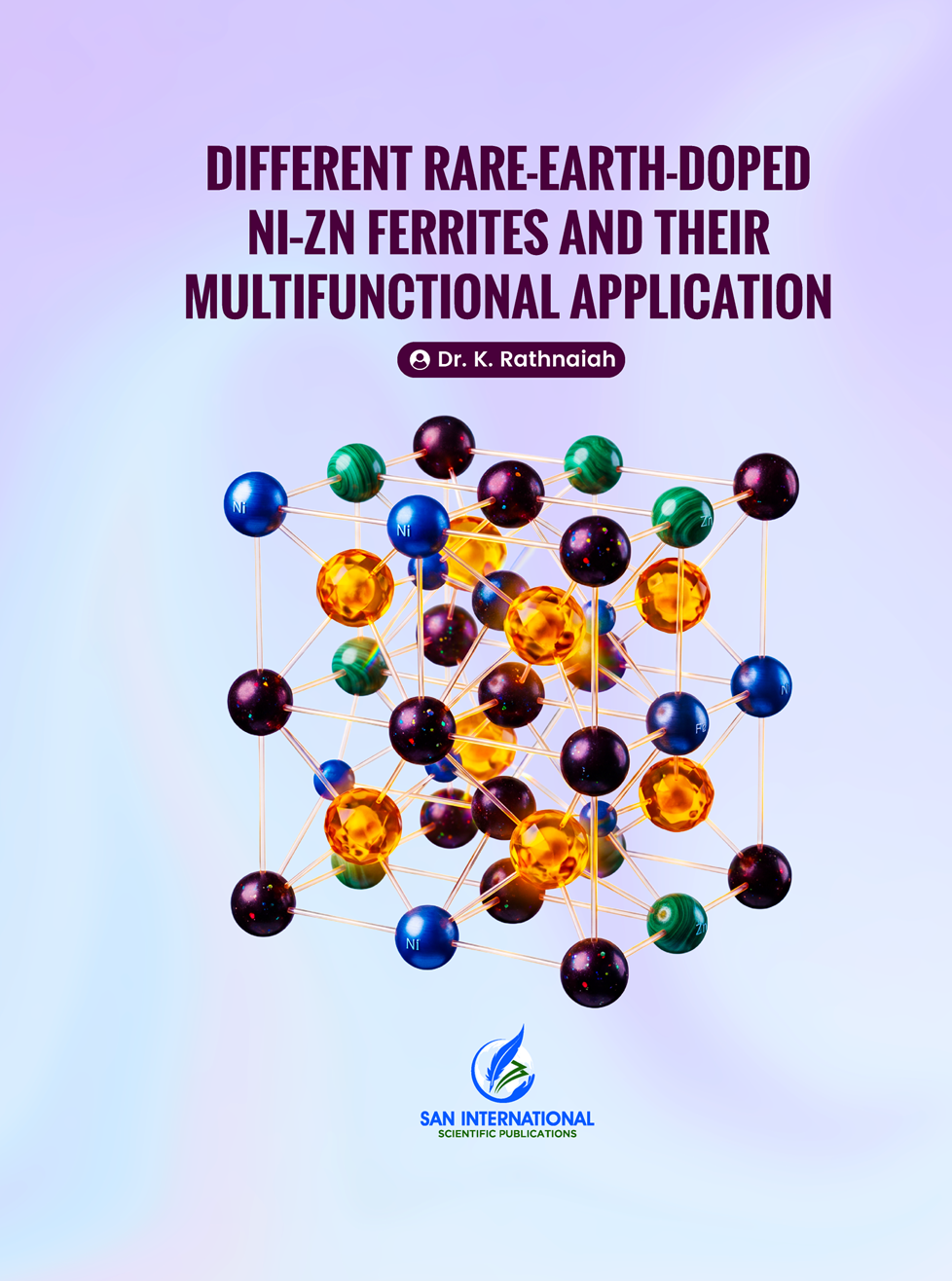
Author: Dr. K. Rathnaiah
ISBN: 978-81-17787-23-6
DOI: https://doi.org/10.59646/875
Date of Publication: November 02, 2026
Preface
The book “Different Rare-Earth-Doped Ni–Zn Ferrites and Their Multifunctional Application” provides a comprehensive understanding of the synthesis, structural characteristics, physical properties, and technological applications of rare-earth-doped nickel–zinc (Ni–Zn) ferrite materials. Ni–Zn ferrites are important spinel magnetic materials owing to their excellent magnetic characteristics, high electrical resistivity, chemical stability, and versatile functional properties. The incorporation of rare-earth elements such as lanthanum, cerium, praseodymium, neodymium, samarium, europium, gadolinium, terbium, dysprosium, holmium, erbium, and ytterbium offers opportunities to modify their crystal structure, cation distribution, microstructure, and magnetic behaviour, thereby enhancing their suitability for advanced technological applications.
The book begins with the fundamental principles of Ni–Zn ferrite systems, focusing on their crystal structure, spinel configuration, cation distribution, and the individual contributions of nickel and zinc ions. It explores the influence of different rare-earth dopants, their electronic configurations, ionic radii, oxidation states, and substitution mechanisms within tetrahedral and octahedral lattice sites. Particular attention is given to dopant concentration, charge compensation, lattice distortion, oxygen vacancies, and defect chemistry, which play significant roles in determining the structural and functional characteristics of ferrite materials. The discussion also establishes the relationship between rare-earth composition and the resulting structure–property variations.
The subsequent sections examine the synthesis principles and characterization techniques employed in the preparation and investigation of rare-earth-doped Ni–Zn ferrites. Various preparation approaches, including solid-state ceramic synthesis, high-energy ball milling, sol–gel processing, auto-combustion, co-precipitation, hydrothermal treatment, microwave-assisted synthesis, and green synthesis, are discussed in relation to their influence on phase formation, crystallinity, particle size, and morphology. Advanced characterization methods such as X-ray diffraction, Rietveld refinement, FTIR, Raman spectroscopy, SEM, TEM, EDX, and XPS are presented to explain the structural, morphological, compositional, and chemical properties of the synthesized materials.
The book further explores the optical, electrical, and dielectric properties of different rare-earth-doped Ni–Zn ferrite systems. It discusses optical absorption, band-gap determination, photoluminescence, defect-related electronic transitions, electrical conductivity, small-polaron hopping, dielectric dispersion, and interfacial polarization mechanisms. Impedance spectroscopy and equivalent-circuit modelling are also examined to understand the contributions of grains and grain boundaries to the electrical response. In addition, the magnetic characteristics of these ferrites are investigated through ferrimagnetic interactions, cation distribution, magnetic anisotropy, saturation magnetization, coercivity, remanence, Curie temperature, and magnetic relaxation. The relationship between rare-earth 4f electrons and transition-metal 3d electrons is highlighted to explain variations in magnetic behaviour. Photocatalytic mechanisms, energy-band alignment, and photogenerated charge-carrier separation are also discussed to establish the potential of these materials in environmental applications.
The final section emphasizes the multifunctional applications of rare-earth-doped Ni–Zn ferrites in high-frequency magnetic components, inductors, transformer cores, electromagnetic interference shielding, microwave absorption, magnetodielectric systems, gas and humidity sensors, magnetic fluids, and biomedical research. Their potential applications in magnetic hyperthermia, electrochemical energy storage, photocatalytic coatings, environmental remediation, ferrite–polymer nanocomposites, and spintronic devices are also explored. Particular importance is given to understanding structure–property–performance relationships, long-term stability, reproducibility, and processing optimization for practical implementation.
This book is intended to serve as a valuable academic and technical resource for undergraduate and postgraduate students, research scholars, scientists, and professionals working in materials science, solid-state chemistry, nanotechnology, magnetic materials, and advanced functional ceramics. It aims to strengthen the understanding of rare-earth substitution in Ni–Zn ferrites while providing a scientific foundation for developing multifunctional materials with improved structural, optical, electrical, dielectric, magnetic, and photocatalytic properties. Through its integrated coverage of fundamental concepts, synthesis strategies, characterization methods, and emerging applications, the book seeks to support further research and innovation in advanced rare-earth-doped ferrite materials.