
Concepts and Strategies in Industrial Management
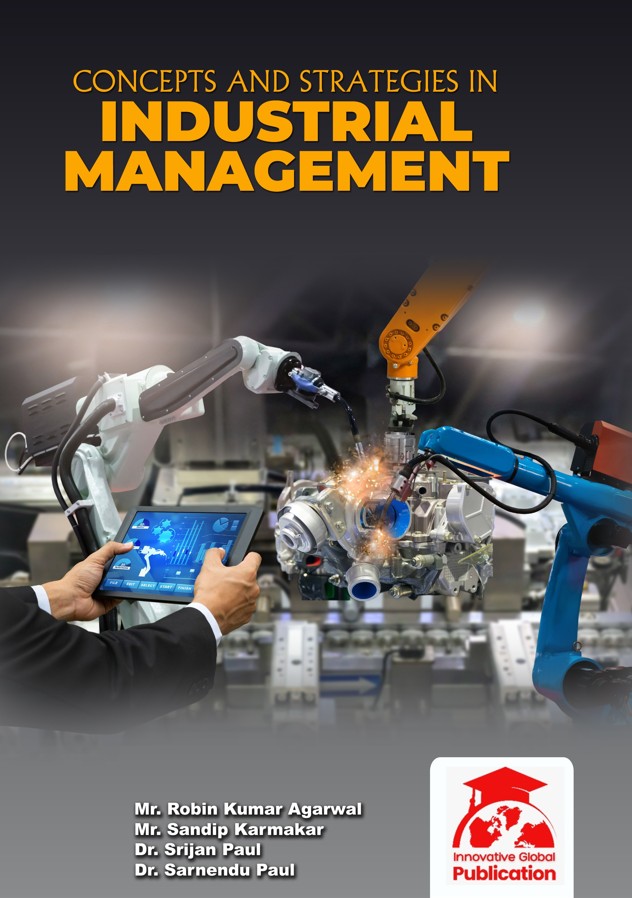
Concepts and Strategies in Industrial Management
Authors: Mr. Robin Kumar Agarwal, Mr. Sandip Karmakar, Dr. Srijan Paul and Dr. Sarnendu Paul
ISBN: 978-81-994205-4-0
DOI: https://doi.org/10.59646/491
Date of Publication: October 11, 2025
About the Book:
Industrial management has evolved into a pivotal discipline that bridges the gap between technological innovation and organizational effectiveness. In today’s fast-changing business landscape, industrial managers are expected to balance productivity, quality, human capital, and sustainability, while also navigating challenges brought about by globalization, digital transformation, and environmental responsibilities. Recognizing the need for a comprehensive resource that combines conceptual clarity with practical strategies, this book Concepts and Strategies in Industrial Management has been designed as both an academic guide and a professional reference.
The book is structured into nineteen chapters, carefully aligned with the contemporary syllabus of industrial management. It begins with a foundational introduction to the scope, objectives, and historical evolution of industrial management, and gradually advances towards modern theories, strategic planning, and organizational design. Core areas such as operations, production systems, materials management, cost and financial management, and human resource practices have been discussed with an emphasis on their interrelationships and applications in industrial enterprises. A significant focus has been placed on productivity, quality management, project management, industrial safety, and risk management, as these dimensions directly influence industrial competitiveness and sustainability. Additionally, the text explores technology and innovation management, supply chain and logistics, and industrial economics, ensuring that readers develop a multidimensional understanding of the subject. Emerging trends—ranging from Industry 4.0, artificial intelligence, robotics, and the Internet of Things to sustainable manufacturing and circular economy models—have been included to familiarize learners and practitioners with the future trajectory of industrial management.
To enhance learning, the book incorporates case studies of both global and Indian industries. These real-world examples not only highlight success stories but also present critical lessons from industrial failures, reinforcing the practical relevance of the concepts discussed. The concluding chapters look ahead, analyzing the skills, ethics, and strategies industrial managers will require to thrive in the twenty-first century. This book is intended for students of management, engineering, and commerce, as well as for researchers, academicians, and industry professionals seeking an integrated perspective on industrial management. By blending theoretical foundations with applied strategies, we aim to provide readers with both the knowledge and the analytical skills required to address contemporary industrial challenges.
As four authors with diverse academic and professional experiences, we have strived to present this text with clarity, coherence, and a multidisciplinary outlook. We acknowledge that industrial management is a dynamic field, constantly reshaped by technological advances and socio-economic changes. Hence, this book is not merely a repository of existing knowledge, but a guide to understanding and responding to the evolving industrial environment.
We extend our gratitude to our institutions, colleagues, and students whose feedback and encouragement inspired the development of this work. We also recognize the contributions of industry leaders and scholars whose insights have enriched our approach to the subject.
It is our hope that this book will serve as a valuable resource for learners and practitioners alike, equipping them with concepts, strategies, and tools essential for effective industrial management in the present and future.