
Computer Organization & Architecture
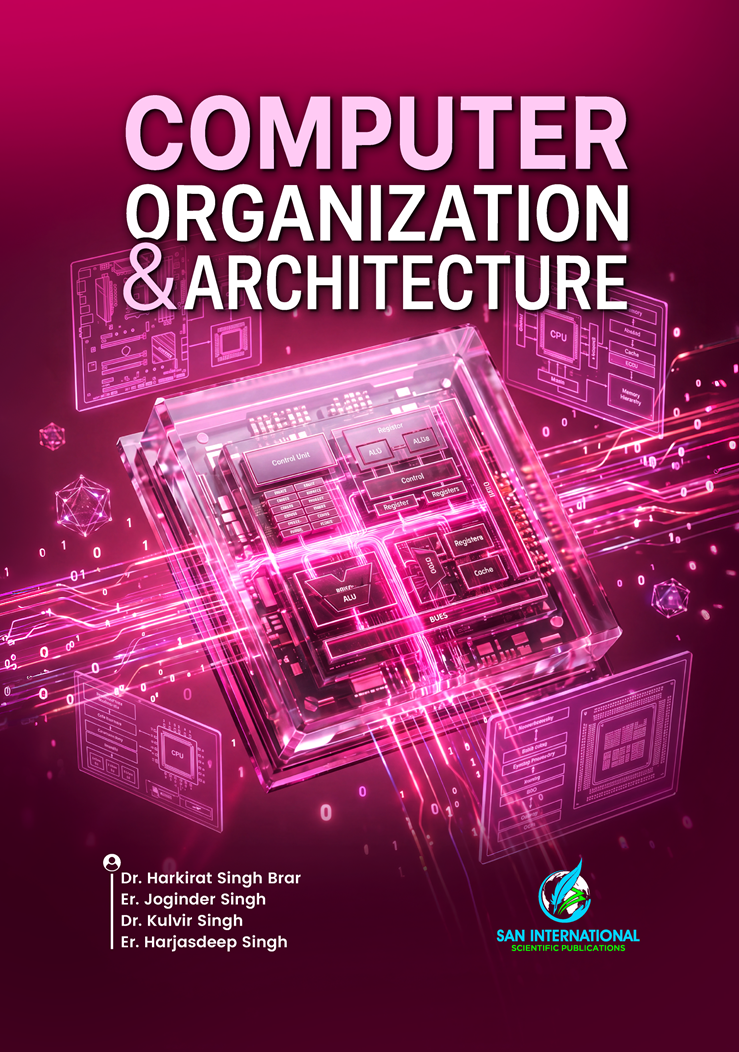
Computer Organization & Architecture
Authors: Dr. Harkirat Singh Brar, Er. Joginder Singh, Dr. Kulvir Singh, and Er. Harjasdeep Singh
ISBN: 978-81-687619-9-5
DOI: https://doi.org/10.59646/737
Date of Publication: June 30, 2026
Cite this book: Harkirat SB, Joginder S, Kulvir S, and Harjasdeep S, (2026), Computer Organization & Architecture, San International Scientific Publications, ISBN: 978-81-687619-9-5, DOI: https://doi.org/10.59646/737
Preface
Computer Organization & Architecture forms the foundation of modern computing systems and serves as a bridge between computer hardware and software. Understanding how computers are designed, organized, and operated is essential for students, researchers, engineers, and technology professionals who seek to develop efficient computing solutions. As digital technologies continue to evolve rapidly, knowledge of computer organization and architecture has become increasingly important for designing high-performance systems, optimizing software execution, and understanding the internal mechanisms that drive modern computing devices. This book has been carefully prepared to provide a comprehensive and systematic understanding of the fundamental principles, architectural concepts, and practical implementations that define contemporary computer systems.
The primary objective of this book is to present the core concepts of computer organization and architecture in a clear, structured, and learner-friendly manner. Beginning with the fundamental functional blocks of a computer system, the text introduces readers to the central processing unit, memory systems, input-output subsystems, control units, registers, instruction execution cycles, and instruction set architectures. The book further explores data representation techniques, computer arithmetic operations, multiplication and division algorithms, and floating-point arithmetic, enabling readers to understand how numerical and logical computations are performed within digital systems. Special emphasis has been placed on illustrating the relationship between hardware components and their coordinated operation during program execution.
The second unit focuses on processor control unit design and the architectural foundations of modern computing platforms. Readers are introduced to hardwired and microprogrammed control units, memory system design, peripheral device characteristics, and various input-output transfer mechanisms. Detailed discussions on interrupts, exceptions, process management, privileged and non-privileged instructions, and device interfaces such as USB and SCSI provide valuable insights into the interaction between operating systems and hardware resources. The inclusion of a hypothetical CPU design case study helps learners visualize the practical implementation of architectural concepts and understand the internal data flow mechanisms within a processor.
As computing demands continue to increase, processor performance enhancement techniques have become critical. Recognizing this importance, the third unit is dedicated to pipelining, parallel processing, and concurrent memory access mechanisms. The concepts of throughput, speedup, pipeline hazards, and hazard resolution techniques are thoroughly examined to demonstrate how modern processors achieve high computational efficiency. The discussion extends to parallel processor architectures, cache coherence challenges, and synchronization mechanisms that enable multiple processing units to work collaboratively. These topics provide readers with a strong foundation for understanding multicore processors, high-performance computing systems, and advanced parallel architectures that power today’s computational environments.
The final unit addresses memory organization, one of the most significant aspects of computer system performance. Topics such as memory interleaving, hierarchical memory structures, cache memory organization, mapping techniques, replacement algorithms, and write policies are presented in detail. Understanding memory hierarchy and cache optimization is essential for improving system throughput and reducing access latency. Through systematic explanations and architectural analysis, readers gain valuable knowledge about how memory subsystems contribute to overall computer performance and efficiency.
Throughout the book, theoretical concepts are complemented with practical examples, architectural illustrations, algorithmic explanations, and case studies that enhance conceptual understanding. The content has been organized progressively, enabling readers to build knowledge from basic principles to advanced architectural techniques. Care has been taken to ensure that the material remains relevant to current computing technologies while maintaining a strong emphasis on fundamental concepts that form the basis of future innovations.
This book is intended for undergraduate and postgraduate students of Computer Science, Information Technology, Computer Engineering, Electronics and Communication Engineering, and related disciplines. It will also serve as a valuable reference for educators, competitive examination aspirants, software developers, system architects, and professionals seeking a deeper understanding of computer hardware and system design. By mastering the concepts presented in this book, readers will be well-equipped to analyze computer systems, design efficient computing solutions, and appreciate the architectural innovations that continue to transform the digital world.
It is hoped that this book will inspire curiosity, strengthen technical knowledge, and provide a solid foundation for further exploration in the fascinating field of Computer Organization and Architecture. The authors sincerely believe that the knowledge gained from this text will empower readers to contribute effectively to the advancement of computing technologies and the development of next-generation digital systems.