
Computational Criminology: AI Applications in Forensic Science and Criminal Justice
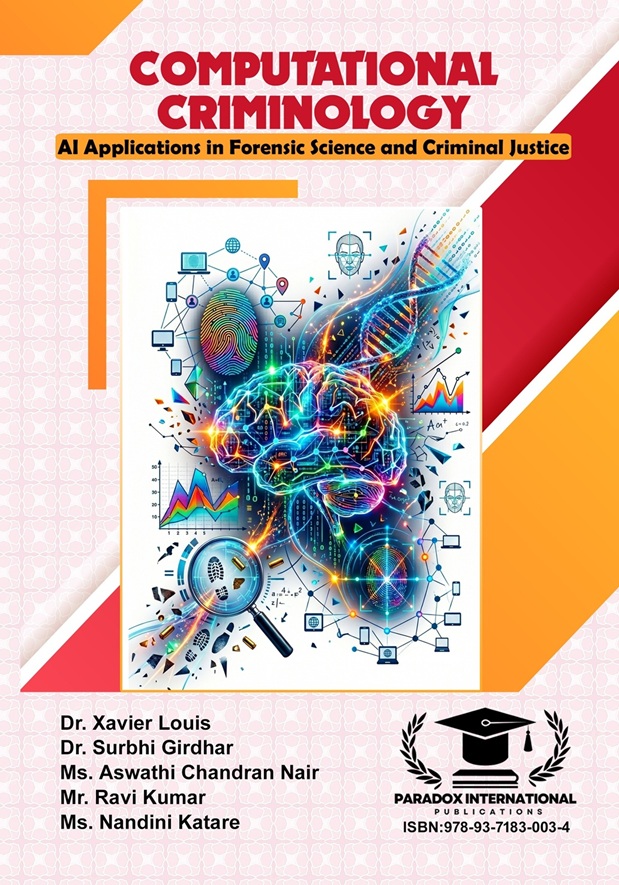
Computational Criminology: AI Applications in Forensic Science and Criminal Justice
Editors: Dr. Xavier Louis, Dr. Surbhi Girdhar, Ms. Aswathi Chandran Nair, Mr. Ravi Kumar, and Ms. Nandini Katare
ISBN: 978-93-7183-003-4
DOI: https://doi.org/10.59646/704
Date of Publication: May 28, 2026
Cite this book: Xavier L, Surbhi G, Aswathi CN, Ravi K, and Nandini K, (2026), Computational Criminology: AI Applications in Forensic Science and Criminal Justice, Paradox International Publications & San International Scientific Publications, ISBN: 978-93-7183-003-4, DOI: https://doi.org/10.59646/704
Chapters and Authors
Chapter 15: Bloodstain Pattern Analysis through Computer Vision and 3D Reconstruction – Satish Rai
Preface
The rapid advancement of artificial intelligence (AI), machine learning, big data analytics, and computational technologies has transformed numerous scientific disciplines, and criminology is no exception. In recent years, the emergence of Computational Criminology has revolutionized the way crime is studied, investigated, predicted, and prevented. By integrating traditional criminological theories with sophisticated computational methods, researchers and practitioners can now analyze vast datasets, uncover hidden crime patterns, forecast criminal activities, and support evidence-based decision-making within the criminal justice system. Simultaneously, forensic science has experienced significant technological innovation, with AI-driven tools enhancing the speed, accuracy, and reliability of evidence collection, analysis, and interpretation. These developments have created unprecedented opportunities for improving public safety, strengthening law enforcement capabilities, and advancing the pursuit of justice.
The book “Computational Criminology: AI Applications in Forensic Science and Criminal Justice” has been developed to provide a comprehensive exploration of this rapidly evolving interdisciplinary field. Bringing together contributions from scholars, researchers, and experts across criminology, forensic science, computer science, artificial intelligence, and legal studies, this volume presents a broad examination of how computational techniques are reshaping contemporary criminal justice systems. The chapters collectively highlight both the transformative potential of AI technologies and the ethical, legal, and social challenges associated with their adoption.
The initial chapters establish the theoretical and historical foundations of computational criminology. They explore the algorithmic transformation of criminal justice research, the evolution of technology in law enforcement, the growing importance of criminal justice data ecosystems, and the integration of criminological theories with computational modelling approaches. These foundational discussions provide readers with the conceptual framework necessary to understand the role of data-driven methods in analyzing crime and criminal behavior. The volume subsequently examines advanced applications such as predictive policing, crime forecasting, spatial crime analysis, hotspot detection, risk terrain modelling, and gang network analysis through machine learning and deep learning techniques. These approaches demonstrate how computational intelligence can assist law enforcement agencies in identifying emerging threats, allocating resources effectively, and developing proactive crime prevention strategies.
A major focus of this book is the application of AI in forensic science. Several chapters explore innovative technologies that are transforming forensic investigations, including digital forensics, forensic DNA phenotyping, computational ballistics, handwriting and signature verification, AI-assisted toxicology, bloodstain pattern analysis, facial recognition, voice identification, and behavioural biometrics. By leveraging computer vision, neural networks, pattern recognition systems, and advanced analytical algorithms, these technologies enhance forensic accuracy and support the objective evaluation of evidence. Such advancements are becoming increasingly important as criminal investigations generate growing volumes of digital and physical evidence that require rapid and reliable analysis.
Beyond investigative and forensic applications, the book also examines the expanding role of AI in judicial and correctional systems. Topics such as social media intelligence, deepfake detection, risk assessment instruments, algorithmic sentencing, pretrial decision-making, legal decision support systems, judicial analytics, and correctional threat assessment illustrate the increasing influence of computational tools throughout the criminal justice process. These technologies offer the potential to improve efficiency, consistency, and informed decision-making while simultaneously raising concerns regarding fairness, transparency, and accountability.
Recognizing these concerns, several chapters critically address issues of algorithmic bias, racial disparities, explainable AI, privacy protection, surveillance practices, and international governance frameworks for AI deployment in law enforcement and forensic science. Such discussions emphasize that technological innovation must be accompanied by ethical responsibility and robust regulatory oversight. The development of trustworthy and transparent AI systems remains essential to maintaining public confidence and protecting fundamental rights within democratic societies.
The concluding chapter explores future directions in computational criminology, including the emergence of generative AI, large language models, autonomous analytical systems, and next-generation forensic technologies. These developments are expected to further redefine criminal investigations, forensic practices, and justice administration in the coming decade.
This book is intended for researchers, students, criminologists, forensic scientists, law enforcement professionals, legal scholars, policymakers, and technology developers interested in the intersection of AI and criminal justice. It is hoped that this volume will serve as a valuable academic resource, stimulate interdisciplinary research, and contribute to the responsible development of intelligent technologies that enhance the effectiveness, fairness, and integrity of criminal justice systems worldwide.