Comparative Politics: Systems and Processes
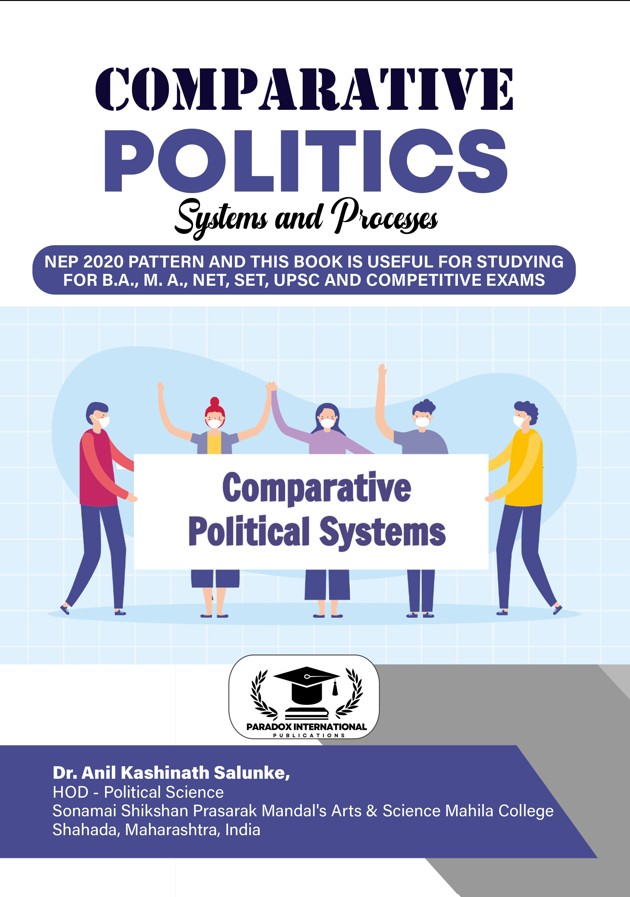
Comparative Politics: Systems and Processes
Author: Dr. Anil Kashinath Salunke
ISBN: 978-93-7183-887-0
DOI: https://doi.org/10.59646/CP/453
Date of Publication: September 10, 2025
About the Book:
The Comparative politics is one of the most dynamic fields of political science, offering students and scholars the tools to understand how political systems function, evolve, and influence societies across the world. In a rapidly changing global landscape marked by democratic transitions, authoritarian resilience, globalization, and technological disruptions, the study of comparative politics has never been more relevant.
This book, Comparative Politics: Systems and Processes, is designed to provide a comprehensive introduction to the structures, functions, and dynamics of political systems, while equipping readers with the analytical frameworks necessary to compare and contrast political realities across diverse contexts. By blending theoretical perspectives with real-world examples, it aims to bridge the gap between abstract concepts and lived political experiences.
The chapters in this volume cover a wide spectrum of themes: political institutions and state structures, processes of democratization and authoritarianism, party systems and electoral dynamics, political culture and participation, governance and public policy, as well as contemporary challenges such as globalization, identity politics, and the impact of digital technology on democracy. Each chapter not only presents key concepts and theories but also includes comparative case studies that illustrate how different systems and processes operate in practice.
The text is intended for undergraduate and postgraduate students of political science, international relations, and related disciplines. It will also serve as a valuable reference for civil service aspirants, educators, and practitioners who seek to better understand political diversity and its implications for governance and development.
The guiding principle of this work is that comparative politics is not simply about cataloguing differences among political systems, but about uncovering patterns, explaining variations, and analyzing the interplay between structure and process. By engaging with this approach, readers are encouraged to think critically, draw connections across regions, and reflect on how political systems adapt to changing environments.
I am deeply grateful to colleagues, students, and reviewers whose insights have shaped the development of this text. It is my hope that this book will inspire readers to appreciate the richness of comparative inquiry and to approach political phenomena with both curiosity and analytical rigor.