Circular Economy and Sustainable Business Transformation
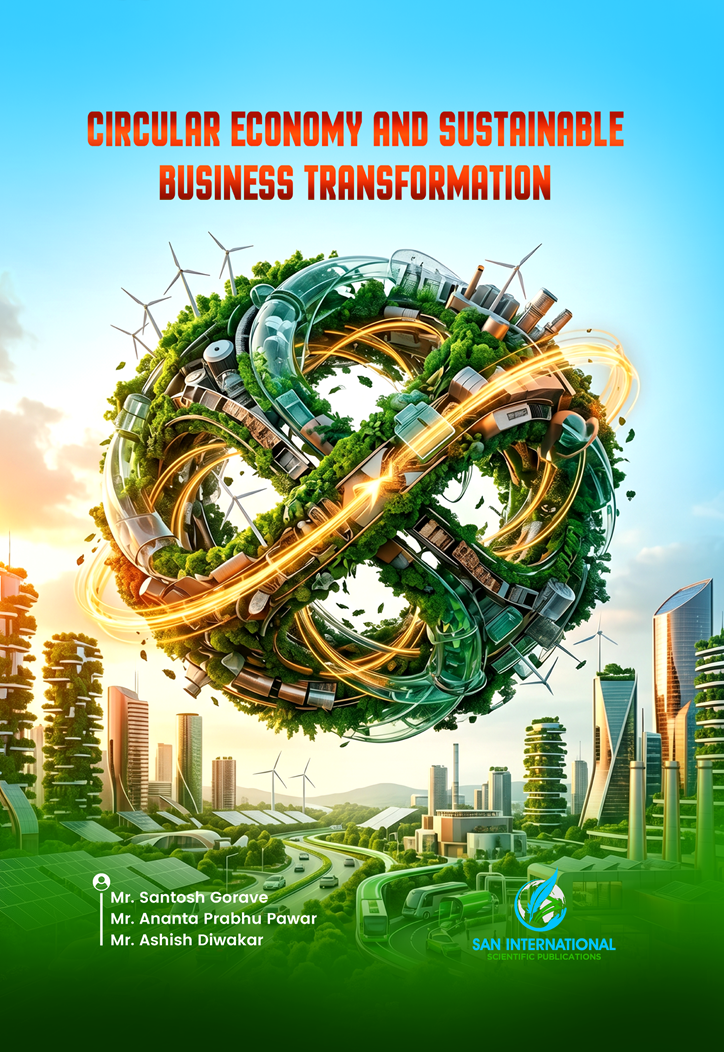
Circular Economy and Sustainable Business Transformation
Authors: Mr. Santosh Gorave, Mr. Ananta Prabhu Pawar, and Mr. Ashish Diwakar
ISBN: 978-81-69297-88-2
DOI: https://doi.org/10.59646/740
Date of Publication: June 29, 2026
Cite this book: Santosh G, Ananta PP, and Ashish D, (2026), Circular Economy and Sustainable Business Transformation, San International Scientific Publications, ISBN: 978-81-69297-88-2, DOI: https://doi.org/10.59646/740
Preface
The twenty-first century has brought unprecedented opportunities for economic growth, technological advancement, and global connectivity. At the same time, it has exposed critical challenges related to resource depletion, climate change, environmental degradation, social inequality, and unsustainable consumption patterns. Traditional linear economic models based on the principle of “take, make, use, and dispose” are increasingly proving inadequate for addressing the complex sustainability challenges facing modern societies and businesses. In response, organizations across the world are embracing the principles of the circular economy and sustainable business transformation as strategic pathways toward long-term resilience, responsible growth, and value creation. The transition from a linear economy to a circular economy is no longer an environmental aspiration alone; it has become a business imperative that drives innovation, competitiveness, operational efficiency, and stakeholder trust.
The book Circular Economy and Sustainable Business Transformation has been developed to provide a comprehensive understanding of how organizations can integrate sustainability principles into their strategic, operational, financial, and technological frameworks. It explores the evolving relationship between environmental stewardship, economic prosperity, and social responsibility while emphasizing the importance of creating regenerative and resilient business systems. The content has been carefully structured to help students, researchers, entrepreneurs, business leaders, policymakers, and sustainability professionals understand the multidimensional aspects of sustainable business practices in a rapidly changing global environment. The book highlights the critical role of innovation, digital transformation, responsible governance, and stakeholder engagement in enabling organizations to achieve sustainable development goals while maintaining profitability and competitive advantage.
The initial chapters introduce readers to the foundations of sustainability, green business management, environmental management systems, circular economy principles, and sustainable resource utilization. These concepts establish a strong theoretical base for understanding how organizations can create value while minimizing environmental impact and promoting social well-being. The discussion extends to global sustainability frameworks, environmental standards, ESG principles, and internationally recognized sustainability initiatives that increasingly influence corporate decision-making and reporting practices.
Recognizing the growing importance of digital technologies in modern business, the book examines digital branding, sustainable marketing strategies, consumer engagement, ethical advertising, and data-driven decision-making. In today’s digital economy, sustainability communication plays a crucial role in shaping consumer perceptions and building trust. Organizations must not only adopt sustainable practices but also communicate them transparently and authentically. The integration of social media analytics, digital customer relationship management, and sustainable brand positioning provides readers with practical insights into developing responsible and impactful marketing strategies.
The book further explores global supply chains, sustainable operations, green procurement, responsible sourcing, and digital supply chain transformation. Modern supply chains are increasingly expected to balance efficiency, resilience, and sustainability while addressing environmental and social risks. Through discussions on circular supply chains, risk management, logistics optimization, and performance measurement, readers gain a deeper understanding of how sustainability can be embedded throughout the value chain to enhance long-term organizational success.
Corporate accountability and climate change management represent another important focus of this work. Organizations today face growing pressure from investors, regulators, customers, and society to demonstrate responsible environmental and social performance. This book examines sustainability reporting frameworks, ESG integration, climate risk assessment, carbon management, net-zero strategies, sustainable finance, and stakeholder engagement. These topics provide a practical framework for understanding how businesses can respond effectively to climate-related challenges while creating sustainable value for shareholders and society.
The final sections focus on innovation ecosystems, open innovation networks, sustainable business models, social entrepreneurship, digital transformation, regenerative enterprises, and future trends in sustainable development. Particular attention is given to emerging technologies such as artificial intelligence, advanced analytics, digital platforms, and intelligent systems that are reshaping business operations and sustainability practices worldwide. The discussion of strategic foresight and long-term sustainable growth encourages readers to think proactively about future challenges and opportunities in an increasingly interconnected and environmentally conscious global economy.
This book is designed not only as an academic resource but also as a practical guide for implementing sustainability-oriented strategies in real-world business environments. By integrating theoretical foundations, contemporary business practices, global frameworks, technological advancements, and future-oriented perspectives, it provides a holistic understanding of sustainable business transformation in the era of circular economy thinking. The authors hope that this book will inspire readers to develop innovative solutions, embrace responsible leadership, and contribute meaningfully to building a more sustainable, resilient, and inclusive future for businesses and society.
The structure of this book aligns with contemporary developments in sustainability management, circular economy implementation, digital innovation, climate responsibility, entrepreneurial growth, and ecosystem-based value creation, offering a comprehensive roadmap for organizations seeking to thrive in a rapidly evolving global landscape. Ultimately, the journey toward sustainability is not merely about reducing environmental impact; it is about redefining how value is created, shared, and sustained across generations. This book seeks to contribute to that journey by equipping readers with the knowledge, skills, and strategic insights necessary to lead the transformation toward a circular, sustainable, and prosperous future.