
Building Information Modelling: 3D, 4D, 5D and 6D
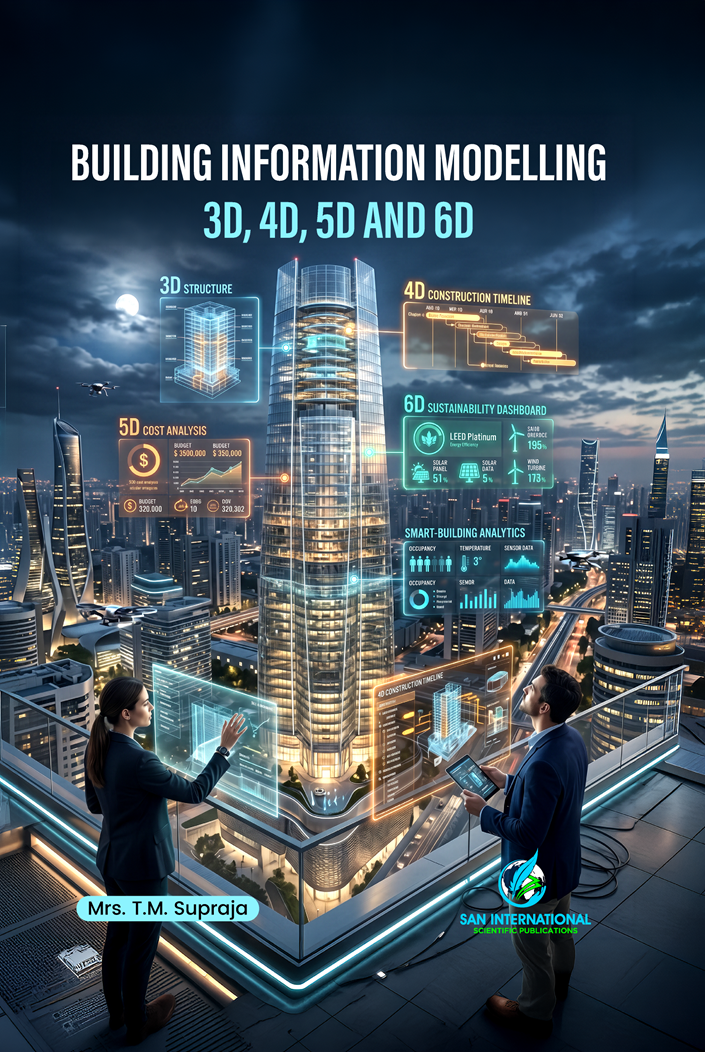
Building Information Modelling: 3D, 4D, 5D and 6D
Author: Mrs. T.M. Supraja
ISBN: 978-81-69297-13-4
DOI: https://doi.org/10.59646/697
Date of Publication: May 20, 2025
Cite this book: TM Supraja, (2026), Building Information Modelling: 3D, 4D, 5D and 6D, San International Scientific Publications, ISBN: 978-81-69297-13-4, DOI: https://doi.org/10.59646/697
Preface
The construction industry has long been challenged by issues such as project delays, cost overruns, poor coordination among stakeholders, inefficient resource management, and a lack of effective communication throughout the project lifecycle. With the rapid advancement of digital technologies, Building Information Modelling (BIM) has emerged as a revolutionary approach that transforms the planning, design, construction, and management of infrastructure and building projects. This book, Building Information Modelling: 3D, 4D, 5D and 6D, has been prepared with the objective of providing students, researchers, professionals, and industry practitioners with a comprehensive understanding of BIM concepts, tools, and applications in modern construction practices. Beginning with an overview of the major issues faced in the construction industry, the book introduces the fundamental BIM terminology and core concepts that form the foundation of digital construction management. To enhance practical understanding, relevant case studies and a sample BIM Execution Plan (BEP) are included, enabling readers to bridge the gap between theoretical knowledge and real-world implementation.
The book further explores widely used BIM tools such as Revit for 3D modelling, BEXEL Manager for 4D scheduling and 5D cost estimation, and QGIS for infrastructure-related applications, providing step-by-step insights into their practical usage. In addition, a real-time sustainability case study has been incorporated to demonstrate the role of 6D BIM in achieving sustainable and energy-efficient construction practices. Through this book, an effort has been made to present BIM as not merely a software-based process, but as an integrated methodology that enhances collaboration, productivity, accuracy, and sustainability in the Architecture, Engineering, and Construction (AEC) industry. It is sincerely hoped that this book will serve as a valuable learning resource and practical guide for readers seeking to understand and implement BIM technologies effectively in academic, research, and professional environments.