
Artificial Superintelligence: Beyond Machine Learning and Cognitive AI
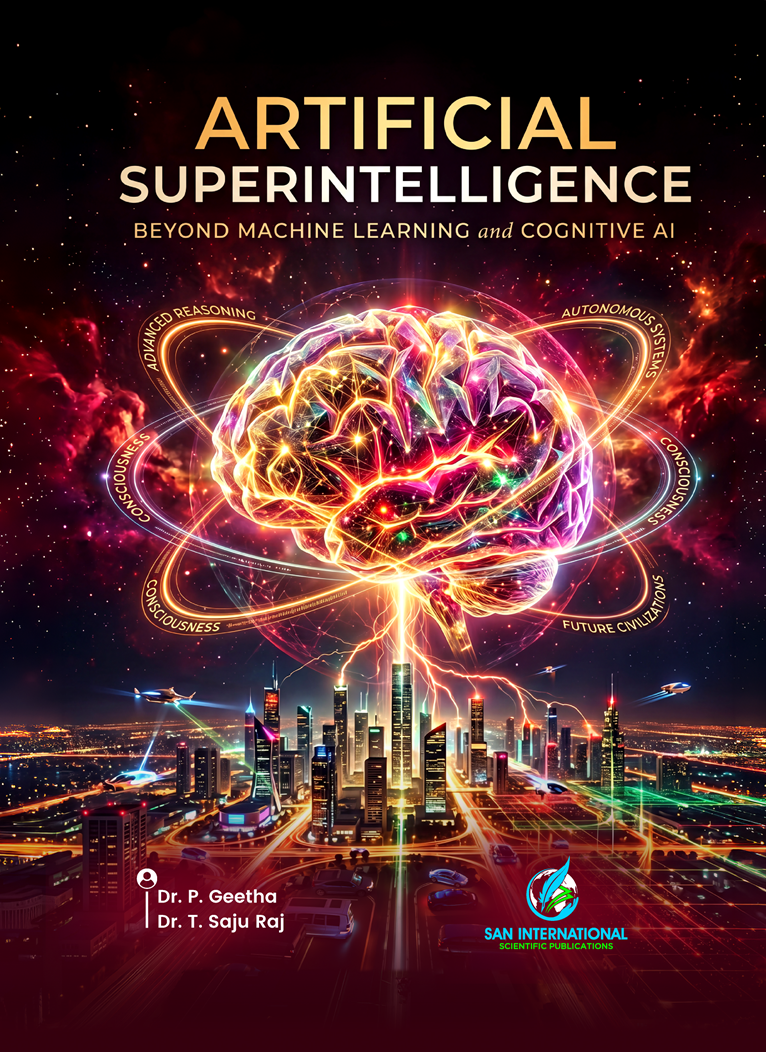
Artificial Superintelligence: Beyond Machine Learning and Cognitive AI
Authors: Dr. P. Geetha, and Dr. T. Saju Raj
ISBN: 978-81-687619-6-4
DOI: https://doi.org/10.59646/732
Date of Publication: June 24, 2026
Cite this book: P. Geetha, and TS Raj, (2026), Artificial Superintelligence: Beyond Machine Learning and Cognitive AI, San International Scientific Publications, ISBN: 978-81-687619-6-4, DOI: https://doi.org/10.59646/732
Preface
Artificial Intelligence (AI) has emerged as one of the most transformative technologies of the twenty-first century, reshaping industries, economies, and societies at an unprecedented pace. From early rule-based systems to modern machine learning and deep learning models, AI has continuously evolved in its ability to process information, learn from data, and perform increasingly complex tasks. Yet, despite remarkable advancements, contemporary AI systems remain largely specialized, excelling within narrowly defined domains while lacking the broad adaptability and reasoning capabilities that characterize human intelligence.
The pursuit of Artificial General Intelligence (AGI) represents the next major milestone in this journey, aiming to create systems capable of learning, reasoning, and solving problems across diverse domains. Beyond AGI lies an even more ambitious vision—Artificial Superintelligence (ASI), a form of intelligence that surpasses human cognitive abilities in virtually every field, including scientific discovery, creativity, strategic planning, and decision-making. ASI has the potential to revolutionize human civilization by addressing some of the world’s most complex challenges while simultaneously raising profound ethical, social, and technological questions.
This book, Artificial Superintelligence: Beyond Machine Learning and Cognitive AI, provides a comprehensive exploration of the concepts, theories, technologies, and implications surrounding the development of advanced intelligent systems. It examines the evolution of AI from its historical foundations to contemporary machine learning paradigms, cognitive architectures, and the theoretical frameworks underlying AGI and ASI. The book further investigates cutting-edge developments such as self-improving systems, neural-symbolic integration, neuromorphic computing, autonomous agents, human–AI collaboration, and intelligent decision-making frameworks.
Structured across seven carefully designed units, the text offers readers a progressive understanding of the field. Beginning with the origins and evolution of intelligence in machines, it advances through cognitive modeling, advanced learning techniques, AGI foundations, superintelligent architectures, human–AI integration, and autonomous intelligent systems. Each unit combines theoretical insights with emerging research directions, enabling readers to appreciate both the scientific foundations and practical implications of future intelligent technologies.
This book is intended for undergraduate and postgraduate students, researchers, educators, and professionals interested in the future of artificial intelligence and intelligent systems. It serves as both an academic resource and a forward-looking guide for understanding how AI may evolve beyond current limitations toward increasingly autonomous, adaptive, and potentially superintelligent forms.
As humanity stands at the threshold of a new era of intelligence, understanding the opportunities, challenges, and responsibilities associated with advanced AI has never been more important. It is our hope that this book will inspire critical thinking, informed discussion, and innovative research, contributing to the responsible development of intelligent systems that benefit society and advance human knowledge.