
Artificial Intelligence: Theory, Tools and Real-World Applications
Artificial Intelligence: Theory, Tools and Real-World Applications
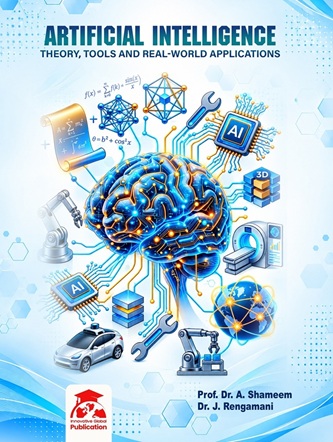
Editors: Prof. Dr. A. Shameem and Dr. J. Rengamani
ISBN: 978-81-69857-67-3
DOI: https://doi.org/10.59646/819
Date of Publication: September 14, 2026
Chapters and Authors
Chapter 14: AI Applications in Supply Chain Optimization and Logistics Management – Ms. M. Nasreen
Chapter 15: Practical Uses of Deep Learning in Medical Image Analysis – Ms. B. Geno Cinthia
Chapter 17: AI-Powered Recommendation Systems in E-Commerce Platforms – Dr. K. Loura Jency
Chapter 19: Practical Applications of AI in Legal Research and Contract Analysis – Dr. S. Lakshmanan
Preface
Artificial Intelligence (AI) has emerged as one of the most transformative technologies of the twenty-first century, influencing the way individuals, organizations, industries, and societies solve problems, make decisions, and create value. From intelligent automation and predictive analytics to generative AI, computer vision, natural language processing, and deep learning, AI is rapidly moving beyond theoretical research into practical applications across diverse domains. The growing accessibility of AI tools has further accelerated this transformation, making intelligent technologies increasingly relevant to researchers, educators, professionals, entrepreneurs, and students.
The book Artificial Intelligence: Theory, Tools and Real-World Applications presents a comprehensive and application-oriented exploration of contemporary artificial intelligence. Rather than limiting the discussion to theoretical concepts, the book emphasizes the practical use of AI tools and techniques in solving real-world challenges. It brings together contributions that demonstrate how AI can improve efficiency, accuracy, innovation, decision-making, and service delivery across multiple sectors.
The chapters cover a wide spectrum of applications, including supply chain optimization and logistics, scientific research, digital marketing, cybersecurity, human resource recruitment, the Internet of Things, e-commerce recommendation systems, smart cities, healthcare, manufacturing, and smart agriculture. The book also examines emerging applications in creative design, multimedia production, predictive analytics, business intelligence, personalized education, financial fraud detection, multilingual communication, computer vision, medical image analysis, higher education, explainable AI, and legal research. Collectively, these contributions illustrate the versatility of AI and its growing significance in both professional and academic environments. An important strength of this volume is its balanced consideration of opportunities and challenges. While AI can provide substantial benefits through automation, personalization, prediction, and intelligent decision-making, its implementation also raises important concerns related to ethics, transparency, privacy, accountability, bias, security, and responsible use. The inclusion of a dedicated discussion on ethical considerations and explainable AI highlights the need to ensure that technological advancement is accompanied by human values, trust, and responsible governance. This book is intended to serve as a useful reference for students, educators, researchers, industry professionals, and practitioners who wish to understand the practical dimensions of artificial intelligence. It may also support readers who are beginning their journey with AI tools and seeking examples of how these technologies can be translated into meaningful real-world solutions. The contributors to this volume have brought together diverse perspectives and applications, reflecting the interdisciplinary nature of artificial intelligence. It is hoped that this book will encourage readers not only to understand the capabilities of AI but also to critically evaluate its limitations, explore innovative applications, and contribute responsibly to the evolving AI-driven world.