Artificial Intelligence in Oral Medicine and Radiology
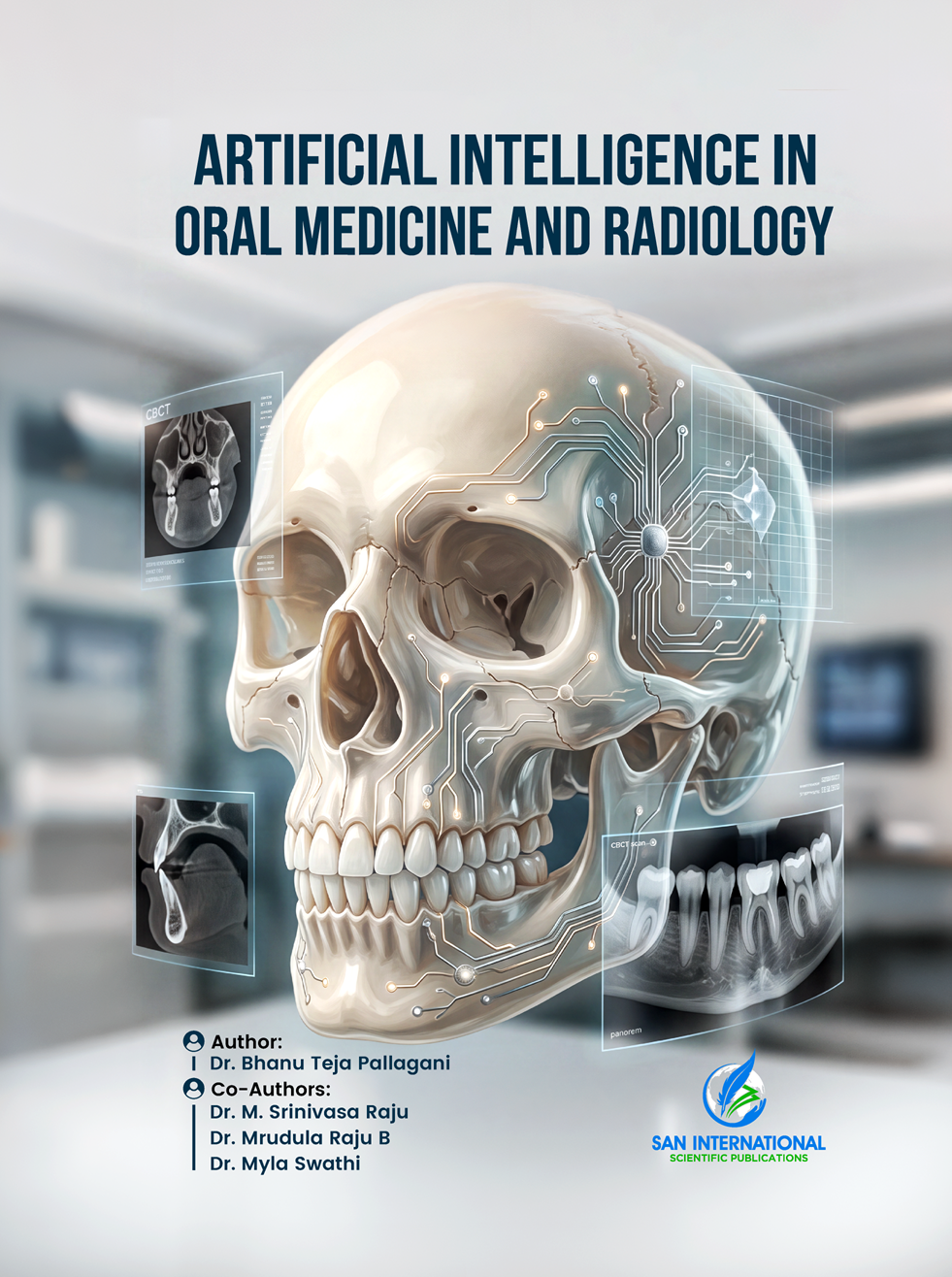
Artificial Intelligence in Oral Medicine and Radiology
Author: Dr. Bhanu Teja Pallagani
Co-Authors: Dr. M. Srinivasa Raju, Dr. Mrudula Raju B, and Dr. Myla Swathi
ISBN: 978-81-69857-22-2
DOI: https://doi.org/10.59646/780
Date of Publication: July 27, 2026
Cite this book: Bhanu TP, Srinivasa RM, Mrudula RB, and Myla S, (2026), Artificial Intelligence in Oral Medicine and Radiology, San International Scientific Publications, ISBN: 978-81-69857-22-2, DOI: https://doi.org/10.59646/780
Preface
Artificial Intelligence (AI) is transforming healthcare by enabling faster, more accurate, and data-driven clinical decision-making. In dentistry, particularly in Oral Medicine and Oral Radiology, AI has become an invaluable tool for enhancing diagnostic accuracy, interpreting radiographic images, detecting oral diseases at an early stage, supporting treatment planning, and improving patient care. The integration of machine learning, deep learning, and computer vision technologies is reshaping traditional dental practices and paving the way for precision dentistry.
Artificial Intelligence in Oral Medicine and Radiology has been designed to provide students, academicians, researchers, and dental practitioners with a comprehensive introduction to the concepts, applications, and future potential of AI in dental healthcare. The book begins with the fundamentals and evolution of artificial intelligence, followed by its relevance to dentistry, core AI concepts, and the development of AI-based radiograph annotation platforms. It further explores predictive analytics, AI applications across dental specialties, annotation tools, commercial AI solutions, and the latest advances in intelligent diagnostic systems.
In addition to technological developments, this book highlights the challenges, limitations, ethical considerations, and regulatory aspects associated with the implementation of AI in dentistry. It emphasizes the importance of responsible and evidence-based adoption of AI technologies while recognizing that these systems are intended to support—not replace—the clinical expertise of dental professionals.
It is hoped that this book will serve as a valuable reference for undergraduate and postgraduate students, educators, researchers, and clinicians seeking to understand the evolving role of artificial intelligence in Oral Medicine and Radiology. By combining theoretical foundations with practical applications, this text aims to contribute to the advancement of digital dentistry and inspire future innovations in oral healthcare.