
Artificial Intelligence in Education: Foundation and Frontiers
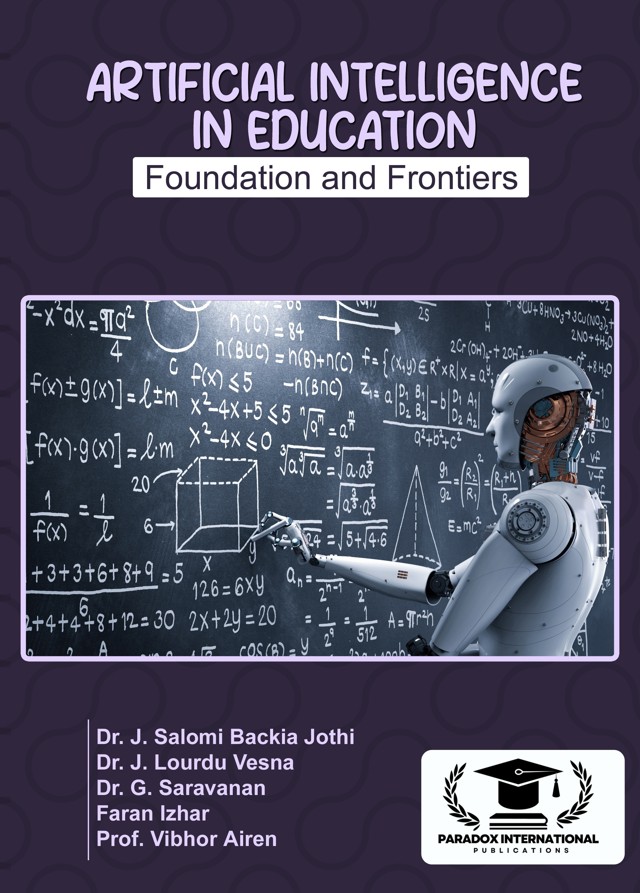
Artificial Intelligence in Education: Foundation and Frontiers
Authors: Dr. J. Salomi Backia Jothi, Dr. J. Lourdu Vesna, Dr. G. Saravanan, Faran Izhar and Prof. Vibhor Airen
ISBN: 978-93-7183-090-4
DOI: https://doi.org/10.59646/495
Date of Publication: October 19, 2024
About the Book:
The twenty-first century has witnessed an unprecedented convergence of technology and education, reshaping how knowledge is created, delivered, and consumed. Among the most transformative forces of this era stands Artificial Intelligence (AI) — a discipline that not only redefines the capabilities of machines but also reimagines the future of learning itself. Artificial Intelligence in Education: Foundation and Frontiers is designed to guide readers through this evolving landscape, offering both a conceptual framework and a practical understanding of AI’s role in modern educational ecosystems.
This textbook serves a dual purpose: to introduce the foundational principles of artificial intelligence and to explore its cutting-edge applications in teaching, learning, and educational administration. From intelligent tutoring systems and adaptive learning platforms to data-driven decision-making and ethical governance, the chapters within this volume connect theory to practice with academic rigor and real-world relevance. The goal is not merely to describe AI tools but to inspire a critical dialogue on how AI can enhance — rather than replace — human-centered education.
The Foundation section delves into the core concepts of AI, including machine learning, natural language processing, neural networks, and data analytics. It offers educators and students a grounding in how these technologies function and how they can be meaningfully integrated into pedagogical design. The Frontiers section moves beyond fundamentals to examine emerging innovations such as generative AI, personalized learning algorithms, emotional recognition systems, and AI-driven assessment models. These discussions are complemented by case studies, global perspectives, and ethical considerations, ensuring a holistic understanding of the opportunities and challenges at the intersection of AI and education.
This book is intended for a wide audience — educators seeking to leverage technology in their classrooms, researchers exploring AI’s pedagogical implications, and students of computer science, educational technology, and cognitive science who wish to grasp the interdisciplinary nature of this field. The structure of the text allows for both linear study and modular reference, making it suitable for academic courses, professional development, and independent learning.
As we stand at the frontier of a new educational paradigm, it becomes imperative to understand AI not as a distant innovation but as an integral component of the learning experience. The authors hope this textbook will empower readers to engage with AI thoughtfully, creatively, and responsibly — shaping a future where technology amplifies human potential and education remains a deeply human endeavour.