Artificial Intelligence for Science Students: A Beginner’s Guide
Artificial Intelligence for Science Students: A Beginner’s Guide
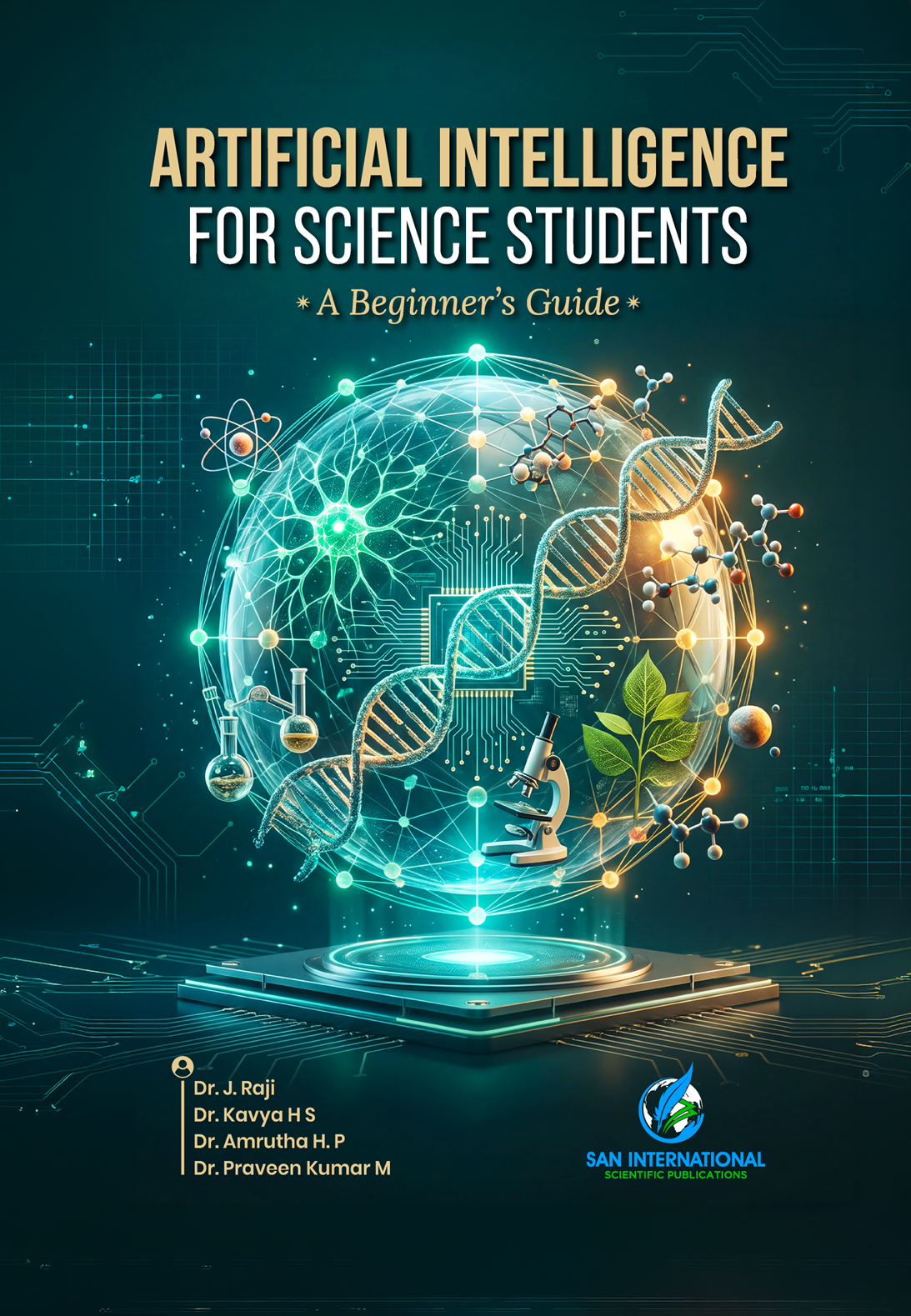
Authors: Dr. J. Raji, Dr. Kavya H S, Dr. Amrutha H. P, and Dr. Praveen Kumar M
ISBN: 978-81-17787-36-6
DOI: https://doi.org/10.59646/891
Date of Publication: November 18, 2026
Preface
Artificial Intelligence for Science Students: A Beginner’s Guide is designed to introduce the fundamental concepts, mathematical principles, computational techniques and practical applications of artificial intelligence (AI) to students from diverse scientific disciplines. Artificial intelligence has emerged as a transformative technology, influencing the way scientific data are analysed, experiments are designed, complex problems are solved and new discoveries are made. This book aims to develop a clear understanding of AI by presenting its concepts in a structured, accessible and student-friendly manner, beginning with the basic principles and gradually progressing towards advanced applications in scientific research. It introduces the history and evolution of AI, different types of intelligent systems, the relationship between artificial and human intelligence, essential AI terminology and its applications in everyday life and scientific investigations. Particular emphasis is placed on understanding how AI supports scientific discovery, improves analytical capabilities and assists researchers in interpreting complex datasets across multiple domains.
The book further explores the mathematical foundations essential for understanding artificial intelligence, including sets, functions, matrices, vectors, probability, statistics, calculus and optimization techniques. These concepts provide the necessary background for understanding how intelligent models learn from data, identify patterns and generate predictions. The fundamentals of machine learning are discussed through supervised, unsupervised, semi-supervised, self-supervised and reinforcement learning approaches, together with data preparation, feature engineering, model training, validation, testing and evaluation. Important algorithms such as linear regression, logistic regression, decision trees, K-nearest neighbours and clustering techniques are explained with practical examples and simple Python implementations.
A significant portion of the book is devoted to exploring the applications of artificial intelligence across major scientific disciplines, including mathematics, physics, chemistry, biology, environmental science, healthcare and engineering. It explains how AI techniques contribute to mathematical modelling, physical simulations, molecular property prediction, protein structure analysis, weather forecasting, environmental monitoring, medical image interpretation, predictive maintenance and intelligent engineering systems. Practical examples, mini projects, case studies and review questions are incorporated to strengthen conceptual understanding and encourage students to apply their knowledge to real-world scientific problems. The book also highlights the importance of scientific validation, reproducibility, uncertainty assessment, responsible AI utilization and the limitations of computational models in research.
By integrating basic theoretical knowledge, mathematical understanding, machine learning methods, programming examples and interdisciplinary scientific applications, this book aims to make artificial intelligence accessible to students who may have limited prior experience in computer science or programming. It encourages learners to develop analytical thinking, computational confidence and an interdisciplinary approach to solving scientific challenges. The book is intended to serve as a valuable learning resource for undergraduate and postgraduate students, science educators, researchers and beginners interested in understanding and applying artificial intelligence in modern scientific education and research.