Artificial Intelligence as A Strategic Bridge Between Marketing and HR Functions
Artificial Intelligence as A Strategic Bridge Between Marketing and HR Functions
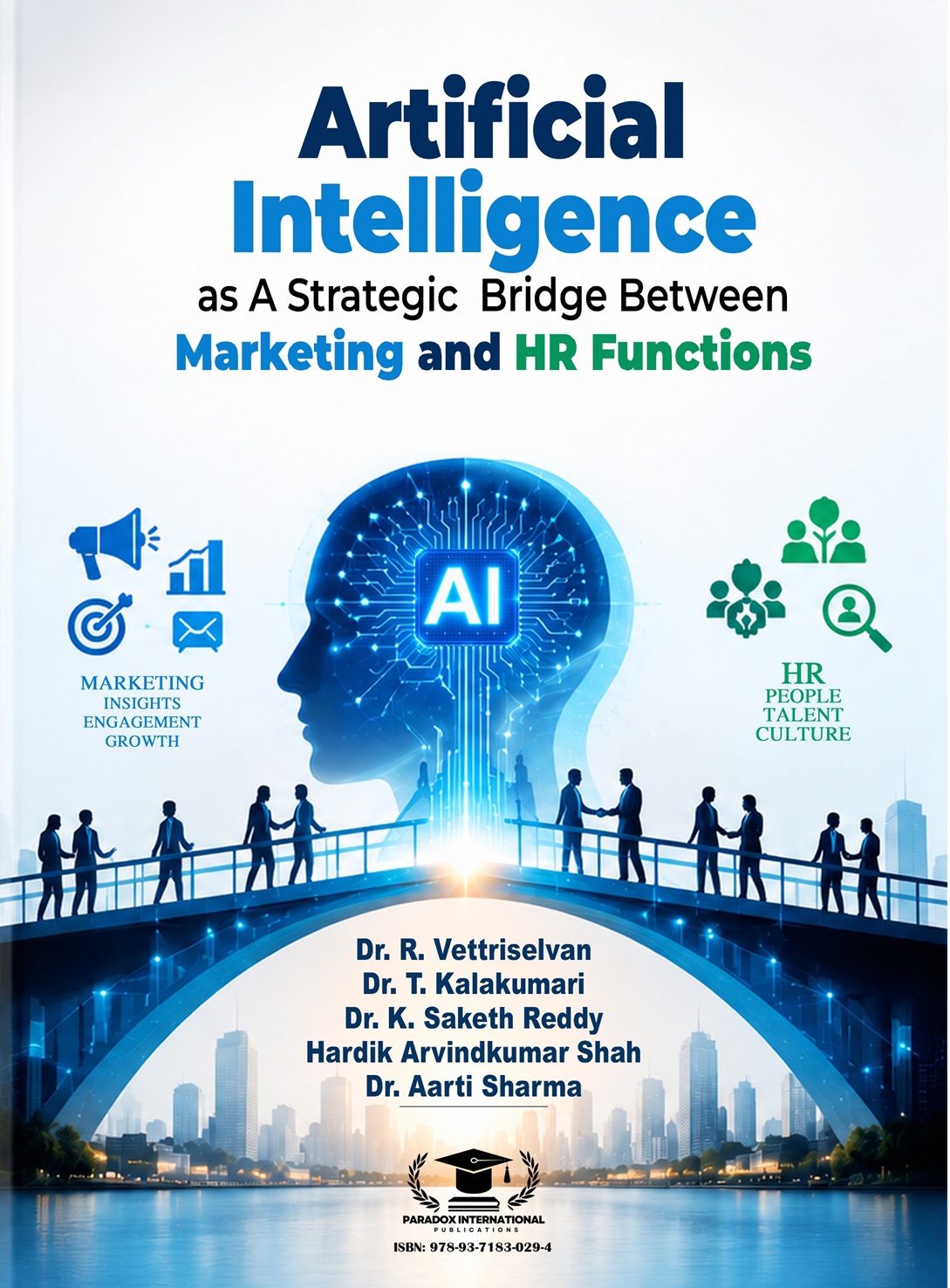
Authors: Dr. R. Vettriselvan, Dr. T. Kalakumari, Dr. K. Saketh Reddy, Hardik Arvindkumar Shah, and Dr. Aarti Sharma
ISBN: 978-93-7183-029-4
DOI: https://doi.org/10.59646/827
Date of Publication: September 21, 2026
Preface
Artificial Intelligence (AI) is rapidly transforming the way organizations create value, compete in markets, manage talent, and build sustainable relationships with stakeholders. Once regarded primarily as a technological innovation, AI has evolved into a strategic business capability that influences decision-making across functional boundaries. Among the organizational functions experiencing significant transformation, Marketing and Human Resource Management (HRM) occupy a particularly important position. While marketing focuses on customers, markets, brands, and revenue generation, HR focuses on people, capabilities, organizational culture, and employee performance. Artificial Intelligence provides a strategic bridge between these functions by enabling organizations to integrate customer intelligence with workforce intelligence and align human capabilities with changing market expectations.
The textbook Artificial Intelligence as a Strategic Bridge Between Marketing and HR Functions has been developed to provide a comprehensive understanding of how AI can facilitate greater integration between marketing and human resource functions. The central premise of this book is that organizational success increasingly depends on the ability to connect external market intelligence with internal human capabilities. AI-powered tools can analyse customer behaviour, predict market trends, personalize marketing strategies, identify talent requirements, support employee engagement, and enhance workforce planning. When these capabilities are strategically integrated, organizations can develop more responsive, innovative, and people-centred approaches to business management.
The book explores the changing relationship between Marketing and HRM in the context of digital transformation and AI adoption. It examines how customer expectations influence workforce requirements and how employee capabilities, engagement, creativity, and organizational culture can ultimately shape customer experiences and brand outcomes. AI creates opportunities to establish continuous feedback mechanisms between these two functions, allowing organizations to use data-driven insights for both customer management and people management.
Particular attention is given to AI applications such as machine learning, predictive analytics, natural language processing, generative AI, recommendation systems, sentiment analysis, intelligent automation, and AI-enabled decision-support systems. Their applications in areas such as customer segmentation, personalized marketing, social media analytics, talent acquisition, employee experience, performance management, learning and development, workforce analytics, employer branding, and strategic workforce planning are discussed from an organizational perspective.
At the same time, the textbook recognizes that AI adoption is not simply a technological exercise. It involves important managerial, ethical, social, and human considerations. Issues relating to algorithmic bias, data privacy, transparency, employee surveillance, explainability, digital skills, job transformation, and responsible AI are therefore incorporated into the discussion. The objective is not to portray AI as a replacement for human expertise, but to examine how intelligent technologies can complement human judgement, creativity, empathy, and strategic thinking.
Another important theme of this book is the convergence of customer experience and employee experience. Modern organizations increasingly recognize that satisfied, skilled, engaged, and empowered employees can contribute to stronger customer relationships and brand performance. AI can support this connection by identifying patterns across customer feedback, employee feedback, performance indicators, and market data. Such integration can help organizations understand how workforce strategies influence customer outcomes and how customer expectations should inform talent and capability development.
The textbook is designed to be useful for undergraduate and postgraduate students, researchers, academicians, management professionals, HR practitioners, marketing professionals, entrepreneurs, and organizational leaders interested in the strategic implications of Artificial Intelligence. It combines conceptual foundations with practical managerial perspectives so that readers can understand not only what AI technologies can do, but also how they can be strategically integrated into organizational functions.
The chapters collectively seek to develop a multidisciplinary perspective in which Marketing and HRM are no longer viewed as isolated functional domains. Instead, they are presented as interconnected components of an AI-enabled organization. The book encourages readers to think beyond automation and consider AI as an enabler of collaboration, organizational learning, innovation, employee development, customer-centricity, and strategic decision-making.
As organizations move toward increasingly data-driven and intelligent operating models, the ability to integrate technology with human potential will become a defining source of competitive advantage. This textbook is therefore an attempt to contribute to the growing academic and professional discussion on AI-enabled management by presenting Marketing and HRM as complementary functions connected through intelligence, data, people, and strategy.
It is hoped that this book will provide readers with meaningful conceptual insights, practical perspectives, and a foundation for further research into the evolving intersection of Artificial Intelligence, Marketing, and Human Resource Management. The ultimate objective is to encourage organizations to adopt AI not merely as a technological tool, but as a strategic mechanism for creating value for customers, employees, and the organization as a whole.