
Artificial Intelligence and Machine Learning: Foundations, Algorithms, Deep Learning, and Intelligent Applications
Artificial Intelligence and Machine Learning: Foundations, Algorithms, Deep Learning, and Intelligent Applications
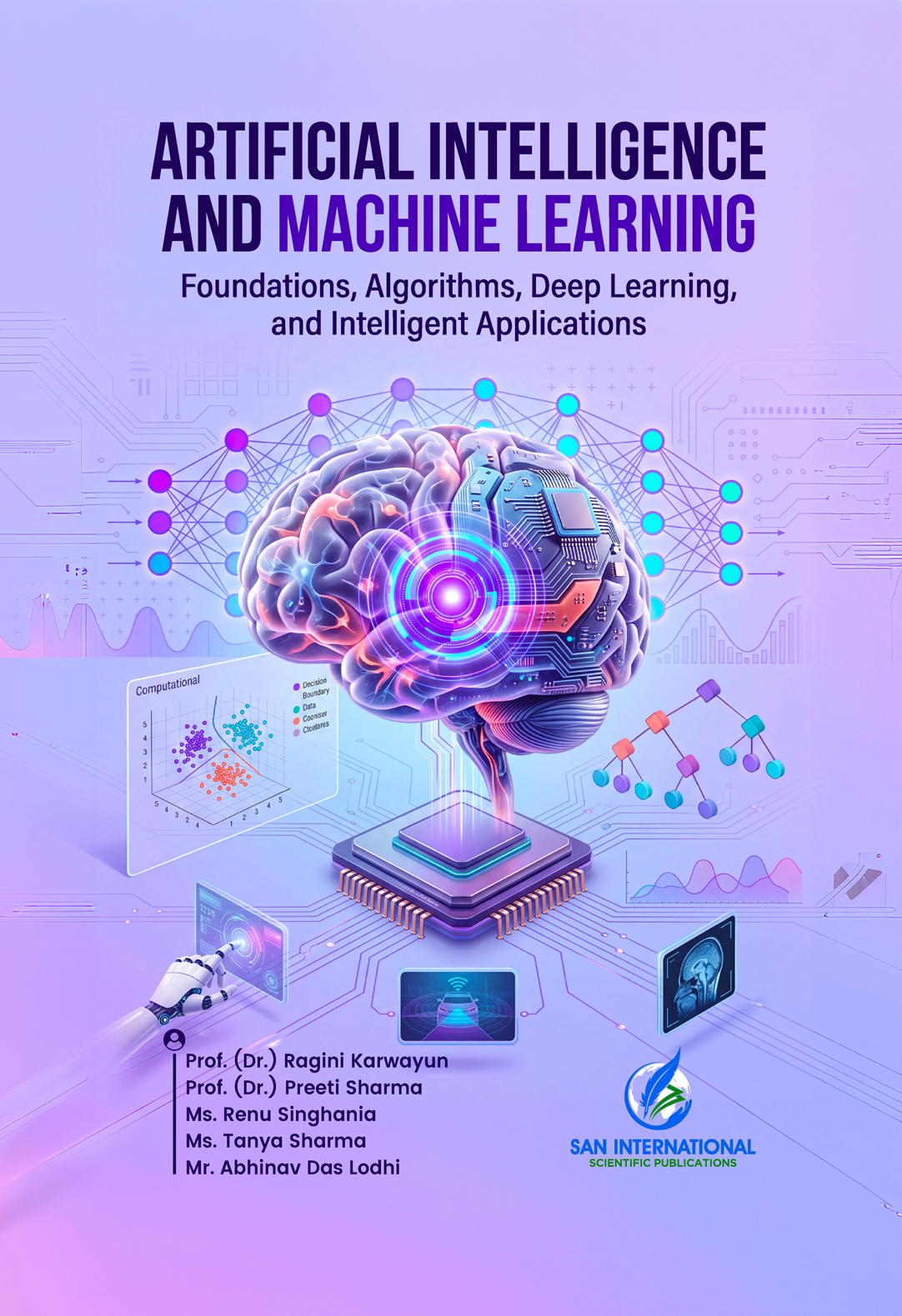
Authors: Prof. (Dr.) Ragini Karwayun, Prof. (Dr.) Preeti Sharma, Ms. Renu Singhania, Ms. Tanya Sharma, and Mr. Abhinav Das Lodhi
ISBN: 978-81-17787-02-1
DOI: https://doi.org/10.59646/858
Date of Publication: October 23, 2026
Preface
Artificial Intelligence and Machine Learning have become transformative technologies, enabling intelligent decision-making, automation, predictive analysis, and innovative problem-solving across diverse domains. The book Artificial Intelligence and Machine Learning: Foundations, Algorithms, Deep Learning, and Intelligent Applications presents a comprehensive exploration of the fundamental principles, mathematical foundations, learning algorithms, advanced architectures, and practical applications of intelligent systems. It begins with Artificial Intelligence fundamentals, including intelligent agents, task environments, state-space search, knowledge representation, logical reasoning, and expert systems. The mathematical foundations of linear algebra, probability, statistics, calculus, and numerical optimization are introduced alongside data preprocessing, feature engineering, and exploratory data analysis. The book subsequently examines machine learning methodologies, covering supervised, unsupervised, and reinforcement learning, together with regression, classification, clustering, dimensionality reduction, association rule mining, and ensemble techniques. Model training, validation, generalization, evaluation, and hyperparameter optimization are discussed to establish a systematic understanding of effective machine learning development.
The book further explores artificial neural networks and deep learning architectures, including multilayer perceptrons, convolutional neural networks, recurrent neural networks, long short-term memory networks, autoencoders, transformers, generative adversarial networks, and variational autoencoders. Specialized chapters address computer vision and natural language processing, encompassing image classification, object detection, segmentation, text representation, sentiment analysis, language models, machine translation, and text summarization. Reinforcement learning concepts, including Markov decision processes, Bellman equations, Q-learning, and deep reinforcement learning, demonstrate the role of intelligent agents in autonomous systems and decision-making. Contemporary developments such as generative AI, large language models, prompt engineering, retrieval-augmented generation, AI agents, and explainable AI are also examined, alongside responsible AI practices involving fairness, privacy, security, and governance. The concluding chapter focuses on practical implementation through model deployment, API integration, MLOps, cloud AI, edge AI, TinyML, and applications in healthcare, finance, agriculture, industry, and smart cities. By integrating theoretical explanations, algorithmic foundations, and application-oriented discussions, this book serves as a valuable resource for students, research scholars, educators, and professionals seeking to understand and apply intelligent computational methods. It aims to bridge the gap between theoretical knowledge and practical implementation while encouraging innovation, research, and the responsible development of AI and ML solutions for emerging computational and societal challenges.