
Artificial Intelligence and Machine Learning: Foundations, Algorithms, and Applications
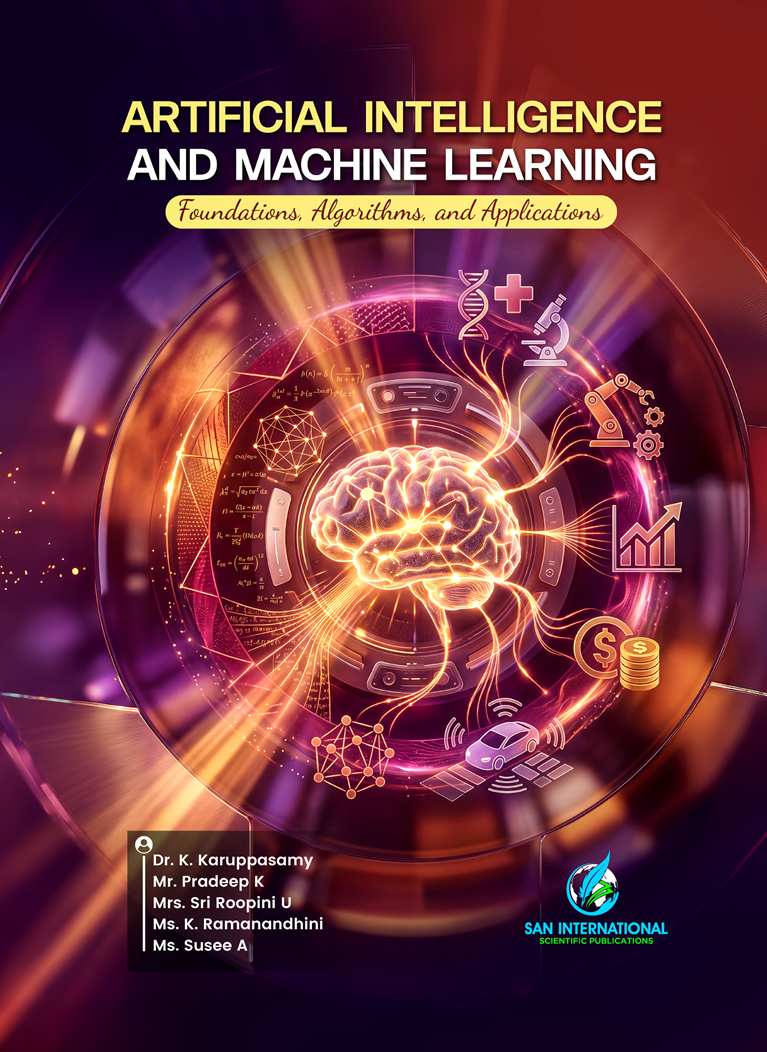
Artificial Intelligence and Machine Learning: Foundations, Algorithms, and Applications
Authors: Dr. K. Karuppasamy, Mr Pradeep K, Mrs. Sri Roopini U, Ms. K. Ramanandhini, and Ms. Susee A
ISBN: 978-81-69857-09-3
DOI: https://doi.org/10.59646/754
Date of Publication: July 13, 2026
Cite this book: Karuppasamy K, Pradeep K, Sri RU, Ramanandhini K, and Susee A, (2026), Artificial Intelligence and Machine Learning: Foundations, Algorithms, and Applications, San International Scientific Publications, ISBN: 978-81-69857-09-3, DOI: https://doi.org/10.59646/754
Preface
Artificial Intelligence (AI) and Machine Learning (ML) have emerged as the defining technologies of the twenty-first century, transforming the way humans interact with information, make decisions, and solve complex real-world problems. From intelligent virtual assistants and autonomous vehicles to precision healthcare, financial forecasting, smart manufacturing, and scientific discovery, AI and ML are reshaping every sector of society. Their rapid evolution has created an unprecedented demand for professionals, researchers, educators, and students who possess not only theoretical knowledge but also the practical skills required to design, develop, and deploy intelligent systems. This book, Artificial Intelligence and Machine Learning: Foundations, Algorithms, and Applications, has been written to serve as a comprehensive guide that bridges fundamental principles with modern computational techniques and real-world applications.
The book adopts a structured learning approach that begins with the historical evolution of artificial intelligence, intelligent agents, knowledge representation, reasoning mechanisms, and problem-solving paradigms before progressing to the mathematical and statistical foundations essential for machine learning. Recognizing that successful AI systems depend heavily on high-quality data, dedicated chapters explore data acquisition, preprocessing, feature engineering, exploratory data analysis, and machine learning pipelines. These foundational concepts provide readers with a solid understanding of how intelligent systems are built upon carefully prepared datasets and rigorous mathematical models. A major strength of this book lies in its comprehensive treatment of machine learning algorithms. Classical supervised learning methods such as linear regression, logistic regression, decision trees, support vector machines, k-nearest neighbors, and neural networks are explained alongside unsupervised learning techniques including clustering, principal component analysis, anomaly detection, and self-organizing maps. The discussion extends beyond algorithmic descriptions to include optimization techniques, loss functions, evaluation metrics, cross-validation strategies, and the bias–variance trade-off, enabling readers to understand not only how algorithms function but also how their performance can be measured and improved.
As artificial intelligence continues to evolve, deep learning has become one of its most influential branches. This book provides detailed coverage of multilayer perceptrons, convolutional neural networks, recurrent neural networks, long short-term memory networks, transformer architectures, transfer learning, and model optimization techniques. Reinforcement learning is introduced through Markov decision processes, Q-learning, SARSA, policy gradient methods, and multi-agent decision systems, allowing readers to appreciate how intelligent agents learn optimal behaviors through interaction with dynamic environments. These advanced topics are presented in a systematic manner that makes complex concepts accessible while maintaining the mathematical rigor expected in higher education and research. Beyond algorithm development, the book recognizes that modern AI systems must be deployed, monitored, and maintained effectively. Dedicated chapters discuss AI project lifecycle management, cloud and edge AI, distributed machine learning, deployment strategies, model monitoring, data drift detection, predictive and prescriptive analytics, and intelligent decision systems.
Ethical and regulatory considerations are also introduced to encourage the responsible development and deployment of AI technologies in accordance with societal values, transparency, fairness, and accountability. Designed for undergraduate and postgraduate students, research scholars, faculty members, industry professionals, and AI practitioners, this book combines conceptual explanations, mathematical formulations, algorithmic insights, and practical perspectives into a unified learning resource. Every chapter has been carefully organized to build knowledge progressively while reflecting current advances in artificial intelligence and machine learning. It is our sincere hope that this book will inspire readers to explore the limitless possibilities of intelligent systems, strengthen their analytical and problem-solving abilities, and contribute meaningfully to the future development of artificial intelligence for the benefit of science, industry, and society.