Artificial Intelligence Across Disciplines: Research, Innovation, and Intelligent Solutions
Artificial Intelligence Across Disciplines: Research, Innovation, and Intelligent Solutions
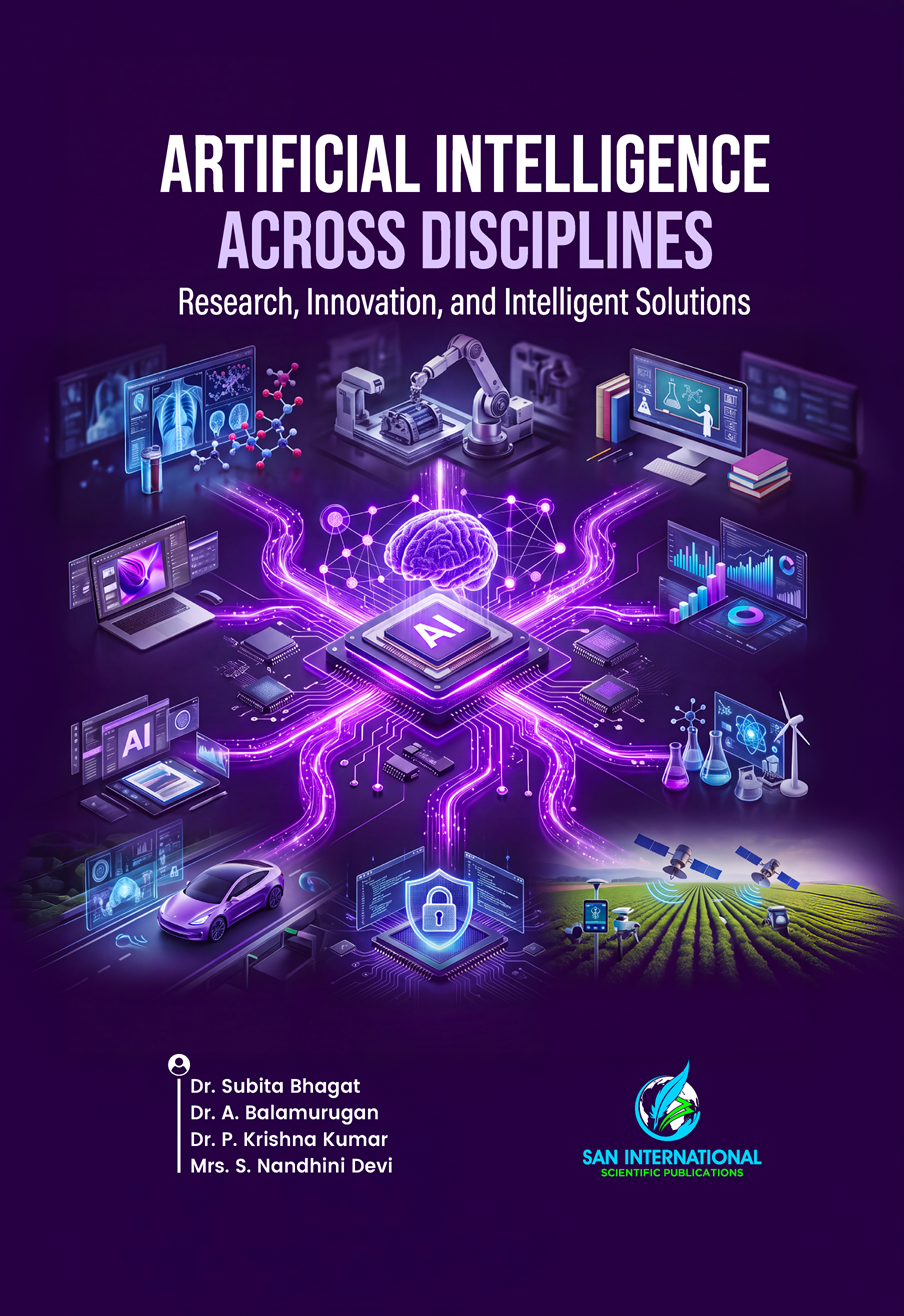
Editors: Dr. Subita Bhagat, Dr. A. Balamurugan, Dr. P. Krishna Kumar, and Mrs. S. Nandhini Devi
ISBN: 978-81-69857-83-3
DOI: https://doi.org/10.59646/815
Date of Publication: October 11, 2026
Chapters and Authors
Chapter 1: AI-Powered Cloud Computing and Intelligent Resource Management – S Rubini
Chapter 2: Internet of Things and AI for Autonomous Smart Environments – H. Pushpakalavalli
Chapter 6: Generative AI in Human Resource Management and the Future of Work – Dr. Shilpa Khanna
Chapter 12: Artificial Intelligence in Financial Markets, and Economic Risk Prediction – S. Bharathi
Preface
Artificial intelligence has evolved from a specialized area of computer science into a transformative technological paradigm influencing research, industry, business, science, engineering, healthcare, finance, education, and numerous emerging domains. Artificial Intelligence Across Disciplines: Research, Innovation, and Intelligent Solutions presents a multidisciplinary perspective on the rapidly expanding applications of AI, machine learning, deep learning, generative AI, intelligent computing, and autonomous systems. The book brings together diverse research contributions that demonstrate how intelligent technologies can address complex problems, improve decision-making, optimize resources, enhance automation, and create innovative solutions across conventional and emerging fields.
The chapters examine a broad spectrum of contemporary AI applications, beginning with AI-powered cloud computing, intelligent resource management, and AI-enabled Internet of Things environments, followed by deep learning approaches for computer vision, visual recognition, and image analytics. The book further explores generative artificial intelligence and foundation models, blockchain-enabled federated learning, explainable and trustworthy AI, and privacy-preserving data analytics, highlighting the growing importance of intelligent systems that are scalable, secure, adaptive, and responsible. Applications of AI in human resource management, smart manufacturing, software engineering, energy and environmental physics, financial markets, accounting, auditing, and economic risk prediction demonstrate the interdisciplinary reach of modern artificial intelligence.
The later chapters extend the discussion toward autonomous and adaptive intelligent systems, dynamic cloud resource allocation, self-evolving AI, quantum artificial intelligence, AI-driven materials chemistry, machine-to-machine intelligence, materials science, distributed computing, semantic computing, knowledge representation, and autonomous information discovery. These contributions collectively illustrate the transition from conventional data-driven automation toward intelligent ecosystems capable of learning, adapting, reasoning, optimizing, and operating with increasing levels of autonomy. Particular emphasis is placed on the convergence of AI with emerging computational paradigms and domain-specific technologies, reflecting the growing need for interdisciplinary approaches to research and innovation. This book is intended for researchers, academicians, postgraduate students, technology professionals, engineers, innovators, and practitioners seeking an updated understanding of AI-driven developments across multiple disciplines. By bringing together diverse perspectives and application-oriented research, the book seeks to encourage interdisciplinary collaboration, stimulate new research directions, and support the development of intelligent solutions for complex real-world challenges. It serves not only as a collection of contemporary research contributions but also as a reflection of the expanding role of artificial intelligence in shaping intelligent, adaptive, and technologically advanced systems.