
AI-Integrated Research Methodology: Foundations and Practices
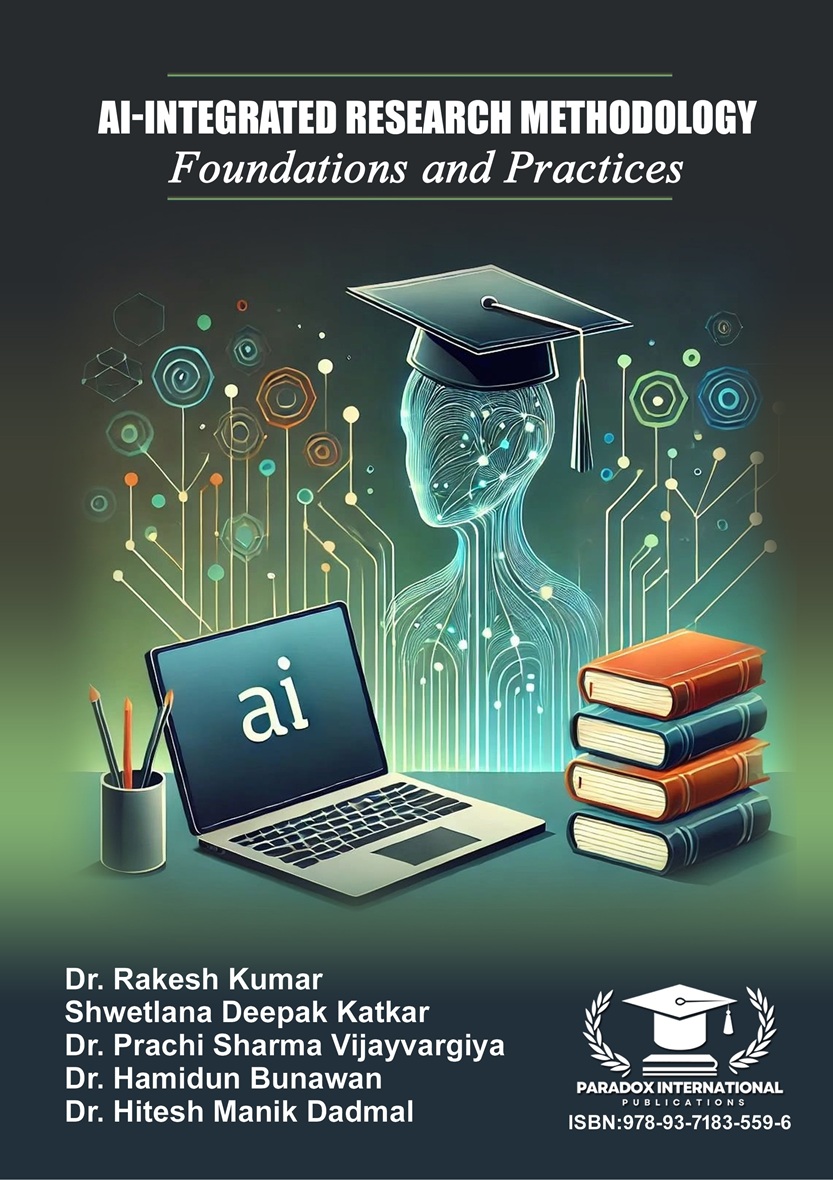
AI-Integrated Research Methodology: Foundations and Practices
Authors: Dr. Rakesh Kumar, Shwetlana Deepak Katkar, Dr. Prachi Sharma Vijayvargiya, Dr. Hamidun Bunawan, and Dr. Hitesh Manik Dadmal
ISBN: 978-93-7183-559-6
DOI: https://doi.org/10.59646/691
Date of Publication: May 15, 2026
Cite this book: Rakesh K, Shwetlana DK, Prachi SV, Hamidun B, and Hitesh MD, (2026), AI-Integrated Research Methodology: Foundations and Practices, Paradox International Publications & San International Scientific Publications, ISBN: 978-93-7183-559-6, DOI: https://doi.org/10.59646/691
Preface
Research methodology has always been the foundation of scientific inquiry, academic excellence, and evidence-based decision-making. In recent years, the rapid advancement of Artificial Intelligence (AI) has transformed the way research is designed, conducted, analyzed, and communicated across disciplines. The integration of AI technologies into research processes has opened new possibilities for innovation, efficiency, accuracy, and interdisciplinary collaboration. Against this backdrop, the present textbook, AI-Integrated Research Methodology: Foundations and Practices, has been developed to provide a comprehensive understanding of both traditional research principles and modern AI-enabled research practices.
This book is designed for undergraduate students, postgraduate learners, research scholars, academicians, and professionals who seek to understand how AI can be responsibly and effectively integrated into research activities. The text bridges the gap between classical research methodology and emerging digital research ecosystems by combining theoretical foundations with practical applications. It introduces readers to the evolving landscape of AI-assisted research tools, data analytics, machine learning applications, automated literature review systems, intelligent survey techniques, predictive modeling, and ethical considerations in AI-driven inquiry.
The primary objective of this book is to equip learners with methodological competence and technological awareness required in contemporary research environments. While maintaining the rigor of conventional research design, hypothesis formulation, sampling, data collection, and statistical analysis, the book also highlights how AI technologies can enhance research productivity, data interpretation, visualization, academic writing, and decision-making processes. The text emphasizes that AI should function as an enabling tool that supports human intelligence, critical thinking, creativity, and ethical scholarship rather than replacing them.
The chapters are organized systematically to ensure conceptual clarity and practical relevance. Beginning with the fundamentals of research and scientific inquiry, the book gradually progresses toward quantitative, qualitative, and mixed-method approaches integrated with AI applications. Special attention has been given to AI-assisted data analysis, natural language processing, research automation tools, bibliometric analysis, digital ethics, plagiarism detection, and responsible use of generative AI in academic research. Case studies, illustrations, practical exercises, and contemporary examples have been included to enhance experiential learning and application-oriented understanding.
In an era where data has become central to governance, business, healthcare, education, and social sciences, researchers must develop the ability to critically evaluate digital tools and algorithmic outputs. Therefore, this book also addresses important issues such as algorithmic bias, data privacy, transparency, reproducibility, cybersecurity, and ethical standards in AI-enabled research. The discussion aims to encourage responsible innovation and integrity in scholarly practices.
The preparation of this book has been inspired by the growing need for interdisciplinary research education that aligns with technological advancements and global academic standards. Every effort has been made to present the content in a clear, structured, and learner-friendly manner while maintaining academic depth and analytical rigor.
It is hoped that this textbook will serve as a valuable resource for students, teachers, researchers, and institutions seeking to adapt research practices to the demands of the digital and AI-driven age. Constructive suggestions from readers and scholars for further improvement of future editions will be sincerely welcomed.