
AI in Fintech: Predictive Analytics and Decision-Making
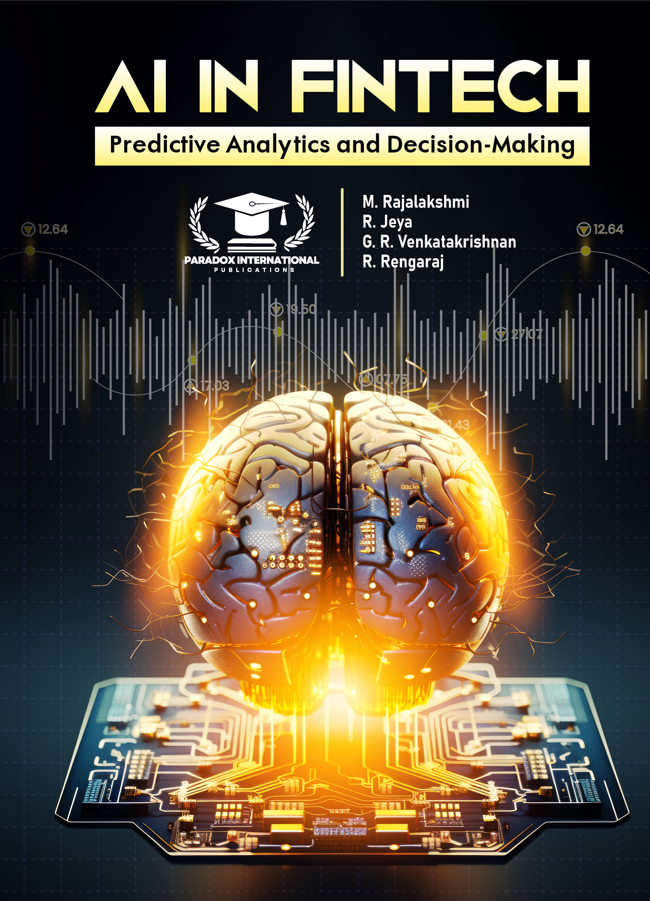
AI in Fintech: Predictive Analytics and Decision-Making
Authors: Dr. M. Rajalakshmi, Dr. R. Jeya, Dr. G. R. Venkatakrishnan and Dr. R. Rengaraj
ISBN: 978-81-986047-4-3
DOI: https://doi.org/10.59646/af/322
Date of Publication: March 05, 2025
About the Book:
The rapid evolution of Artificial Intelligence (AI) has significantly reshaped the financial technology (Fintech) landscape, revolutionizing how financial institutions assess risks, make decisions, and personalize services. As AI-driven predictive analytics and decision-making continue to gain prominence, it is crucial to understand their transformative potential, challenges, and ethical considerations. This book, AI in Fintech: Predictive Analytics and Decision-Making, aims to provide a comprehensive exploration of AI’s role in modern financial services, equipping researchers, practitioners, and policymakers with the knowledge needed to navigate this dynamic field.
The book is structured to offer a balanced mix of theoretical foundations, practical applications, and emerging trends. We begin by laying the groundwork in Chapter 1, where we discuss the evolution of AI in financial services and its key drivers. From there, we explore predictive analytics (Chapter 2) and its applications in risk assessment, fraud detection, and forecasting, demonstrating how AI enhances decision-making in finance. Chapter 3 delves deeper into AI’s role in decision-making, comparing AI-driven and human decision processes while addressing ethical considerations.
Subsequent chapters introduce key AI techniques that power Fintech innovations. Chapters 4 and 5 discuss machine learning models and natural language processing (NLP), showcasing their applications in risk modeling, sentiment analysis, and customer engagement. The significance of big data in AI-driven financial services (Chapter 6) and the role of AI in risk management and fraud detection (Chapter 7) are also thoroughly examined.
The book further explores AI’s impact on core financial operations, including algorithmic trading (Chapter 8), credit scoring (Chapter 9), and personalized financial services (Chapter 10). We highlight how AI enhances financial decision-making frameworks, customer interactions, and regulatory compliance (Chapters 11 and 12), while also addressing the ethical and security challenges associated with AI adoption (Chapter 13).
Looking ahead, Chapters 14 through 17 present emerging trends, case studies of AI implementation in financial institutions, and ongoing research frontiers in AI and Fintech. We examine cutting-edge developments such as quantum computing, decentralized finance (DeFi), and AI governance frameworks. The book concludes with Chapter 18, offering policy recommendations for responsible AI adoption and future directions for financial institutions and regulators.
As authors, we have drawn from extensive academic research, industry insights, and real-world applications to craft this book as a valuable resource for financial professionals, AI practitioners, researchers, and students. We hope this book will serve as both a foundational guide and an inspiration for further exploration into the evolving synergy between AI and financial technology.
We extend our gratitude to the researchers, industry experts, and institutions whose contributions and innovations have shaped the field of AI in Fintech. We also appreciate the support of our colleagues, students, and readers who continue to drive meaningful discussions in this transformative domain.
We look forward to engaging with the global AI and Fintech community in advancing responsible and impactful AI solutions for financial services.