
AI For Inclusive Education: Bridging Gaps with Technology
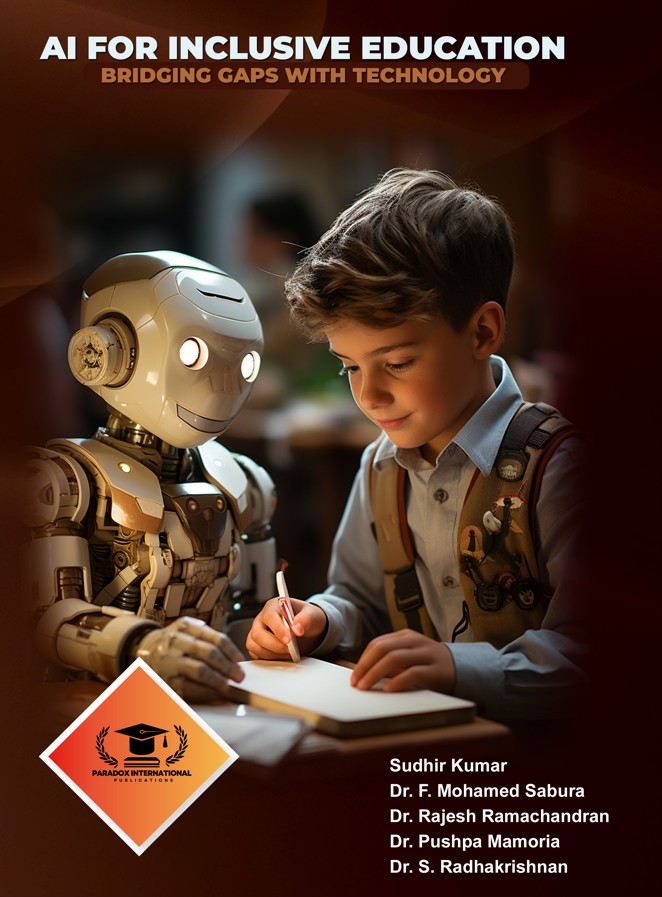
AI For Inclusive Education: Bridging Gaps with Technology
Authors: Sudhir Kumar, Dr. F. Mohamed Sabura, Dr. Rajesh Ramachandran, Dr. Pushpa Mamoria, and Dr. S. Radhakrishnan
ISBN: 978-93-7183-436-0
DOI: https://doi.org/10.59646/545
Date of Publication: December 19, 2025
About the Book:
In an era defined by rapid technological transformation, artificial intelligence (AI) is reshaping every dimension of human life — including how we teach, learn, and engage with knowledge. AI for Inclusive Education: Bridging Gaps with Technology emerges from a deep conviction that AI, when thoughtfully designed and equitably implemented, can become a powerful catalyst for inclusive education. This book seeks to illuminate the promise and practice of AI in education, emphasizing its potential to dismantle barriers, broaden access, and personalize learning for students of all backgrounds and abilities.
Across the globe, educational systems strive to fulfill the fundamental principle that every learner deserves meaningful opportunities to succeed. Yet persistent gaps — rooted in socio-economic disparities, geographic constraints, linguistic diversity, disability, and cultural marginalization — continue to hinder the realization of equitable learning experiences. Traditional approaches, though valuable, have often fallen short in addressing the nuanced and varied needs of diverse learners. This gap invites new thinking — and AI offers a compelling frontier.
This textbook is designed for educators, policymakers, researchers, curriculum developers, and students who are passionate about leveraging AI to create more inclusive, adaptive, and learner-centered environments. It blends theoretical insights with practical frameworks, real-world case studies, evidence-based practices, and ethical considerations. Readers are introduced to foundational concepts in AI and machine learning, followed by explorations of how these technologies can be harnessed to support differentiated instruction, accessibility for learners with special needs, multilingual education, data-driven decision-making, and community-engaged learning. A central theme throughout this book is that technology alone cannot guarantee inclusion. True transformation requires human-centered design, critical reflection, and collaborative action among educators, technologists, learners, and communities. We address not only the potentials but also the limitations, risks, and ethical responsibilities associated with deploying AI in educational settings — from biases in algorithms to issues of data privacy and digital equity.
The chapters that follow are structured to guide readers on both conceptual and applied journeys. Early sections lay the groundwork by introducing core AI principles and frameworks for inclusive pedagogy. Subsequent chapters showcase implementations across diverse contexts — from urban classrooms to remote learning environments — highlighting innovative tools and practices that empower learners rather than replace the irreplaceable human elements of teaching and mentorship. We are grateful to the many educators, technologists, and learners whose insights and experiences have shaped the ideas presented here. Their voices remind us that the heart of education lies not in technology itself but in the aspirations it enables: equitable opportunity, meaningful participation, and lifelong engagement with learning.
As you explore this book, we invite you to reflect, question, and imagine new possibilities — not simply for the sake of innovation, but for the purposeful advancement of inclusive education that truly leaves no learner behind.